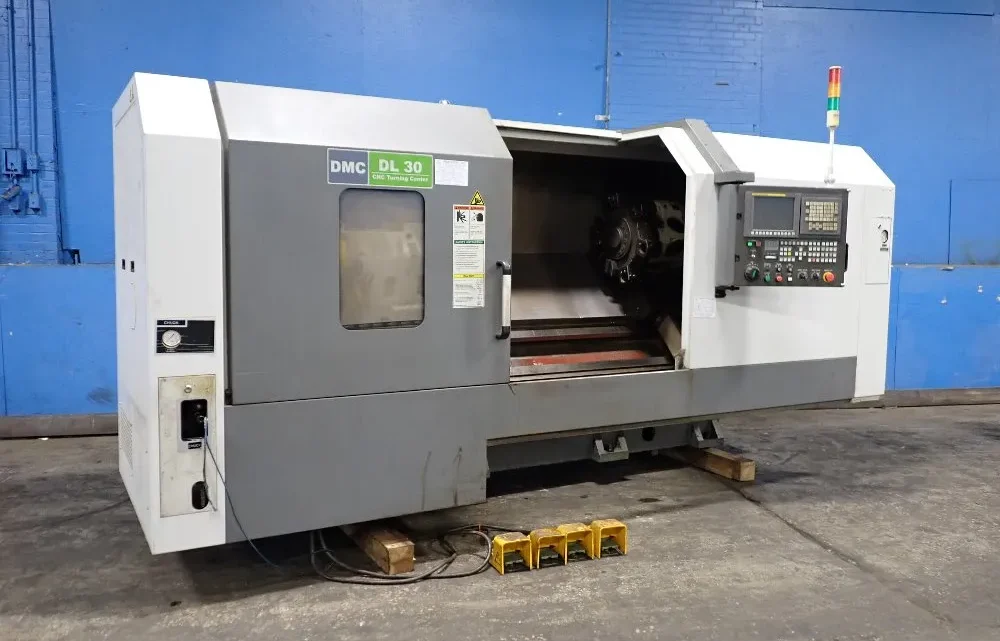
Avoid Costly Mistakes: Professional Tips for Purchasing a Pre-Owned / Second-Hand / used DMC DL 30 CNC Lathe Made in South of Korea
Here’s a professional “due diligence / risk mitigation” guide for buying a used DMC DL-30 (or a similar “DL 30 CNC lathe made in South Korea”) — what to check, what to beware of, and how to structure the a deal to protect yourself. Use this as a checklist when you inspect.
A. Know the Typical Specs / Design Features (so you can spot exaggerations)
Before arriving, arm yourself with what a DL-30 should reasonably be. Below are sample specs from listings and catalogs:
| Spec | Typical / Published Value |
|---|---|
| Swing over bed / maximum swing | ~ 610 mm (≈ 24.0″) |
| Machining length (Z travel) | ~ 1,080 mm (≈ 42.5″) |
| Spindle motor power | 18.5 kW (≈ 24.8 hp) |
| Max spindle speed | 3,000 rpm |
| Bar / bore capacity | ~ 90 mm bore / ~ Φ90 mm bar allowable |
| Tool turret | 12-station BMT style (or servo turret) common in DL series |
| Bed type / angle | 45° slant bed is common in the DL family |
| Rapid traverses, guideway style, etc. | Box ways / heavy construction expected in this class |
If the seller claims wildly higher speeds, larger diameters, or features outside this envelope without proof, be skeptical.
Also note: the DL series has variants (DL M, DL L, sub-spindle, driven tools) so always confirm exactly which configuration you’re examining.
B. Documentation & Provenance (Must Get Before Buying)
- Service & Maintenance Records
- Spindle rebuilds, bearing changes, major repairs
- Any alignment or scrapping / reconditioning work
- Periodic preventative maintenance logs
- Control / CNC Backups / Parameters
- All parameter files, tool library, macro programs
- Any custom user code backups
- Original Manuals & Schematics
- Mechanical drawings, electrical wiring diagrams, hydraulic / pneumatic schematics
- Parts catalogs / exploded views
- Modification / Retrofit History
- If any non-OEM spindles, turrets, drives, or electronics were swapped
- Any structural weld repairs, additions, or machining
- Usage & Operating Environment
- Hours, shifts, materials processed
- Was it in a clean air-conditioned shop or rugged environment
- What Comes with the Sale
- Tool holders, chucks, collets, tailstock, turret tooling
- Spare parts, backup drives / modules, belts, etc.
If the seller cannot provide convincing records, that should reduce your confidence (or your offer).
C. Visual / Structural Inspection (Before Powering On)
Start with what you can see:
- Castings & bed / structure: Inspect for cracks, repairs, distortions, welds
- Guideways & ways: Look for scoring, gouges, rust, pitting
- Way covers, bellows, guards: If missing or badly damaged, internal wear is more likely
- Spindle nose / head area: oil or coolant leakage, stains, seal damage
- Turret & tool magazine: bent arms, misaligned pockets, wear marks
- Electrical cabinets & wiring trays: open panels if allowed, look for water damage, corrosion, burnt wiring
- Coolant tanks, pumps, filter housings: check for rust, leaks, poorly maintained plumbing
- Foundation / mounting evidence: check if the machine has been moved, re-anchored, or suffered floor damage
A machine that looks neglected or abused externally often hides internal trouble.
D. Power-Up & Motion / Mechanical Tests (No Cutting)
Once power is allowed, perform systematic tests before doing any machining.
- CNC / Control Boot & Diagnostics
- Boot up, check for alarms, missing modules, error logs
- Operate all control panel inputs, emergency stops, displays
- Axis Motion & Backlash
- Jog X, Z (and any other axes) through full travel at different speeds
- Reverse direction to test for backlash; use a dial indicator to measure direction reversal play
- Feel for sticking zones, “dead spots,” uneven resistance
- Listen for scraping, rubbing, metal-to-metal noise
- Spindle No-Load Run
- Run the spindle through its speed range (low to high) without load
- Listen for bearing noise, vibration, wobble
- Mount a precision test bar or mandrel and measure radial and axial runout (rotate 360°)
- Tool Changer / Turret Operation
- Cycle turret / tool magazine through all positions, many times
- Watch for hesitation, mis-index, collisions, timing issues
- Check tool clamp / release repeatability
- Auxiliary Systems
- Turn on coolant pump, flushing, chip conveyor – check for proper flow, leaks, noises
- If hydraulics / pneumatics are used for tailstock, tooling actuators, test their function
If any of these tests show abnormal behavior, you have leverage to demand discount or walk.
E. Precision Machining Tests & Accuracy Verification
This is where you see whether the machine still earns its keep (i.e. makes accurate parts).
- Mount a known ground reference bar or certified test piece
- Use dial indicators or test indicators to measure straightness, taper, perhaps multiple points along the length
- Retract and return to the same point to check repeatability
- Perform a light finish cut under real tooling / material; measure resultant diameter, surface finish, straightness
- Do test cuts near the ends of travel (start, middle, end) to see if accuracy degrades toward stroke limits
- Run the machine warm (e.g. 20–30 min) and re-measure to detect thermal drift
F. Likely Wear & Hidden Cost Items
Even a machine that “looks pretty good” may require investment. Some of the most common and expensive repair areas:
- Spindle bearings or spindle rebuild
- Ball screws & nut replacement (if backlash is evident)
- Wear on guideways / ways (requiring scraping / reconditioning)
- Turret drive/clamp wear, index mechanism refurbishment
- Electrical / drive electronics failure or obsolescence
- Cable harnesses, connectors, aging insulation
- Plumbing, coolant, filtration, pump overhauls
- Calibration, alignment, tests after relocation
- Spare parts sourcing—Korean or model-specific parts may be harder to find
Plan to reserve a refurbishment budget (often 10–20 % of the machine’s purchase price) for such unknowns.
G. Structuring the Deal & Protecting Yourself
Use your inspection leverage to build safeguards:
- Insist on an acceptance / testing period (e.g. run motions, test cuts) before full payment
- Withhold a portion of payment until performance criteria are met
- Require the seller to provide all documentation (manuals, parameter backups, drawings)
- Get a written condition disclosure (known defects, wear)
- If possible, negotiate a short warranty (30–90 days) on critical systems (spindle, drives, turret)
- Clarify who pays for transport, rigging, installation, leveling, calibration
- Request inclusion of tooling, adaptors, spare parts
- If possible, ask seller assistance in initial setup / alignment
H. Red Flags / Walk-Away Conditions
Some signs are too serious to proceed unless deeply discounted (or better avoided altogether):
- Seller refuses full inspection or restricts motion / spindle testing
- Excessive backlash, binding, or inconsistent motion in axes
- Spindle hum, vibration, or unacceptable runout on test bar
- Tool changer misindexing, dropped tools, erratic cycles
- Electrical cabinet with burn marks, corrosion, missing modules
- Structural damage: cracked castings, welded repairs, distortion
- Way covers / guards missing or severely damaged
- Obsolete or unavailable spare parts for that model
- Control software corrupted, inaccessible parameter data