Advanced Foaming and Sealing Systems in Industrial Manufacturing
In modern industrial applications, sealing systems play a critical role in ensuring the durability, performance, and safety of a wide range of products. From automotive components and electrical enclosures to household appliances and packaging, the demand for high-performance seals is growing steadily. Liquid-applied sealing technologies, especially formed-in-place (FIPG) and formed-in-place foam gaskets (FIPFG), have revolutionized how manufacturers approach protection against dust, moisture, chemicals, and environmental conditions.
Technology Overview: Formed-In-Place Sealing
Unlike traditional gaskets that require manual installation, FIPG and FIPFG systems involve directly dispensing liquid or foam sealants onto component surfaces using automated machines. The material adheres to the substrate, forming a seamless, stress-free seal. This results in:
- Improved sealing integrity due to the absence of joints or bonding seams,
- Lower assembly costs due to reduced manual handling,
- Greater flexibility for design modifications through NC-controlled application.
Material Types: Polyurethane vs. Silicone
The two primary chemistries used in sealing foams are polyurethane (PU) and silicone. Each offers distinct advantages:
- Polyurethane Systems
- Operating temperature: –40°C to +140°C (short-term)
- Excellent adhesion to various substrates
- Good resistance to oils, detergents, and UV exposure
- Cost-effective with customizable mechanical properties
- Silicone Systems
- Operating temperature: –60°C to +300°C
- Exceptional long-term elasticity and weather resistance
- Low water absorption (≤ 0.3%)
- Ideal for harsh and high-temperature environments
Selection depends on environmental exposure, mechanical requirements, and regulatory standards (e.g., UL 94, IP ratings).
The Foaming Process: A Controlled Reaction
Sealing foams are created through the controlled reaction of two components:
- Component A: Polyol or equivalent base
- Component B: Isocyanate or reactive hardener
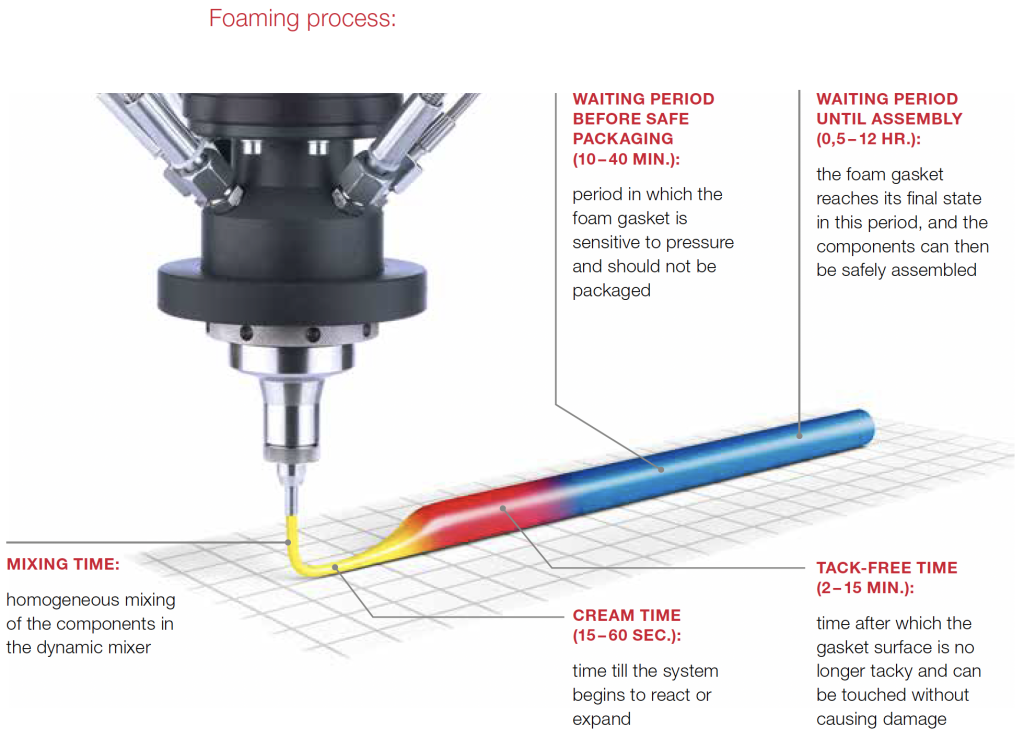
These components are dynamically mixed and dispensed onto a surface or into a groove. Key stages in the process include:
- Cream Time (15–60 seconds): Reaction initiation
- Tack-Free Time (2–15 minutes): Surface hardens enough for handling
- Safe Packaging Time (10–40 minutes): Gasket can be moved
- Final Cure (0.5–12 hours): Gasket achieves full mechanical strength
Machines designed for low-pressure mixing and dispensing ensure consistent quality and fast throughput.
Types of Foam Gaskets
- Liquid Foams – Self-leveling sealants used in narrow grooves (e.g., LED lighting)
- Thixotropic Foams – Ideal for vertical or complex geometries (e.g., automotive door seals)
- Compact Seals – High-strength, vibration-absorbing systems for mechanical assemblies
- Molded Foam Gaskets – Injected into forms, expanding and bonding inside the cavity
Applications Across Industries
Automotive
Sealing systems are used in brake lights, ventilation grills, battery housings, and door modules. They meet NVH, fire retardancy, and emissions standards.
Electronics and Control Cabinets
Foam gaskets protect against moisture and contaminants, meeting IP65, IP66, or IP67 standards and UL certifications.
E-Mobility
Battery packs, charging stations, and power units are protected by custom sealing solutions resistant to heat and chemicals.
Packaging
Foam seals ensure hygiene and protection for food-grade and chemical containers, complying with FDA and EU regulations.
Household Appliances
High-speed foaming machines are used in sinks, washers, and hobs to create reliable and durable seals that resist heat, moisture, and detergent exposure.
Conclusion
Advanced sealing systems based on polyurethane and silicone have become indispensable across numerous industrial sectors. Their versatility, performance, and compatibility with automated foaming equipment make them the preferred choice for manufacturers aiming to optimize production efficiency, product reliability, and compliance with safety and quality standards.
With continued innovation in chemical formulation and machine integration, these technologies will remain at the forefront of modern sealing and gasketing solutions.