06/07/2025
What is Vibratory Finishing Equipment?
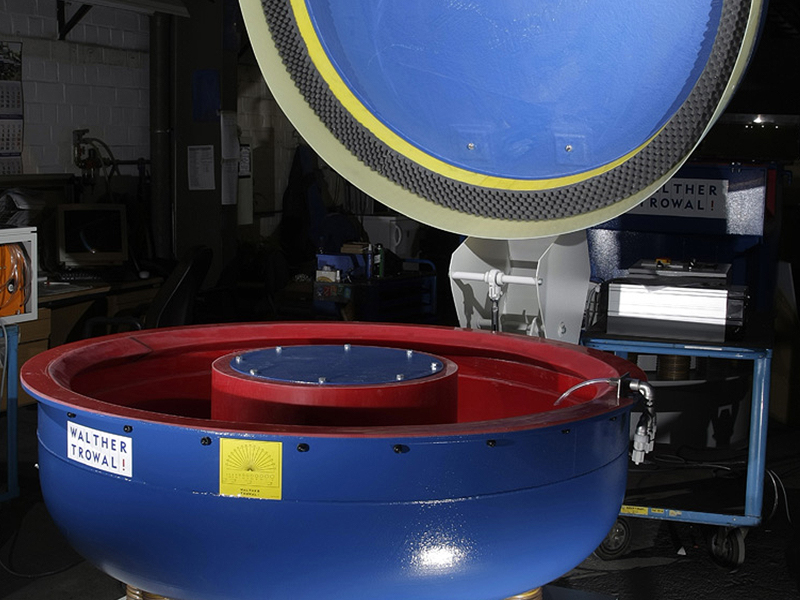
Vibratory Finishing Equipment is an industrial machine used for surface finishing, deburring, descaling, polishing, and cleaning of metal and plastic parts through vibration-assisted mass finishing. It is widely used in the automotive, aerospace, medical, jewelry, and general manufacturing industries for processing large batches of small- to medium-sized parts.
🔧 Technical Explanation
✅ Working Principle:
Vibratory finishing equipment operates based on mechanical vibration. A vibratory motor drives a tub- or bowl-shaped container filled with a mix of parts, abrasive media, and compounds (liquid or powder). The vibration causes the media and parts to rub against each other, which results in material removal or surface refinement.
⚙️ Key Components:
- Processing Chamber (Bowl or Tub)
- Contains the media, parts, and finishing compounds.
- May have internal dividers for part separation.
- Vibratory Drive Unit
- An eccentric weight motor generates high-frequency, low-amplitude vibrations.
- Media (Abrasive Chips or Balls)
- Can be ceramic, plastic, steel, or organic.
- Designed to match the part material and desired finish.
- Compound System
- Liquids or powders added to aid in cleaning, corrosion protection, or enhancing the finish.
- Controls
- Adjustable vibration frequency, amplitude, timer, and compound dosing.
⚙️ Process Parameters:
- Vibration Frequency: Typically 900–3,600 RPM.
- Amplitude (Stroke): Usually 1–6 mm.
- Cycle Time: 15 minutes to several hours depending on the operation.
- Media-to-Part Ratio: Typically 2:1 to 5:1 by volume.
📦 Types of Operations:
- Deburring: Removes sharp edges and burrs.
- Polishing: Creates a smooth, sometimes mirror-like surface.
- Descaling: Removes rust, heat scale, or oxidation.
- Surface Blending: Achieves uniform surface textures before coating or painting.
🏭 Common Applications:
- Precision deburring of CNC-machined parts.
- Polishing die-cast or stamped components.
- Surface smoothing before anodizing or coating.
- Cleaning metal injection molded (MIM) or 3D-printed parts.
✅ Advantages:
- Processes many parts simultaneously (high throughput).
- Uniform finish across complex geometries.
- Lower labor cost compared to manual finishing.
- Can be automated and integrated into production lines.
⚠️ Limitations:
- Not suitable for very large or delicate parts.
- Potential media lodging in small holes or blind cavities.
- Surface finish may not meet ultra-precision standards (e.g., for optical components).