What Should I Pay Attention To When Buying a Second-Hand / used Lapmaster SS-24H Single Side Lapping-Polishing Machine?
If you’re considering buying a Lapmaster SS-24H single-side (single face / flat) lapping-polishing machine second-hand, there are many technical, consumable, mechanical and operational aspects to check. These machines are precision finishing equipment, and even fairly small defects can cause poor surface finish, lost parts, or high consumable cost. Below is a detailed checklist: what to verify, common issues, what questions/tests to run, plus value indicators.
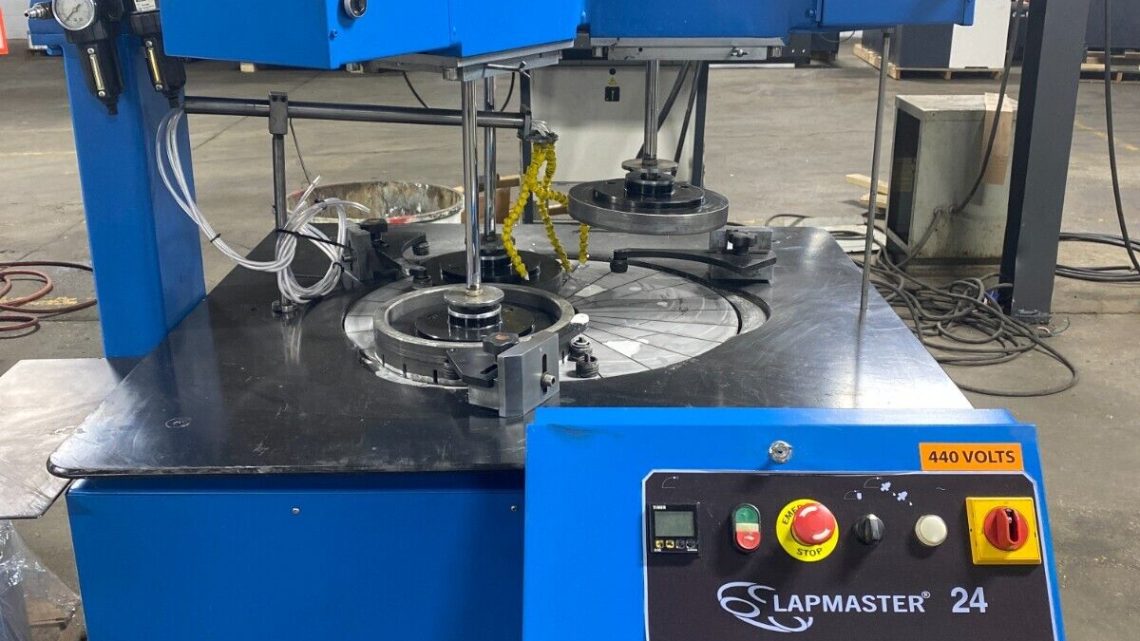
What the SS-24H / Similar Lapmaster “Model 24 / SS-24H” is / What Should Be
To inspect well, you want to know what the machine should typically be capable of, both so you can verify what the seller claims, and so to know your base requirements.
Relevant specs typical for Lapmaster “Model 24” / SS-24H single-side lapping machines:
- The lap plate (working plate) is ~ 24 inches (≈ 610 mm) diameter.
- Plate speed ~ 70 rpm.
- Drive motor typically ~2 HP for the lap plate and drive system.
- Conditioning rings (often 3 or 4 rings) to run around the lap plate, to maintain or condition the plate surface, help with abrasion, even wear.
- The machine may have “open face” or “pneumatic lift” versions. Pneumatic lift versions allow the pressure weight to be lifted or adjusted, useful for adjusting pressure on parts.
- The base structure is heavy, rigid (often tubular steel or similar) to reduce vibration and ensure stability.
- The machine includes systems for abrasive storage/distribution, slurry or abrasive flow, possibly filtering, work table, fixtures or work holding.
Knowing that, you can compare what the seller claims (machine year, condition, modifications) to what standard machines have.
What to Pay Attention To / Inspect Thoroughly
When inspecting a used SS-24H / Model 24 type single-face flat lapping / polishing machine, these are the key components and possible weak points. For many, the difference between a good used machine and a headache is in small details.
| Component / Area | What to Inspect / Test | Why It Matters / What Can Go Wrong |
|---|---|---|
| Lap Plate (Table) Surface | • Flatness: Check that the lap plate is true (no warps or dips). Use straight edges, dial test indicators. • Surface condition: Are there deep grooves, scores, pits, rust? • Serration or grooves (if serrated plate): Is serration still visible or worn down? • Thermal distortion or heat damage (discolored areas). • Whether plate has been resurfaced or reconditioned recently. | If the plate is worn, it reduces flatness, increases finish defects, causes uneven wear of parts, higher consumable use. Reconditioning costs time and money. |
| Drive / Motor / Speed Control | • Check the drive motor (HP, speed) – does it run smoothly at operating speed (70 rpm or the spec)? Any vibration, overheating? • Are RPM controls stable? If variable speed version, does the control work reliably? • Gearbox / reduction drive: is it free of play, noise, backlash? • Belts / pulleys / couplings (if used): condition, any slipping or misalignment. | Motor or drive faults lead to speed fluctuations affecting finish. Worn gearing causes noise, vibration, lead to inaccuracies. |
| Conditioning Rings and Ring Yokes / Fixtures | • Are the conditioning rings intact (not excessively worn), true, undamaged? • The yoke or arm assembly that holds the rings — check bearings, alignment. • Adjustability: can rings be adjusted for pressure, position relative to plate surface? • Movement: do rings condition the lap properly (they help “refurbish” lap surface during operation) and are there controls to adjust or raise/lower them. | If conditioning rings are worn, the plate will not be maintained properly, lap surface will degrade, finish and flatness suffer. Also, uneven conditioning causes uneven wear. |
| Pressure / Load / Lift Mechanism | • If pneumatic lift version, check whether lift weights / air cylinders operate properly ( raise/lower works, seals in cylinders are good). • Check how pressure or load is applied to workpiece / weights: is it even, adjustable, reliable? • Check the load of pressure weights / plate, whether the work table or fixtures distribute pressure evenly. • If it has an adjustable work table height: does that mechanism work, is it stable? | Uneven pressure gives uneven material removal, warpage. Lift system failure means you may always have full pressure which may damage parts or consume abrasives unnecessarily. |
| Abrasive / Slurry Distribution / Filtration | • Check the abrasive or slurry feed system: tanks, pumps (if used), supply lines, metering. • Distribution: does the abrasive / slurry spread evenly over working area? • Filtration: is there a filtering or cleaning system so that worn particles, grit, contaminants don’t circulate? • Cleanliness of existing slurry or remainder: are there signs of contamination (metal particles, grit, foreign material) that may scratch parts? • Is there an abrasive “vehicle” used (oil, water, other medium), and is that part correct/operational? | Poor or uneven slurry distribution causes uneven wear or damage to parts. Contamination causes scratches, quality issues. Frequent consumable cost. |
| Work Holding / Fixtures / Table Accessories | • Are work holding fixtures (jigs, holders, carriers) included or functional? Are they flat, aligned, clean? • Are clamps, carriers, or vacuum if used (if any) in good state? • Are any accessories included (felt pads, work blank holders, carriers, etc)? • Table leveling / alignment: is the table level and rigid? Are T-slots or mounting points (if applicable) intact? | Good fixturing is essential for repeatable flatness and finish. If fixtures are missing or badly worn, you may have to invest. |
| Mechanical Integrity & Wear | • Structural frame: check for cracks, warpage, distortion, rust. • Bearings, shafts for work table or rings: smooth movement, no binding, play, excessive wear. • Any wobble in rotating plate. • Condition of bearings in drive, especially in plates / rings. • Condition of seals, avoiding ingress of slurry or abrasive into unwanted places. | Mechanical wear degrades flatness, surface finish, increases vibration, reduces life. Replacement bearings or plates can be expensive. |
| Electrical / Controls / Safety | • Motor starters, controllers, switches: do they operate properly (on/off/speed). • Wiring: intact insulation, grounding good, no signs of overheating or water ingress. • Control panel: if timer or automated functions exist, do they work? • Emergency stop / safety guards / covers / splash protection. • Is the machine compliant with local electrical safety standards? | Safety risks if not; faulty wiring causes breakdowns or hazard. Timer / control malfunctions affect process repeatability. |
| Operational Performance / Test Cuts / Polishing / Lapping Tests | • Run the machine: see how it behaves under load (with a real part or sample). Observe flatness, finish, consistency over entire plate area. • Does the finish meet what you need (mirror, matte etc)? • How long does it take to reach finish? Is it economical with consumables? • Does the lap plate stay cool or does heat buildup cause warping? • Are parts staying in place, not slipping or being moved by slurry or spin forces? • Observe performance on different materials if you will be using different materials. | What specs matter is what it actually delivers; sometimes a machine with “good plates” still gives poor finish due to wear elsewhere, bad fixturing or poor distribution. |
| History and Maintenance | • Ask how many hours of operation / years since new / duty cycle. Has it been used heavily, or lightly? • Maintenance records: when plates were resurfaced or reconditioned, when bearings replaced, when motors serviced, when slurry system cleaned, when fixtures aligned. • Storage and environment: has it been in humid or dusty environment? Has it been exposed to corrosive slurry? • If idle for long, whether lubrication has been preserved, seals kept moist, parts turned occasionally etc. | Machines neglected or with heavy use may require refurbishment. Hidden costs could come from needing reconditioning, replacement consumables, etc. |
| Consumables / Spares / Support | • What consumables are included (abrasives, slurry medium, felt pads, etc)? • Are spare plates or spare conditioning rings available and at what cost? • Are work holding fixtures or carriers included or do you need to make or buy new? • Are manuals, spare parts list, service documentation available? • Are local or regional suppliers able to provide parts or abrasives? Import costs? | Consumable cost and availability are major components of operational cost. If spare parts or plates are expensive or hard to source, lifecycle cost is high. |
| Utilities / Shop Fit / Installation | • Power requirements: voltage, phase, amperage. Does your shop meet them? • Floor vibration / base: stable mounting is important for precision. • Space around the machine for operator to load/unload, cleaning, maintenance. • Drainage / cleanup: lapping uses slurry which is messy; is there facility for slurry containment / disposal / cleaning? • Air supply or water supply if needed for certain slurries or cooling, and exhaust / ventilation of dust / aerosol. | If your shop isn’t ready, you may need to invest in infrastructure. Poor installation degrades precision or increases wear. |
| Value & Price Considerations | • Compare what similar used SS-24H or Model 24 machines are going for (look at recent listings) including condition. • Estimate what refurbishing will cost (resurfacing plates, replacing bearings, refurbishing fixtures) and deduct from price. • Include transport, rigging, installation in cost. • Estimate consumables and ongoing operating cost (slurry, abrasives, plates, power). • Factor spare parts availability. • Consider how much throughput you need; cost per part may change depending on how many parts you will do. |
Common Issues / Weak Points
These are problems frequently seen by owners of SS-24H / Model 24 / single-face lapping machines:
- Lap plate wear or “dish” / out of flatness: material removal over long use, leading to central depression (“dish”), warping.
- Conditioning ring issues: rings wear unevenly; bearings or yokes deteriorate so rings do not maintain uniform conditioning of the plate. Poor conditioning = poor lap surface = uneven finish.
- Surface damage (grooves, pits, rust): these can engrave into parts if not addressed.
- Drive motor or gearbox wear / noise: sometimes gears get loosened; bearings in the drive unit degrade.
- Contaminated slurry or abrasive mix: metal fragments, older abrasive particles, foreign matter causing scratch or defect.
- Control switch / timer failures: especially in older machines sometimes timer, safety switchgear, emergency stop may be aging or intermittent.
- Fixture / work holding problems: worn fixtures / carriers may cause parts to move, slip, or warp during lapping.
- Seal / splash damage, bad guarding and cleanup: slurry splashing, corrosion. Slurry/water ingress into bearings or drive unit.
- Heat / thermal distortion: high speed or long runtime, or parts that heat up, can warp the plate or the work.
- Uneven pressure distribution: if lift or weight system is flawed, press weights off center, or wear in supports, causing non-uniform pressure.
Questions to Ask the Seller / Tests to Run
Here are specific questions & tests you can ask or perform before purchasing, to help you assess condition, hidden issues, and value:
- Operational Demonstration
- Ask to see the machine running with a sample workpiece (similar size/thickness/material to what you plan to use). – Observe lap plate, conditioning ring action, finish. – See how uniform the finish is across the face. – See how the machine handles water/slurry — whether it sprays or splashes, how well it’s contained.
- Test for Flatness & Finish
- Have a sample part lapped, measure flatness, parallelism, surface roughness. – Use standard test parts if available. – Inspect edge to edge (center outwards) for variation.
- Check Lap Plate Condition & Reconditioning History
- Ask whether the plate has been reconditioned/resurfaced — when and by whom. – If not, measure whether there’s “dish” or warping; you may need a resurfacing cost.
- Inspect Conditioning Rings & Fixtures
- Check ring adjustability; their bearings, yokes; are they free-turning / properly aligned? – Inspect fixtures for wear or deformation.
- Drive & Motor Tests
- Run at speed, listen for vibration or noise. – Check gearbox (if gearbox present) for oil leaks, play, slop. – If speed control variable, test its consistency.
- Slurry / Abrasive System
- Examine the current slurry or abrasive used; check pumps, tanks, lines. – Are filters clean? Are there signs of clogging or sediment buildup? – Ask about past consumables usage and cost.
- Check Lift/Load/Pressure Mechanism
- If pneumatic lift: test lift up/down, check seals, pressure stability. – If weights: are weights present, correct, safely mounted?
- Inspect Electrical / Safety
- Check all switches, emergency stops, guards. – Inspect motor wiring, connections, control panel. – Grounding and insulation condition.
- Maintenance & Usage History
- Hours of use, duty cycle; idle periods. – Any history of accidents (plate collisions, jamming, etc). – Environment: temperature, exposure to moisture or corrosive slurry.
- Consumables & Spare Parts
- What is included: extra plates, rings, abrasives, fixtures. – Are these OEM or aftermarket? Quality? – Source of consumables locally; cost & lead time.
- Check for Hidden Costs
- Plate resurfacing or reconditioning cost. – Freight, rigging, installation at your location. – Shop modifications: slurry containment, drainage, safety guards, ventilation.
- Warranty, Manuals, Documentation
- Are manuals available (operation, parts, service)? – Wiring diagrams, drawings. – Spare parts list. – Any past service or refurbishment receipts.
Value Indicators: What Makes a Good Deal vs What Lowers Value
Here are things that typically indicate a used SS-24H is a good buy, vs red flags that should reduce price or lead you to walk away.
| Good Signs | Red Flags |
|---|---|
| Lap plate has been recently resurfaced; still good flatness. Conditioning rings and fixtures in good condition. Drive motor runs smoothly; gearbox clean, no excessive noise. Included consumables, fixtures, extra parts. Clean electrical system; safety features intact. Good documentation, manual, spare parts availability. Shop environment is clean; machine has been maintained; not abused. | Plate badly worn / dished; needing re-surfacing. Fixtures / conditioning rings worn or misaligned. Drive noisey, motor overheating, speed fluctuations. Missing parts / lack of fixturing / work holders. Safety guards missing or electrical issues. No documentation or history. Abusive environment (lots of contamination, rust, aggressive slurry wear). Unclear or underestimated consumable cost. Too much refurbishment required for your precision specs. |