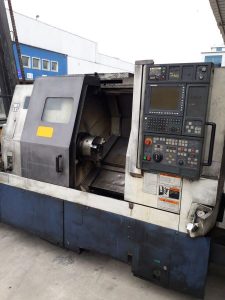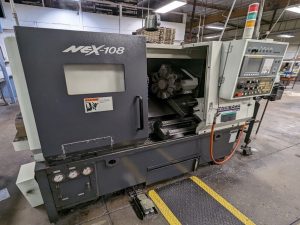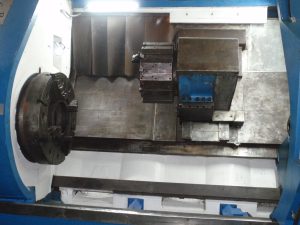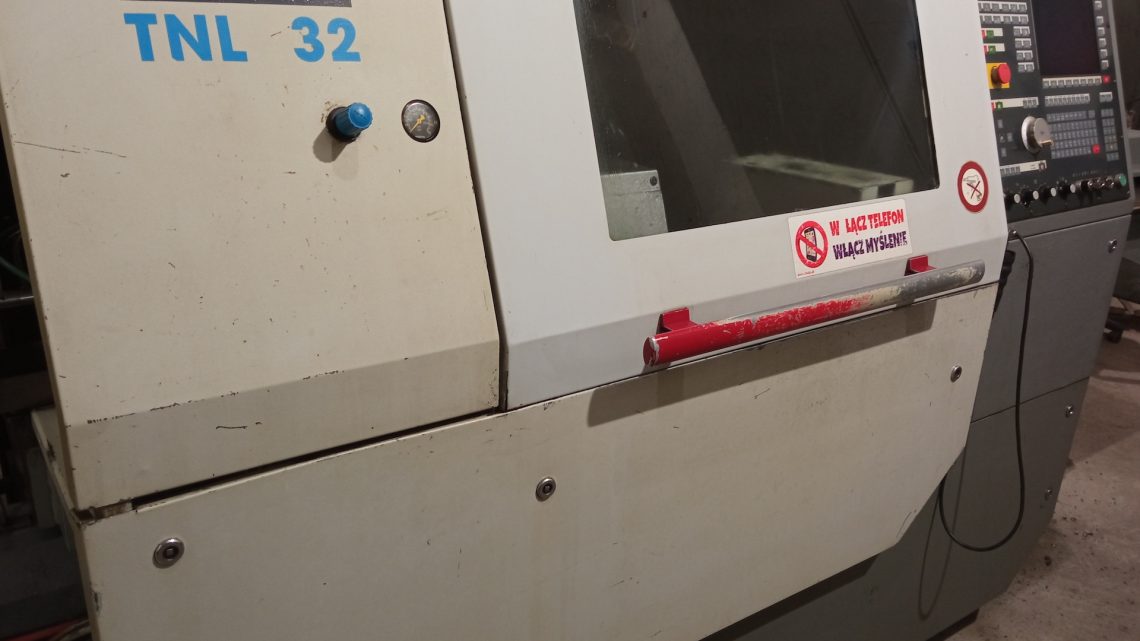
What Should I Pay Attention To When Buying a Second-Hand, Pre-Owned, Surplus, Used Traub TNL 32G CNC Lathe made in Germany?
When buying a used Traub TNL 32G (or TNL-32G variant) CNC lathe (a Swiss/automatic sliding-head style machine from Germany), there are many potential issues and pitfalls to be aware of. Below is a detailed checklist and advice (both general and model-specific) to help you assess candidates carefully.
What is the Traub TNL 32 / 32G — baseline for expectations
Understanding the machine’s design and typical specs helps you know where wear or failure is likely. Some reference points:
- The Traub TNL series is a sliding headstock / automatic lathe for small to medium parts (typical bar capacity 32 mm)
- The “G” variant (e.g. TNL 32G) often denotes a version with twin turrets or additional backworking capability. For example, the used listing for TNL 32G shows two turrets, a counter-spindle, etc.
- From a published listing:
• Spindle bore / bar clear through: 32 mm (i.e. bar diameter pass)
• First turret: X = 60 mm, Z = 320 mm; second turret: X = 180 mm, Z = 1200 mm
• Main spindle: ~ 6.9 kW, with a C-axis function
• Subspindle (counter spindle): ~ 4.4 kW, with its own C-axis - Another source (INDEX / Traub product info) gives for TNL 32 variants: bar capacity 32 mm, 8,000 rpm max spindle speed, ~ 6.7 kW main spindle, rapid traverse in Z axis ~ 20 m/min.
So when inspecting, you should check whether the machine you are considering still approaches these nominal capabilities (or if it has been heavily derated / worn).
Inspection & evaluation checklist for a used Traub TNL 32G
Below is a structured checklist of subsystems and specific tests you should perform (or insist on) before purchase. Where possible, push for running tests / sample parts.
| Subsystem / Feature | What to Inspect / Test | Why It Matters / Red Flags |
|---|---|---|
| Frame, base & alignment | • Check the machine’s base, foundation mounting, anchor points for cracks, distortion, past repair welding. • Verify that the headstock slide, tool posts, turrets remain aligned and that there is no sag or twist in structure. | Structural distortion is difficult and expensive to correct. |
| Headstock / sliding head mechanism | • Move the sliding headstock over full bar feed travel; feel for smoothness, binding, inconsistent friction. • Check for wear in the guides, bearing blocks, lubrication paths. | The sliding head mechanism is critical in a Swiss-type; wear or misalignment there kills part accuracy. |
| Spindle & bearings | • Run spindle at various speeds (low, medium, high); listen for noise, vibration, bearing hum. • Mount a test bar or collet and measure runout (radial & axial) using a dial indicator. • After some continuous operation, measure spindle housing / bearing temperature. | Worn spindle bearings are costly to replace and often a dealbreaker. |
| Turrets / tool magazines | • Cycle tool changes many times; check for misindexing, delays, sticking, or failed tool transitions. • Inspect turret locking mechanisms, plungers, sensors, proximity switches, indexing accuracy. • If live / driven tools are included, test their operation: bearing quality, vibration, runout. | Poor turret behavior often causes scrap or crashes; repair parts may be expensive. |
| Counter spindle / subspindle (if present) | • Test clamping, synchronization, alignment, and repeatability of the second spindle. • Run dual spindle operations (if the machine supports) and check for positional consistency. | In double-spindle lathes, imbalance or misalignment between spindles is a frequent source of error. |
| Axis motion, ball screws, guides | • Jog X / Z / Y (if present) axes over their full range; detect binding, “steps,” stiction zones. • Reverse direction and feel for backlash or dead zones. • Inspect ball screw surfaces and nut housings for pitting, wear, lubricant contamination. • Inspect linear guides or slide surfaces for scoring, scratches, embedded chips. | Wear in axes degrades repeatability, precision, and may require regrinding or replacement. |
| Home / limit switches / software referencing | • Test the homing routines on each axis; check limit switch behavior and software limits. • Move axes near travel ends to trigger limit switches and see whether motion is properly curtailed. | Faulty switches or referencing can lead to overtravel, crashes, or unreliable positioning. |
| Control system, electronics & wiring | • Power up and watch boot diagnostics; look for missing modules, error messages, I/O faults. • Inspect drive cabinets, cooling fans, wiring, connectors, signs of burnt wires, dust, corrosion. • Test feedback loops, encoder signals, check for signal dropouts or noise. • Ensure the parameter / configuration backup exists and can be restored. • Run interpolation, multi-axis tool paths, test program upload/download. | Control electronics are as critical as mechanics; failure or corruption here can render the machine unusable. |
| Coolant / lubrication / fluids | • Check coolant system: pumps, hoses, filters, plumbing, leaks, fluid clarity. • Inspect lubrication (axis, headstock, turrets) systems: whether delivery works, lines are intact, no blockages. • Check coolant / lubricant reservoir cleanliness and signs of mixing contamination. | Poor lubrication or coolant systems accelerate wear and cause failures. |
| Chips / debris, guards / covers | • Inspect whether the machine is clean or has chip build-up, particularly around guides, slides, turrets. • Check that covers, bellows, guards, wipers are intact and properly sealed. | Chips and debris on precision surfaces cause scratches, scoring, and misalignment over time. |
| Running / test part check | • Execute a test job (turning, drilling, milling if applicable) representative of your actual workpieces. • Monitor tool changes, spindle behavior, turret indexing, cycle times, vibrations. • Measure the finished parts: dimensional accuracy, repeatability, surface finish, concentricity. | Running under load is the best real test; hidden issues often show only under real use. |
| Thermal stability & drift | • Run the machine continuously for a period (e.g. 30–60 min) and then re-check positions or parts to see if any drift has occurred. • Check whether the machine’s axes / parts heat up nonuniformly, causing expansion or internal stresses. | Thermal drift destroys accuracy in production conditions. |
| Maintenance history / utilization / wear documentation | • Request machine age, spindle hours, cycle counts, usage profile (lights, heavy cuts, continuous shifts). • Ask for maintenance logs: parts replaced, rebuilds, crash history. • Ask about environment: how clean the shop was, coolant quality, whether the machine was stored or idle for long periods. | Good history gives insight into hidden problems; unknown or sloppy history raises risk. |
| Parts availability & support | • Research whether replacement spares (bearings, screw-nuts, servo drives, electronics, turrets) are still available for Traub TNL series. • Check whether local service / support for Traub / INDEX brand (Traub is under Index group) is available in your area. • Confirm you get documentation: manuals, wiring diagrams, parts lists, control parameter backups. | If spares or support are unavailable, downtime or repairs may become prohibitively expensive. |
| Shop compatibility, installation & infrastructure | • Verify your power supply (voltage, phases, amps) matches machine requirements. • Ensure grounding, clean electrical supply, stable current. • Check the shop floor: is it flat, rigid, capable of supporting the machine without vibration or tilt? • Confirm there is adequate clearance around the machine for maintenance, tool changes, access to axes, and removal of parts. • Cooling / ventilation, chip / coolant management systems, drainage must be available. • Safety: check emergency stop, interlocks, guards comply with your local safety norms. | Even a good machine fails if installed poorly or in an unsuitable shop environment. |
| Negotiation & risk mitigation items | • Estimate repair / refurbishment costs (bearings, drives, guides, alignment) and deduct from asking price. • Ask for an acceptance period after installation, during which you can run test parts to validate performance. • Demand inclusion of tooling, fixturing, spare parts, or control backups. • Bring a lathe / Swiss-machine expert with you during inspection. • Require documentation (manuals, parts lists, electrical diagrams) as part of the sale. |
Additional Tips & “Gotchas” specific to Traub / Swiss-type machines
- Sliding-headstock wear: Because the sliding guide is constantly in motion (especially for bar feeding), wear in that path is often an early failure mode.
- Guide bush alignment: Many Swiss-type operations use a guide bushing; misalignment or wear here ruins part accuracy.
- Turret indexing vs collision risk: With multiple tools in tight space, turret collisions are more likely—check if crash protection or tool path safeguarding is still active.
- Bar feeder / collet chuck integrity: The bar feed mechanism and collet chuck system (bar gripper, feeding chuck) are under frequent load—check for slippage, wear, accuracy in feed.
- Control / older CNC versions: Some older Traub machines use TX or TX8 controls; ensure that software versions are intact, parameter backups exist, and no modules are missing.
- Synchronization of multiple spindles / turrets: If the machine has twin turrets or front / back working attachments, synchronization and coupling among multiple axes must be proven good.
- Tool holder / shank wear: Because of tight movements, tool holders and shanks may wear; check taper surfaces, repeatability of tool positioning.