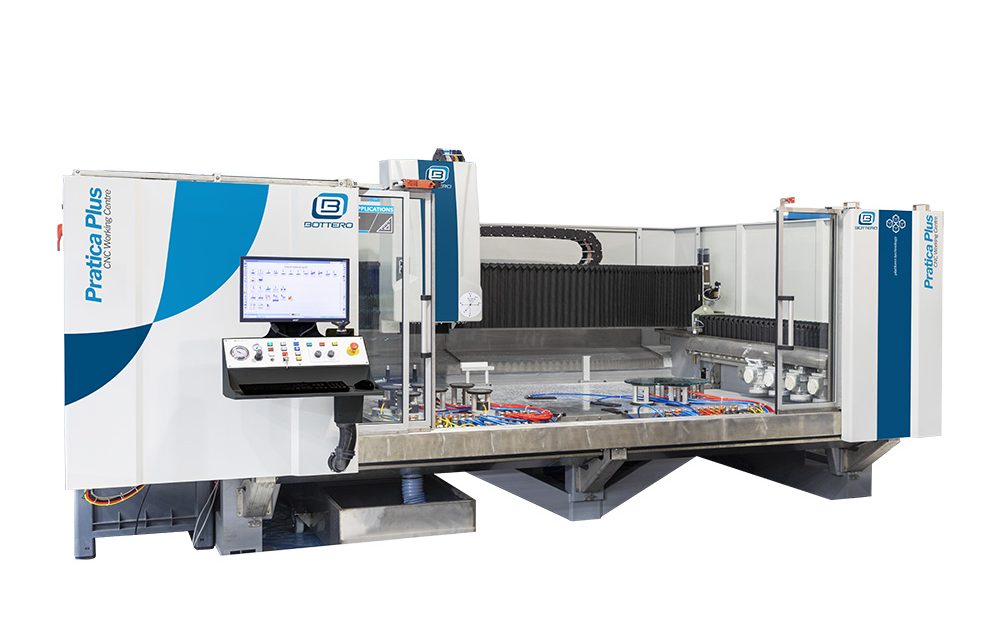
What Should I Pay Attention To When Buying a Second-Hand, Pre-Owned, Surplus, Used Bottero Practica Plus CNC Working Center Profiling Drilling Edge Finishing Cutting for Flat Glass Sheet Processing made in Italy?
Buying a used Bottero Pratica Plus (CNC work centre for flat glass – profiling, drilling, edging, polishing, cutting) is a specialized and somewhat high-risk purchase. Because glass machining involves precision, exposure to coolant / water / abrasive dust, and many moving subsystems, you need to inspect many details carefully. Below is a detailed checklist and caution list tailored to the Pratica Plus line (drawing from Bottero’s own specs and typical use).
What the Pratica Plus is / what it should be able to do
Here are some reference specs & features (so you know what to expect) from Bottero documentation:
- The Pratica Plus variant is offered in sizes: 2500, 3300, 4000 (glass sheet dimensions).
- Standard operations include: milling on the glass sheet (linear / curved paths), edge polishing / edging (straight / curved), drilling / countersinking (perpendicular), underside drilling, writing / drawing on the surface.
- The machine structure: a steel base, mobile beam / bridge carrying the machining head, electro-spindle (often with tool cooling and pressurized circuit), vacuum clamping system (suction cups) on a smooth work table (no grooves) with retractable stops, tool magazine (fixed or retractable depending on variant).
- The spindle is “pressurized” (to prevent ingress of dust / coolant) and cooled/ventilated.
- Tool magazine options: fixed for smaller models, retractable / mobile magazine in larger variants.
- The vacuum / suction cup clamping is crucial; many suction cup variants (diameters ~ 65, 90, 120, 160 mm) are used, with symmetric cups usable in either direction (“upside-down”) depending on configuration.
- Additional optional modules: C-axis rotation, bevel cutting, matrix table (for faster positioning of stops / suction cups), tool head dressing, laser presetter, shape scanner, remote pendant, etc.
Because of these capabilities, the machine is relatively complex. Let’s break down what you must check when evaluating a used one.
Checklist: What to Inspect, Test & Verify
Below is a comprehensive checklist (mechanical, electronic, functional, consumables) you should go through on-site (or demand evidence) before buying:
Structural, Frame & Geometry
- Machine base & frame integrity
– Look for cracks, distortions, weld repairs, twisted structure, or sag in the bridge or beam.
– Check that the machine is properly leveled and mounted (or was). - Bridge / mobile beam & head carrier alignment
– Move the machining head / bridge along X / Y and see if there are binding zones, increased friction, or uneven resistance.
– Use a straightedge, laser line, or reference bars to check that the beam stays straight, with minimal deflection across the span. - Work table & support surface
– The work table is smooth (no grooves) to allow free arrangement of suction cups and stops. Check for wear, flatness, corrosion, pitting. Bottero’s design uses a smooth table so suction cups can be repositioned arbitrarily.
– Check the stops (telescopic stops) that position the glass sheets—are they retractable, aligned, and smooth? - Suction / vacuum zones & piping
– Inspect vacuum lines, connectors, seals, buffer / vacuum tank, pumps. The vacuum system must maintain good vacuum even in fluctuations. The specification mentions a buffer tank to compensate for vacuum drops.
– Check if the vacuum cups themselves show wear, leakage, cracks, or sealing problems. - Material choice in wet zones
– Bottero states that parts in contact with water are made from stainless steel (to resist corrosion).
– Check for rust, corrosion, galvanic damage, or degraded joints in those wet / coolant-exposed areas (spindle housing, head, wiring in wet zones).
Motion Systems, Axes, Drives & Spindle
- Axis motion (X, Y, Z, and possibly C if equipped)
– Jog axes slowly across full travel; feel for smoothness, stiction, sticking zones, friction changes.
– Reverse direction and check for backlash, hysteresis, or dead zones.
– Use a precision reference (dial indicator, laser interferometer) to check linear positional accuracy across travel (straightness, linear deviation). - Ball screws / drive trains
– Inspect screw threads (where accessible), nuts, couplings for wear, pitting, abrasion.
– Listen and feel during motion—roughness or noise may hint at deterioration.
– Ensure that coupling between motor and screw is not loose, misaligned, or has wobble. - Spindle & electro-spindle
– Run the spindle at multiple speeds; listen and feel for bearing noise, vibration, hums, grinding.
– Mount a test bar or precision reference and measure radial / axial runout.
– Operate long enough to warm it up, then check bracket / spindle housing temperature—excessive heat is a red flag.
– Examine spindle nose / taper / tool interface surfaces for wear, corrosion, or damage.
– Check the pressurized circuit (if present) that keeps dust/coolant out of bearings; damaged seals or pressure circuits are dangerous. - Tool magazine / tool changer
– Cycle tool changes many times; detect misindexing, delays, jamming, failures to clamp / release.
– Inspect magazine rails, sensors, grippers, sensors, switches, motor drives.
– If the machine has a retractable magazine (in larger variants), test extension / retraction mechanism. - Optional axes / C-axis (if installed)
– If the unit has rotary axis or interpolation (C), test its motion, backlash, repeatability.
– Test it under combined motion (milling + rotation) to verify the path interpolation works reliably.
Clamping, Vacuum & Sheet Handling
- Vacuum clamping
– Test whether the vacuum properly holds glass sheets (simulate with a dummy plate). See if vacuum loss, leakage, or poor sealing occurs.
– During machining, ensure the sheet does not shift or vibrate under machining load. - Stops / reference elements
– Check telescopic stops (mechanism, alignment, smoothness).
– See whether stop positions are repeatable and accurate. - Suction cup arrangement flexibility
– Because the work table is smooth (no grooves), cups and stops must be repositionable. Check whether the vacuum circuits for cups and stops are intact and functioning. - Vacuum pump & buffer system
– Verify vacuum pump capacity, its health, buffer tank (if installed) operation (i.e. small power drops should not immediately drop vacuum).
– Inspect for leaks, old / cracked piping, and insufficient vacuum retention.
Control / Electronics / Software
- Power-up & diagnostics
– Observe startup: are there error messages, missing modules, I/O faults, warnings?
– Test control responsiveness, HMI, touchscreen / keyboard, backup / restore functionality. - Motion commands, interpolation & complex paths
– Run machining programs with curves, multiple axes, path interpolation (milling + engraving + edge finishing).
– Test tool change macros, path simulation, collision avoidance, lookahead. - Encoder / feedback / sensor wiring
– Check encoder cables, shielding, connections for wear, looseness, corrosion.
– During movement, test for feedback signal dropouts or noise. - Software / parameters / backups
– Confirm that the control parameters, tool tables, compensation tables, calibration arrays are backed up and restorable.
– Check software version, custom patches, whether the software has modifications / updates. - Safety & interlocks
– Test emergency stop, door guards, safety fences, interlock circuits.
– Open guard doors (safely) and confirm machine stops motion where required.
Operational & Functional Testing
- Test part processing
– Run real or representative glass processing tasks (profiling, drilling, edge finishing, polishing) under user conditions.
– Monitor for vibration, chatter, dislodgement of workpiece, quality of surface finish, dimensional accuracy.
– After machine is stable (warm-up), re-measure previously machined parts to see drift or deviation. - Edge finishing, polishing ability
– Since edge finishing and polishing are often weaker points, pay special attention to the quality of edge polish, curve transitions, consistency over long runs.
– For curved edges: check acceleration transitions, smoothness, waviness. - Drilling on both faces (top / underside)
– If the machine supports underside drilling, test that functionality and verify alignment, tool engagement, and positional accuracy. - Long run / stability test
– Run the machine for an extended period under typical use. Observe whether errors accumulate, thermal drift, changes in precision.
– After warm-up, re-check reference positions. - Tool dressing / wheel dressing systems
– If equipped, test the dressing of drill bits or polishing wheels (automatic dressers). Verify correct alignment, repeatability, wear.
Maintenance History, Uses & Wear Background
- Ask for year of manufacture, serial number, hours of operation (if logged), and production cycle counts.
- Request maintenance / service logs: parts replaced (spindles, guides, seals, vacuum pumps, electronics).
- Ask whether collisions, crashes, or power failures have occurred.
- Ask about the working environment: was the machine used in a clean, temperature/humidity-controlled facility, or in dirty, wet, or aggressive environments?
- Ask about retrofits, upgrades, or modifications (e.g. replaced spindle, updated electronics, added axes).
- Check wear on easily replaced items: suction cups, seals, belts, piping, hoses, vacuum system parts.
Spare Parts, Support & Documentation
- Confirm whether Bottero (or its distributors) still supports the Pratica Plus line, and whether spare parts are available for spindles, vacuum pumps, electronics, tool magazine parts, etc.
- Obtain all documentation: operation manual, maintenance manuals, electrical schematics, spare parts lists, parameter backups, software license, calibration / compensation data.
- Request any spare modules, backup electronics, or consumables the seller may have.
- Ask whether service / support or trained technicians are available in your region (or Europe / Turkey).
Shop / Infrastructure / Facility Compatibility
- Ensure your shop’s electrical supply (voltage, phases, current capacity) matches the machine’s requirements.
- Good grounding, clean power, noise suppression are important (electronics + motion control are sensitive).
- Floor / foundation: the machine must be anchored on a stable, rigid, flat floor to avoid vibration or deflection.
- Clearance / space: ensure full movement, maintenance access, loading / unloading of large glass sheets.
- Chip / coolant / water handling: the machine will use coolant and wash / rinse flows. Ensure drainage, filtration, water recirculation, waste water treatment, and corrosion control.
- Environmental control: humidity, temperature stability, dust control are useful for maintaining precision.
- Safety: guards, interlock systems, emergency stops, enclosures must meet your local regulations.
Pricing, Negotiation & Risk Mitigation
- Estimate cost of wear items / repairs (vacuum pump reconditioning, spindle bearing replacement, guide rework, electronics repair) and deduct from asking price.
- Insist on a trial / acceptance clause: allow setting up your own test tasks after installation to verify performance.
- Request that the seller include documentation, software backups, spare parts, tooling.
- Bring an expert (especially in glass processing / CNC glass machines) with you during inspection.
- Factor in rigging, transport, foundation, leveling, installation, and calibration costs into total acquisition cost.
- If possible, tie part of payment to performance outcomes (e.g. “if runs within ±X tolerance for X hours, final payment released”).
Red Flags / Deal Killers
Here are conditions that should make you walk away (or demand huge discount):
- Vacuum / suction cup system in very poor condition (leaks, non-holding, cracked or missing cups).
- Spindle with excessive noise, wear, or poor runout / overheating.
- Axis motion with binding, “sticky” zones, or inconsistent friction along travel.
- Tool magazine / changer failures, indexing errors, jamming, misalignment.
- Control electronics with error logs, missing modules, corrupt software, no backups.
- Missing documentation (wiring, parts lists, software license, calibration data).
- Parts / spares for the Pratica Plus line not available or extremely expensive.
- Excessive corrosion, rust, water damage, or mechanical wear in structural / wet areas.
- Poor working environment history (e.g. constant water spray, acidic coolant, lack of maintenance).
- The seller refuses to let you run the machine or perform full tests.