17/08/2025
What is Table-Top Vacuum Solder Reflow Station
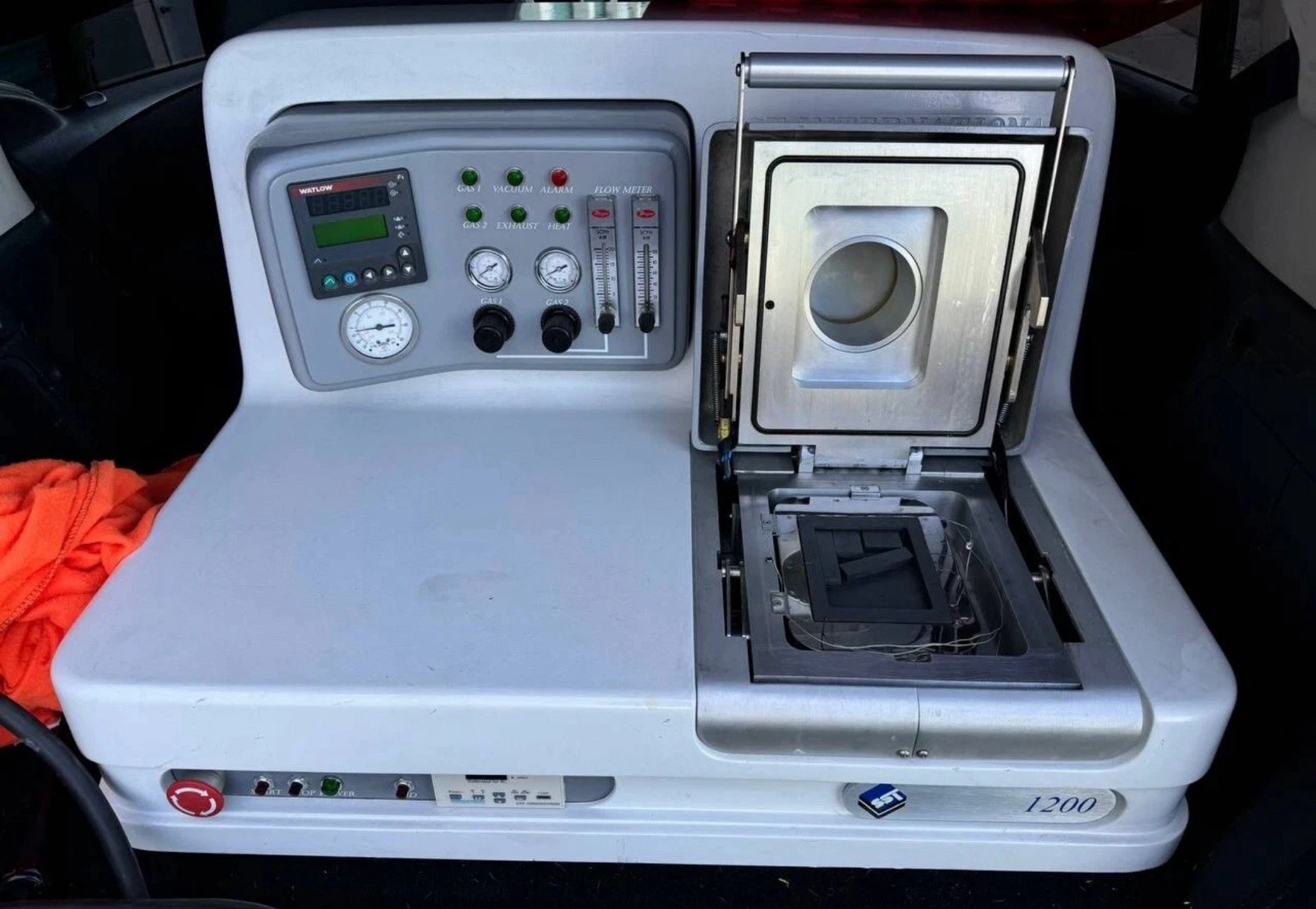
A table-top vacuum reflow station is a benchtop, batch reflow oven with a sealed chamber and a controllable vacuum cycle. It’s used to solder SMT and die-attach assemblies while actively removing entrapped gases from molten solder to minimize voids and improve thermal/electrical reliability—especially under thermal pads, power devices, and large copper areas.
How it works (process sequence)
- Load & purge – PCB or substrate is placed on the stage/fixture. Chamber is closed and optionally purged with N₂ (or process gas such as formic acid for flux-reduction/fluxless processes).
- Preheat – Controlled ramp (≈0.5–3 °C/s) to activate flux and equalize board temperatures.
- Soak – Narrow ΔT across the assembly; volatiles begin to outgas.
- Reflow (above liquidus) – Peak typically 220–250 °C for Sn-Ag-Cu pastes (higher for high-Pb or AuSn).
- Vacuum hold – While solder is liquid, the chamber is drawn down (e.g., to 1–50 mbar absolute or –80 to –95 kPa gauge) for 10–90 s. Pressure cycling (vacuum ↔ vent) can be used to “pump” voids out.
- Cool-down – Controlled cooling (0.5–4 °C/s) to set microstructure and mitigate warpage; vent to atmosphere.
The vacuum step must occur above liquidus—otherwise voids are trapped when the solder freezes.
Core subsystems
- Sealed thermal chamber (IR, conduction plate, hot-gas convection, or vapor-phase variants).
- Heater zones & PID control with multi-point thermocouples (board and air) for closed-loop profile control.
- Vacuum train: electro-pneumatic valves, vacuum reservoir, gauge (Pirani/Capacitance), and a dry pump.
- Gas management: N₂ purge optional; some units integrate formic-acid vapor for oxide reduction (fluxless).
- Motion/fixtures: anti-skid or pin fixtures to prevent component shift during depressurization.
- Data & safety: recipe storage, profile logging, O₂/pressure interlocks, over-temperature protection.
Why vacuum? (technical benefits)
- Void reduction: Gas bubbles in molten solder expand under vacuum and escape; typical results <1–3 % void area on optimized processes (vs. 10–30 % with conventional reflow), critical for QFN/BTC thermal pads and power modules.
- Lower junction-to-case thermal resistance (Rᴊᴄ) and lower contact resistance, improving power cycling life.
- Improved wetting on thick copper and heavy thermal masses due to controlled soak and oxygen-reduced ambient.
- Better reliability: fewer hotspots, reduced electromigration risk, and stronger intermetallic coverage.
Typical capabilities (table-top class)
- Work envelope: small to medium boards (e.g., ~150×200 mm up to ~300×400 mm, model-dependent).
- Peak temp: 260–320 °C; uniformity ±1–3 °C across the field.
- Vacuum level: 1–50 mbar abs; programmable multi-pulse vacuum profiles.
- Throughput: batch (1 panel per run); cycle times ~6–20 min depending on thermal mass and recipe.
Materials & use cases
- SnAgCu pastes, high-Pb (power electronics), AuSn eutectic and Ag-sinter preforms (with formic-acid options).
- Power MOSFET/IGBT modules, QFN/BTC, RF shields, LED MCPCBs, die-attach on Cu/DBC, TIM-solder attach.
Integration/DFM notes
- Run actual thermal profiles with on-board thermocouples; avoid profiling by air only.
- Time the vacuum hold ≥10–20 s above liquidus; use staged vacuum to prevent component float/tombstoning.
- Use low-volatility flux designed for vacuum reflow; excessive flux can boil under deep vacuum.
- Consider N₂ for oxidation-sensitive alloys or flux-reduced processes; maintain low O₂ ppm if specified.
- Plan for condensate management (cold traps/filters) to protect the pump from flux vapors.
Advantages vs. conventional benchtop reflow
- Orders-of-magnitude void reduction, superior thermal/electrical performance.
- Better results on thick copper, heavy thermal pads, and large ground planes.
- Chamber process allows repeatable atmospheres (N₂, formic).
Limitations
- Lower throughput than inline conveyor ovens; best suited for prototyping, NPI, repair, or high-reliability low-volume.
- Board size limited by chamber; fixtures required for very fine or tall components.
- Process tuning needed to avoid paste spatter or component shift under vacuum.
In short, a table-top vacuum reflow station is a compact, chamber-based soldering system that adds a programmable vacuum cycle during the molten phase to evacuate gases, dramatically cutting voids and boosting thermal/electrical reliability in demanding assemblies.