What is Propulsion & Conveying Technology?
Propulsion & conveying technology — a technical overview
Propulsion is the set of technologies that generate thrust or tractive effort to move a body (vehicle, rotor, belt, screw, fluid column) through a resistive environment.
Conveying is the engineered transport of materials (bulk solids, powders, parts) along a defined path inside a process or facility.
They’re closely linked in industry: a conveyor’s drive is a propulsion system sized to overcome loads and losses with controlled motion.
Core physics (shared ideas)
- Force & power: to move at speed
vagainst total resistanceF_total, powerP ≈ F_total · v / η. - Traction: available drive force is limited by friction/adhesion (e.g., belt-to-pulley, wheel-to-rail):
T1/T2 = e^{μθ}(Euler belt equation). - Momentum transfer: thrust can be produced by accelerating mass (air/water/propellant or the conveyed solid):
T = ṁ · (V_out − V_in); in rockets add pressure term+ (p_e − p_0) A_e. - Losses: rolling, bearing, and aerodynamic losses; for fluids/air, pressure drop via Darcy–Weisbach and two-phase corrections for solids/air or slurry.
Conveying technologies (what moves the material)
Mechanical (continuous):
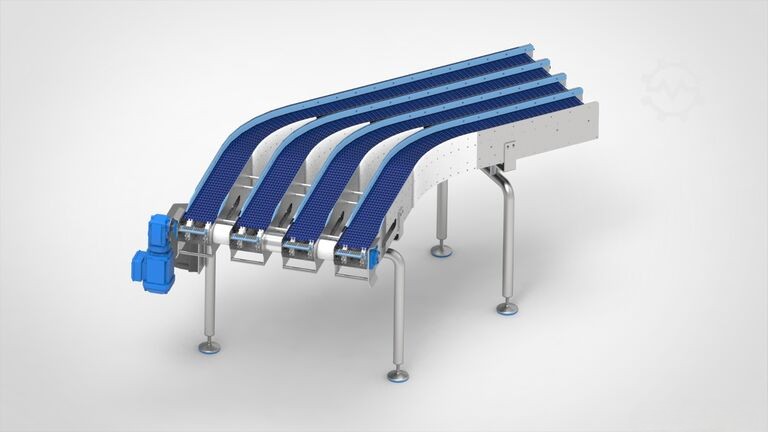
- Belt conveyors: High throughput, gentle handling. Sized by belt width, speed, idler spacing; power from belt tension (lift + friction). Typical belt speeds 1–4 m/s.
- Roller/chain conveyors: Unit loads (pallets/cases); accumulation via clutch rollers or zone drives.
- Bucket elevators/flight conveyors: Vertical or steep-incline bulk transport.
- Screw conveyors: Enclosed, dust-tight, short to medium distances; capacity ≈ cross-section × pitch × rpm × fill factor; suited to metering.
- Vibratory feeders: Short distances, precise feed; throw angle and frequency (15–60 Hz) control rate.
Pneumatic conveying (air + solids):
- Dilute phase: High air velocity (typically 18–25 m/s in lines), low solids loading; particles are suspended; higher wear/energy, flexible routing.
- Dense phase: Lower velocity with plugs/slugs; higher solids loading; gentler on fragile product; needs boosters and careful control.
Key parameters: pickup/transport velocity, solids loading ratio (ṁ_s/ṁ_air), line pressure drop ΔP, saltation velocity (minimum to keep particles from settling).
Hydraulic/slurry conveying:
- Solids carried in liquid (e.g., mineral slurry). Governed by carrier velocity to avoid settling, solids volume fraction, and pipeline head loss.
Aero-mechanical & tubular drag:
- Cables/discs or rope/flights pull product in a sealed tube; low power, gentle, compact layouts.
Propulsion technologies (what provides the drive)
- Electric drives: Induction/PM motors + VFD/servo drives; torque
τ = k_t·I, closed-loop speed/position; regenerative braking possible. - Hydraulic drives: High torque density; force
F = p·A; used for heavy feeders/elevators and mobile equipment. - Pneumatic actuators: Simple, fast on/off positioning; lower precision/efficiency for continuous duty.
- Fluid-dynamic propulsion: Fans/blowers (airflow for pneumatic lines), pumps (slurries); selection by duty point (Q,H) or (ṁ, ΔP).
- Propulsors (vehicles/robots): Wheels/tracks (tractive effort), propellers
T ≈ C_T ρ n² D⁴, waterjets, and—at the extreme—jets/rockets (thrust equation above).
Sizing & selection (what engineers actually calculate)
- Duty & load profile: peak vs. continuous throughput (t/h), total static head (elevation), frictional losses, start/stop frequency.
- Material properties: bulk density, particle size/shape, abrasiveness, cohesion, moisture, ATEX classification.
- Environment & routing: distance, vertical lifts, elbows, temperature, sanitation requirements.
- Controls & safety: VFDs/soft starts, torque limiting, speed/plug sensors, zero-speed switches, overload/overfill interlocks, dust control (filters, cyclones), guards and emergency stops.
- Efficiency & life: select drives near the peak efficiency island; specify lagging, idlers/bearings, liners and bend radii to manage wear/noise.
When to use what (rules of thumb)
- High tonnage, gentle, energy-efficient, predictable path: belt/chain conveyors.
- Sealed, flexible routing across plant (no open belts), moderate rates: pneumatic conveying (dilute for flexibility; dense for fragile/abrasive).
- Short, metered, enclosed feeds from hoppers: screw/vibratory.
- Vertical bulk transfer: bucket elevator (granular) or pneumatic lift (powder).
- Liquids/slurries: pumps & pipelines (with solids transport velocity checks).
Integration example
A powder line may use a screw feeder (metering), a roots blower (propulsion—air source), and a dense-phase pipeline (conveying), all coordinated by a PLC/VFD to hold mass flow setpoint while staying above saltation velocity and below maximum line ΔP.