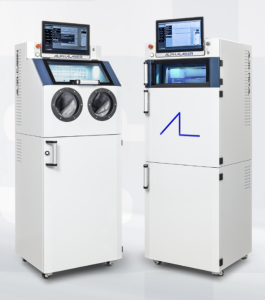
What is Stainless Steel Humpback Furnace for Soldering & Annealing?

A humpback furnace is a continuous, controlled-atmosphere belt (or pusher) furnace whose hot zone is built with an arched centerline—the work climbs up a “hump” and descends before exit. The raised tunnel creates a natural gas lock that dramatically reduces air infiltration at the entrance/exit and prevents process vapors from back-streaming out of the hot zone. This geometry is widely used for flux-free soldering/brazing and bright annealing of stainless-steel parts.
Why the humpback geometry matters
- Atmosphere segregation: The elevation change plus curtain-gas nozzles at both ends keep a stable reducing atmosphere inside (e.g., H₂ or N₂/H₂), critical for wetting during soldering and for bright, scale-free anneals.
- Vapor containment: Decomposed formic-acid or flux volatiles condense in the low-temperature legs instead of escaping, protecting seals and minimizing emissions.
- Thermal efficiency & quality: Less air ingress → lower oxygen and moisture → consistent surface chemistry, minimal discoloration.
Process uses
1) Flux-free soldering/brazing of stainless steel
- Goal: Remove the passive Cr₂O₃ film and wet with Sn-based solder or Cu/Ag brazes without corrosive flux.
- Atmospheres: High-purity H₂ (99.99%) or N₂/H₂ (typically 95/5 to 90/10). Many lines add formic-acid vapor in preheat to chemically reduce surface oxides.
- Thermal profile:
- Preheat/activation: 120–200 °C (formic-acid reduction window).
- Ramp to peak: 220–260 °C for SnAgCu solder, 620–800 °C for Ag-Cu brazes (per alloy).
- Controlled cool to lock joint geometry.
- Controls: Dew point ≤ −40 °C (≤ ~100 ppm H₂O) for soldering; lower for high-finish parts. Closed-loop belt speed, zone power, IR pyrometry, O₂/dew-point analyzers.
2) Bright annealing of stainless steel
- Goal: Relieve cold-work, restore ductility/corrosion resistance, and maintain a bright finish with no scale.
- Atmosphere: Dry H₂ (often 100% H₂) or ultra-dry N₂/H₂; dew point typically ≤ −60 °C (≤ ~10 ppm H₂O) to avoid tinting.
- Setpoints (typical):
- Austenitic grades: 1040–1150 °C soak, then rapid cooling to bypass sensitization range (500–800 °C).
- Ferritic/martensitic grades: 750–950 °C, then controlled cool per grade.
- Outcomes: Uniform recrystallized microstructure, low hardness, bright surface—ready for passivation.
Major subsystems
- Muffle/hot tunnel: Heat-resistant alloy (e.g., RA330/253MA) or ceramic; arched (“humpback”) geometry.
- Heating: Radiant tubes or elements (FeCrAl, SiC, or MoSi₂ for >1100 °C).
- Conveyance: Metallized mesh belt or pusher trays; guided to climb and descend the hump.
- Atmosphere management: Entrance/exit curtain nozzles, slight positive pressure, recirculation fans, burn-off/ABAT for formic-acid processes, exhaust and flare.
- Quench & cooling: Water-jacketed or forced-gas cooling sections sized for required cooling rates.
- Instrumentation & safety: PLC/HMI, zone thermocouples, IR pyrometers, O₂/DP analyzers, H₂ detectors, purge/LEL interlocks, water-cooled seals.
Typical capability (varies by model)
- Peak temperature: 260 °C (soft solder) up to 1150 °C (bright anneal).
- Dew point: ≤ −40 °C (soldering); ≤ −60 °C for true bright anneal.
- Throughput: Determined by belt width (100–900 mm), load height, and belt speed (seconds to minutes of soak).
- Surface quality: Mirror-bright stainless without pickling; flux-free, clean solder joints.
Advantages vs. straight-through furnaces
- Better atmosphere integrity with lower gas consumption, cleaner seals, and tighter control of oxygen/moisture.
- Improved wetting (soldering) and brighter surfaces (annealing) with fewer rejects.
- Continuous, recipe-driven operation compatible with high-volume production.
Key setup parameters to specify for a job
Material grade & condition, joint alloy (if solder/braze), required peak temperature and soak time, belt speed, gas type/flow & dew point, oxygen limit, cooling rate, cleanliness of incoming parts, and safety interlocks for H₂ or formic-acid operation.
In short: a stainless-steel humpback furnace is a continuous, controlled-atmosphere thermal system whose arched tunnel design keeps a very clean, reducing environment—ideal for flux-free soldering/brazing and bright annealing of stainless parts with excellent surface finish and reproducible metallurgy.