21/06/2025
What is Rotating Head Cladding System?
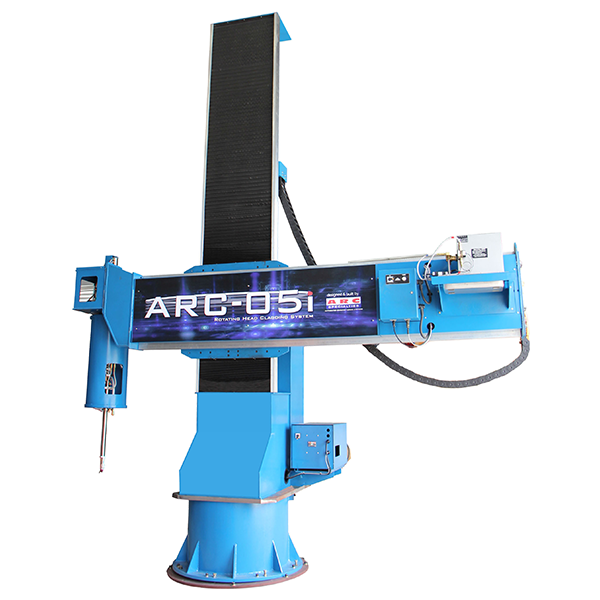
A Rotating Head Cladding System is a specialized industrial machine used for cladding metal surfaces — typically in oil & gas, aerospace, power generation, and heavy engineering — where a protective or corrosion-resistant layer is applied to a base metal using welding or thermal processes. The “rotating head” refers to the mechanism that rotates the cladding tool or welding torch around or along the workpiece, allowing for uniform, high-precision cladding on cylindrical or contoured surfaces.
🔧 Technical Explanation
✅ 1. Purpose of Cladding:
Cladding is used to:
- Improve corrosion resistance
- Enhance wear resistance
- Restore dimensional tolerances
- Protect expensive base materials by using cheaper substrates
✅ 2. Components of a Rotating Head Cladding System:
| Component | Function |
|---|---|
| Rotating Cladding Head | Holds and rotates the welding/cladding torch/tool around the workpiece |
| Welding Torch (TIG/MIG/Laser/Plasma) | Delivers the energy and filler material for the cladding process |
| Wire Feeder or Powder Feeder | Supplies filler material (e.g. Inconel, Stellite, SS) during the operation |
| Servo Motors | Precisely control rotational and linear movement |
| Positioner/Chuck | Holds and rotates the cylindrical workpiece if required |
| CNC or PLC Control System | Controls all motion axes and process parameters for repeatable automation |
| Cooling System | Manages heat during continuous cladding to prevent distortion |
✅ 3. Working Principle:
- The workpiece remains stationary or rotates slowly.
- The rotating head (which holds the torch) spins around the axis of the workpiece.
- Filler material is fed while the heat source melts and deposits the clad layer on the surface.
- The system may move axially along the workpiece for helical cladding or multiple layers.
✅ 4. Common Cladding Processes Used:
- GTAW (TIG) Hot Wire Cladding
- GMAW (MIG) Cladding
- Plasma Transferred Arc (PTA) Cladding
- Laser Cladding
📌 Applications
- Valve bodies, pump shafts, cylinders
- Pipeline flanges & elbows (internal bore cladding)
- Large rolls or shafts subject to wear
- Nuclear and thermal power components
✅ Advantages
- Uniform coverage even in hard-to-reach areas (due to rotating head)
- High precision and repeatability with CNC control
- Multi-axis control allows complex geometry cladding
- Minimizes dilution between base and clad material