What is Linear Brush Cleaning System used for 24/7 industrial applications?
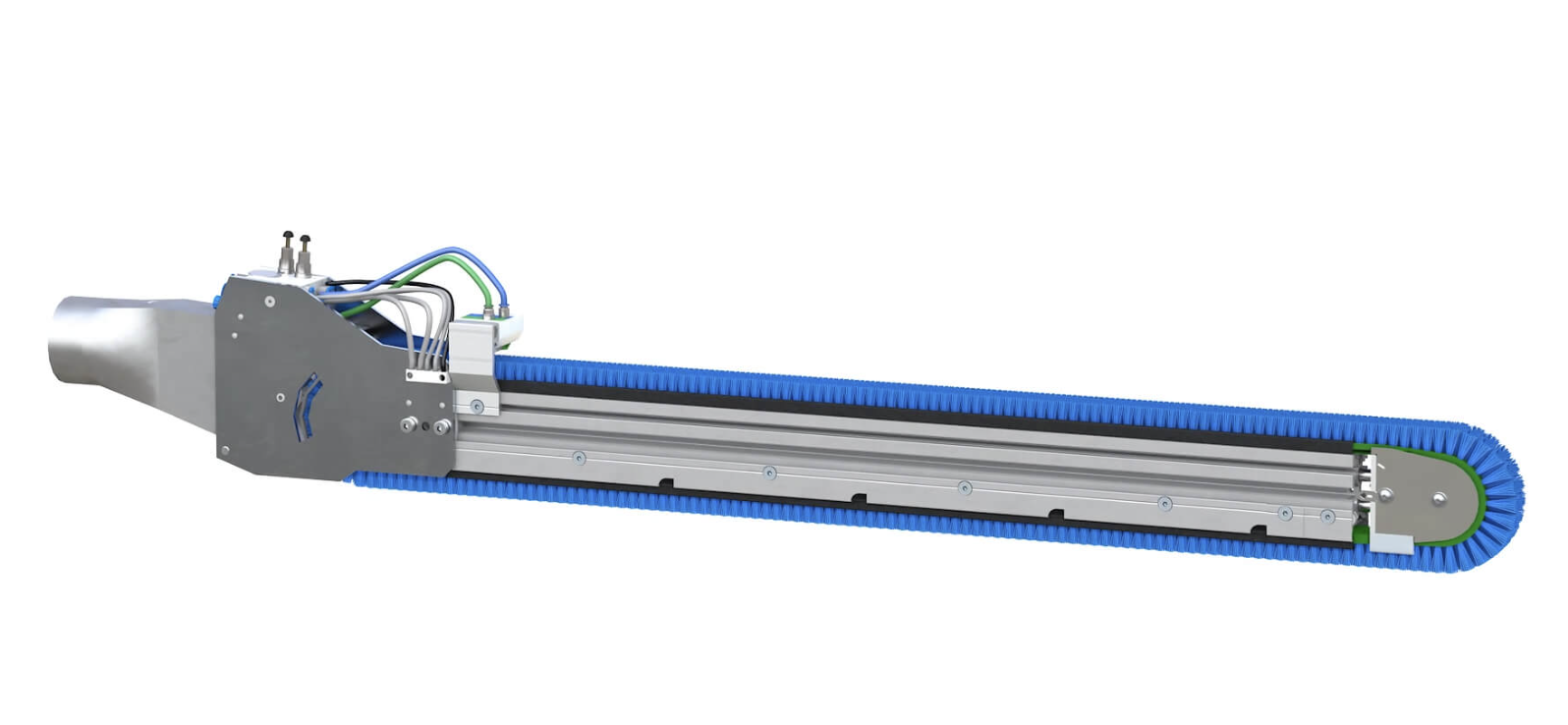
The Linear Brush Cleaning System, particularly as exemplified by the Sword Brush® developed by Wandres GmbH, is a specialized industrial cleaning technology designed for continuous, high-throughput removal of particles, dust, and contaminants from flat or slightly curved surfaces in production lines. It is optimized for 24/7 industrial applications, where uninterrupted operation is essential to maintain productivity, ensure product quality, and minimize downtime. This system is commonly used in sectors such as printing, paper processing, film and foil production, packaging, textiles, and metalworking, where even minor contamination can lead to defects, equipment wear, or production halts. Unlike traditional cleaning methods that rely on chemicals, water, or manual intervention, the linear brush system achieves dry, agent-free cleaning through mechanical action, making it cost-effective, environmentally friendly, and suitable for sensitive materials.The system’s core advantage in 24/7 operations is its self-regenerating mechanism, which allows it to maintain consistent performance without frequent stops for maintenance. It integrates seamlessly into automated production chains, providing reliable cleaning at speeds up to several meters per second, depending on the substrate and contamination level.Technical ExplanationThe Linear Brush Cleaning System operates on principles of mechanical adhesion, pneumatic adaptation, and continuous regeneration. Below, I’ll break it down into key components, working mechanism, and technical specifications, focusing on the Sword Brush® as the primary embodiment of this technology (based on its explicit design for 24/7 use).1. Core Components
- Linear Brush Element: The heart of the system is a continuous, circulating linear brush made from high-density micro-filaments (typically synthetic fibers like polyamide or nylon, with filament diameters as fine as 0.1–0.3 mm). These filaments are densely packed (up to 30,000–50,000 filaments per meter of brush length) to create an enlarged contact area that “dips” into the micro-structures of the substrate surface. This design enhances particle capture through electrostatic and mechanical adhesion, removing contaminants as small as 1–10 microns without damaging delicate surfaces.
- Pressure Buffer System: The brush is mounted on a pneumatically regulated pressure buffer, which applies controlled force (typically 0.5–5 N/cm², adjustable via air pressure regulators). This buffer uses elastomeric or spring-loaded bedding to flex and compensate for surface irregularities, such as variations in material thickness (±2 mm tolerance) or unevenness (e.g., warps or vibrations in conveyor-fed substrates). The buffer ensures uniform contact pressure, preventing over-compression that could cause wear on the brush or substrate.
- Drive and Circulation Mechanism: The brush circulates linearly (parallel to the substrate movement) via a hub motor or belt drive system, achieving speeds of 10–50 m/min. In advanced variants like the Robot Sword Brush Laura®, twin brushes rotate in parallel with hub motors, enabling counter-rotation for enhanced scrubbing on curved surfaces (deviation tolerance of -30 mm to +10 mm).
- Self-Cleaning and Regeneration Unit: For 24/7 reliability, the system includes an integrated self-cleaning module. This uses a secondary brush or vacuum-assisted scraper to regenerate the primary brush continuously. Contaminants adhered to the filaments are removed via mechanical agitation or suction (flow rates up to 500–1000 m³/h), preventing filament clogging and maintaining >95% cleaning efficiency over extended periods. Sensors (e.g., inductive or optical) monitor brush wear, filament depth impression, and particle load, triggering automated adjustments or alerts.
- Optional Enhancements: In some configurations, like the Combi Sword Brush, additional pre-cleaning stages (e.g., coarse particle absorbers or ionized air blowers) are added upstream to handle bulk debris, reducing the load on the main brush.
2. Working Mechanism The system functions in a continuous inline process:
- Contact and Cleaning Phase: As the substrate (e.g., a web of paper or film moving at production speeds) passes under/through the unit, the linear brush makes tangential contact. The micro-filaments penetrate surface pores and textures, dislodging particles via shear forces and van der Waals adhesion. No cleaning agents are needed, as the mechanical action suffices for dry particulates like dust, fibers, or residues. Cleaning efficiency is quantified by particle removal rates (e.g., >99% for particles >5 microns, per ISO 14644 standards for cleanroom-like validation in industrial settings).
- Adaptation and Compensation: The pneumatic buffer dynamically adjusts to substrate variations using feedback from pressure sensors (e.g., maintaining constant force via PID control loops). For instance, if the substrate thickness fluctuates by 1 mm, the buffer extends/retracts in <0.1 seconds to avoid gaps or excessive pressure.
- Particle Removal and Regeneration: Captured particles are transported along the circulating brush to the self-cleaning unit. Here, a counter-rotating regeneration brush or vacuum nozzle strips them off, depositing waste into a collection hopper. This process occurs without halting the main production line, ensuring 24/7 uptime. In sensor-monitored systems, parameters like suction flow and brush speed are optimized in real-time via PLC (Programmable Logic Controller) integration.
- Integration in Production Lines: The unit mounts transversely or longitudinally to conveyors, with modular lengths (0.5–3 m) to match line widths. Electrical requirements are low (e.g., 230V AC, 0.5–2 kW), and it operates in ambient conditions (0–40°C, 20–80% RH), with IP54-rated enclosures for dust resistance.
3. Technical Specifications and Performance Metrics
- Operating Parameters:
- Substrate Speed Compatibility: Up to 1000 m/min (high-speed lines).
- Brush Life: 5,000–10,000 hours in 24/7 use, with low running costs (<€0.01/m² cleaned).
- Cleaning Width: Customizable, typically 300–2500 mm.
- Power Consumption: 0.2–1 kW, energy-efficient for continuous operation.
- Advantages for 24/7 Applications:
- Reliability: Self-cleaning prevents buildup, reducing maintenance to quarterly inspections. Mean Time Between Failures (MTBF) exceeds 10,000 hours.
- Efficiency: Achieves cleaning results equivalent to chemical methods but without residue or drying times, improving downstream processes (e.g., printing registration accuracy by reducing defects by 50–80%).
- Cost-Effectiveness: Initial investment offset by zero consumables and minimal downtime; ROI typically within 6–12 months in high-volume production.
- Safety and Compliance: No emissions or hazardous materials; conforms to EU Machinery Directive 2006/42/EC and ISO 9001 for quality management.
- Limitations: Best suited for dry particulates; for oily or sticky residues, hybrid systems with minimal agents may be needed. Not ideal for highly abrasive contaminants without reinforced filaments.
In summary, the Linear Brush Cleaning System represents a robust, automated solution for maintaining cleanliness in relentless industrial environments, leveraging precise mechanical and pneumatic engineering to deliver consistent, high-performance cleaning without compromising production flow.