What is Filling & Closing Machine used for the pharmaceutical, consumer healthcare, cosmetics industries?
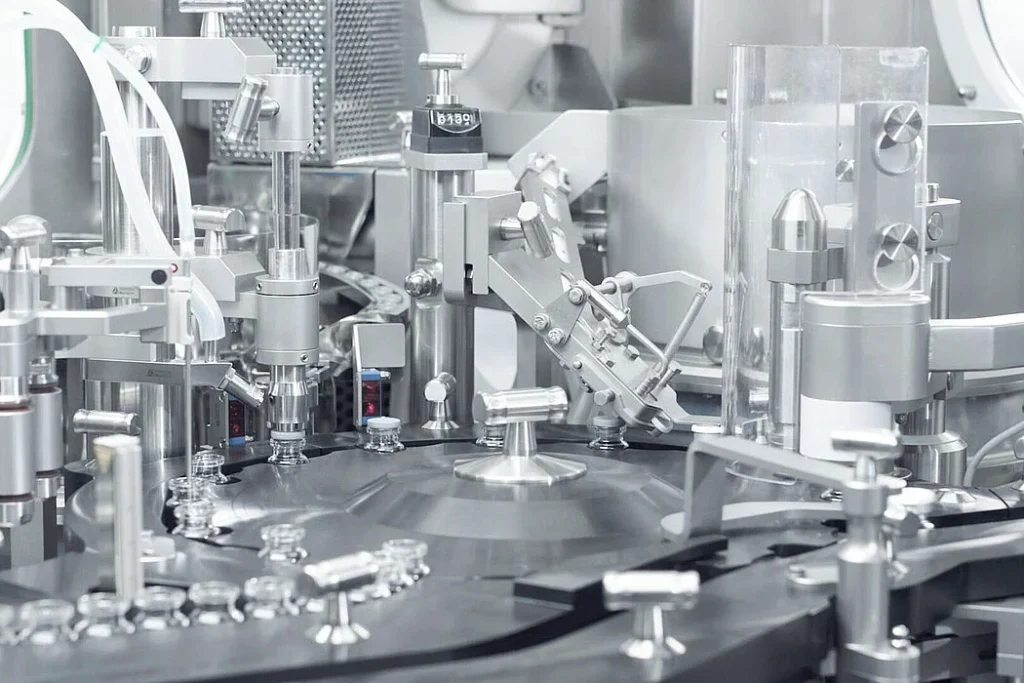
A filling and closing machine is an automated or semi-automated industrial system designed to precisely dispense (fill) products into containers and subsequently seal (close) them to ensure product integrity, safety, and compliance with regulatory standards. In the pharmaceutical, consumer healthcare, and cosmetics industries, these machines are critical for packaging liquids, semi-solids (e.g., creams, gels), powders, or suspensions into vials, bottles, tubes, syringes, ampoules, or cartridges. They enable high-volume production while minimizing contamination risks, ensuring accurate dosing, and maintaining sterility where required. These machines are often integrated into aseptic processing lines and are engineered for cleanroom environments, adhering to standards like cGMP (Current Good Manufacturing Practices), FDA regulations, and ISO 14644 for particulate control.Unlike manual packaging, which is labor-intensive and prone to errors, filling and closing machines automate the process to achieve throughput rates from 2,700 to 30,000 units per hour, depending on the model and configuration. They are versatile for handling diverse container types (glass, plastic/PET, foil) and product viscosities, making them indispensable for scaling production in these regulated sectors.Technical ExplanationFilling and closing machines operate on principles of precision metering, mechanical automation, and hygienic design to deliver consistent results. They typically combine filling, capping/sealing, and sometimes ancillary functions like washing, sterilizing, or labeling into a monoblock (compact, integrated unit) or linear/rotary line. Below is a detailed breakdown of their components, operational principles, physics/engineering aspects, and industry-specific adaptations.1. Key Components
- Container Handling System: Includes infeed mechanisms (e.g., rotary tables, conveyor belts, or robotic arms) to orient and transport containers. For pharmaceuticals, ready-to-use (RTU) vials or nested syringes are common, with formats supporting 2R to 500 mL sizes. Unscramblers or elevators ensure single-file alignment.
- Filling Station: The core for dosing. Utilizes volumetric, peristaltic, piston, time-pressure, or flow-meter pumps. Contact parts (e.g., nozzles, hoses) are made from stainless steel (316L), autoclavable plastics, or ceramics for easy sterilization via autoclaving, CIP (Clean-In-Place), or SIP (Sterilize-In-Place). Precision is achieved with servo-driven actuators for ±0.5% fill accuracy.
- Closing/Sealing Station: Applies closures like screw caps, crimped seals, plugs, or heat-sealed foils. Mechanisms include torque-controlled screw heads, rotary crimpers, or ultrasonic/heat sealers. For ampoules, it’s often a direct flame-sealing process.
- Sterilization and Hygiene Modules: Integrated washers/sterilizers (e.g., using hydrogen peroxide vapor or steam) for aseptic processing. Laminar flow hoods or RABS (Restricted Access Barrier Systems) provide ISO 5/Grade A environments.
- Control and Inspection Systems: PLC (Programmable Logic Controllers) or SCADA for automation, with HMI (Human-Machine Interfaces) for operator control. Includes 100% In-Process Control (IPC) via vision systems, weigh cells, or non-contact sensors (e.g., laser or X-ray for fill level verification). Sensors detect defects like over/under-fills or misclosures, rejecting via air blasts or diverters.
- Frame and Safety Features: Stainless steel construction with smooth surfaces to prevent microbial harborage. Interlocks, guards, and emergency stops ensure operator safety. Power ratings vary (e.g., 5–20 kW), with compressed air (6–8 bar) for pneumatic operations.
2. Operational Principle and Physics/Engineering The process follows a sequential, synchronized workflow, often in a rotary (intermittent motion) or linear (continuous motion) configuration for efficiency. Here’s the technical flow:
- Infeed and Preparation: Containers are fed at rates up to 400–600 per minute. For aseptic lines, pre-sterilized RTU containers bypass washing. Physics: Gravity or vacuum assists orientation; centrifugal forces in rotary infeed bowls align asymmetric items.
- Filling Phase: Product is metered from a bulk reservoir (e.g., via positive displacement pumps). Common methods:
- Volumetric Piston Filling: A piston draws and dispenses a fixed volume V=πr2hV = \pi r^2 h
V = \pi r^2 h, where ( r ) is piston radius and ( h ) is stroke length, controlled by servo motors for precision (±1% variance). Ideal for viscous creams in cosmetics. - Peristaltic or Time-Pressure Filling: Uses rollers to compress tubing, avoiding direct contact for sterile pharma applications. Pressure P=FAP = \frac{F}{A}
P = \frac{F}{A}(force over area) ensures consistent flow for low-viscosity liquids like injectables. Flow rate Q=AvQ = A vQ = A v, where ( v ) is velocity, is regulated to prevent foaming or splashing. - Powder Filling: For dry pharma products, auger fillers rotate a screw to dispense mass m=ρVm = \rho V
m = \rho V, with ρ\rho\rhoas density, achieving ±2% accuracy. Dosing occurs under laminar airflow (velocity ~0.45 m/s) to maintain sterility. For biologics, nitrogen purging displaces oxygen to prevent degradation.
- Volumetric Piston Filling: A piston draws and dispenses a fixed volume V=πr2hV = \pi r^2 h
- Closing Phase: Immediately after filling to minimize exposure.
- Screw Capping: Torque τ=Fr\tau = F r
\tau = F rapplied via clutch mechanisms (e.g., 0.5–5 Nm) to secure without over-tightening, preventing leaks. Sensors monitor torque in real-time. - Crimping or Plugging: For vials, aluminum seals are crimped using dies with force up to 500 N, ensuring hermetic seals (leak rate <10^{-6} mbar·L/s).
- Heat/Ultrasonic Sealing: For tubes or pouches, energy E=I2RtE = I^2 R t
E = I^2 R t(current, resistance, time) melts polymers at 150–250°C, forming bonds with peel strength >20 N/cm. Rejection of faulty closures uses pneumatic ejection, recirculating via centripetal paths.
- Screw Capping: Torque τ=Fr\tau = F r
- Inspection and Outfeed: IPC systems use machine vision (CCD cameras with AI algorithms) for defect detection (e.g., cap presence via edge detection). Throughput self-regulates via sensors to match downstream lines. Total cycle time per unit: 0.1–2 seconds.
- Validation and Compliance: Machines undergo IQ/OQ/PQ (Installation/Operational/Performance Qualification). For pharma, aseptic isolators maintain <1 CFU/m³ (Colony-Forming Units per cubic meter). Energy efficiency: Servo drives reduce consumption by 30–50% vs. pneumatic systems.
3. Applications in Specific Industries
- Pharmaceutical Industry: Used for sterile injectables, oral liquids, and biologics in vials/syringes. Emphasis on aseptic fill-finish to prevent contamination; e.g., MICRO BI rotary systems for RTU vials in clinical production. Handles small batches (e.g., FSV models for labs) to high-volume (up to 30,000/h).
- Consumer Healthcare: For OTC products like cough syrups or eye drops in bottles/tubes. Focus on hygienic, non-sterile processing with high throughput; e.g., flexfill lines for medium-volume OTC.
- Cosmetics Industry: Fills creams, lotions, or serums into tubes/jars. Requires flexibility for diverse viscosities and containers (glass/PET/foil); e.g., Optima systems for precise dosing of powders/semi-solids without air incorporation.
4. Advantages and Limitations (Technical Perspective)
- Advantages:
- High precision and repeatability (±0.5–2% dosing accuracy) reduce waste and ensure regulatory compliance (e.g., USP <905> for uniformity).
- Aseptic designs minimize bioburden, with CIP/SIP cycles <30 minutes for quick changeovers.
- Scalability: Modular for 10–500 mL formats; integration with robotics for Industry 4.0 (e.g., real-time data via OPC UA).
- Cost savings: Automated lines cut labor by 70–90%, with ROI in 1–2 years for high-volume ops.
- Limitations:
- High initial cost ($100,000–$1M+ USD) due to validation and customization.
- Sensitivity to product variability (e.g., foaming liquids require anti-drip nozzles); foaming can reduce efficiency by 20%.
- Maintenance: Requires skilled technicians for CIP validation; downtime ~5–10% for cleaning/tooling changes (10–60 minutes).
5. Examples of Manufacturers and Models
- Groninger Group: flexfill and flexcare series for pharma/OTC/cosmetics; rotary monoblocks with 100% IPC.
- Optima Packaging: Versatile fillers for sterile/non-sterile pharma and cosmetics, supporting vials to cartridges.
- NJM Packaging/Dara Pharma: Liquid filling systems for syringes/vials, compliant with FDA/cGMP.
- Colanar/INOS: FSV models for small-batch biotech/pharma in laminar hoods.
In summary, filling and closing machines represent a pinnacle of precision engineering in regulated industries, combining fluid dynamics, automation, and sterility controls to safeguard product quality from fill to seal. For tailored implementations, factors like product rheology and batch size dictate the optimal configuration—consulting manufacturers for simulations (e.g., via FEA for flow optimization) is advised.