What is Centrifugal Bowl Cap Sorter?
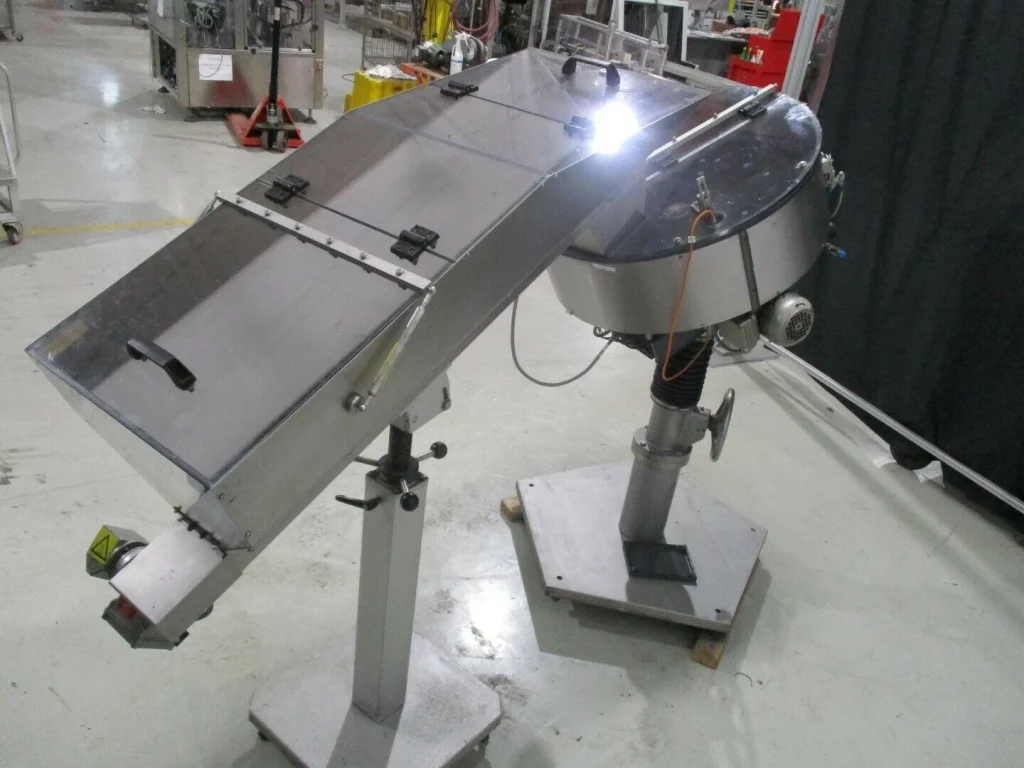
A centrifugal bowl cap sorter is a specialized piece of industrial packaging machinery designed to automatically orient and sort bottle caps (or similar closures) into a consistent, upright position for efficient delivery to downstream processes like capping machines. It is commonly used in beverage, pharmaceutical, and food packaging lines where high-speed, precise cap handling is essential. Unlike vibratory sorters, which rely on vibrations to align caps in a bowl, centrifugal sorters use rotational motion and centrifugal force to achieve sorting. This makes them particularly suitable for handling tall caps, custom geometries, or scenarios requiring higher throughput speeds without excessive air consumption.The term “bowl” refers to the rotating, bowl-shaped or disc-like feeder component where caps are introduced and processed. These machines are engineered for reliability, ease of changeover, and integration into automated lines, often featuring stainless steel construction for hygiene and durability in clean environments.Technical ExplanationCentrifugal bowl cap sorters operate on principles of rotational dynamics, gravity, and selective rejection mechanisms to achieve orientation. Below is a step-by-step technical breakdown of their functioning, including key components, physics involved, and operational parameters.1. Key Components
- Hopper/Feeder: A bulk storage unit (typically elevated) where unsorted caps are loaded manually or via automated pre-feeders. Capacity varies by model, often handling 10–90 mm diameter caps and heights from 0.125 to 2.5 inches. It includes a vibrator or agitator (e.g., 1/3 HP DC gear motor with potentiometer speed control) to prevent jamming and ensure even distribution into the bowl.
- Rotating Bowl/Disc: The core element, usually a 32-inch diameter stainless steel disc or bowl mounted on a central spindle. It spins at controlled speeds (e.g., adjustable via DC motor) to generate centrifugal force. The bowl’s inner surface features custom-tooled ramps, slots, or grooves (often 4 adjustable slotted crosses) tailored to cap geometry for guiding and aligning.
- Rejection System: Photoelectric sensors (e.g., low-friction limit switches) detect cap orientation in real-time. Improperly oriented caps (e.g., upside-down) are rejected using compressed air jets or mechanical deflection back to the bowl’s center for reprocessing.
- Discharge Chute: A single-file exit ramp or chute where correctly oriented caps are ejected tangentially. For tall caps, an optional powered belt with hooks may assist final alignment before chute entry.
- Control Systems: Includes air filters, pressure regulators, flow controls on hoses, and cap-level sensors for demand-based operation. The sorter often mounts directly on the capping machine frame, eliminating separate height adjustments.
- Frame and Materials: Aluminum or stainless steel frame with plastic/stainless contact parts for corrosion resistance and FDA compliance. No external air supply is always required, as centrifugal effect handles primary sorting (eco-friendly variants like PRO.SELECT use zero air for certain designs).
2. Operational Principle and Physics The sorter leverages centrifugal force (a fictitious force in the rotating frame of reference) to separate and orient caps. Here’s the process:
- Loading and Initial Distribution: Unsorted caps from the hopper are gravity-fed or vibrated onto the center of the stationary or low-speed rotating bowl. As the bowl accelerates (driven by the motor), caps experience a uniform radial acceleration due to rotation.
- Centrifugal Separation: The bowl spins at angular velocity ω (typically 500–1500 RPM, adjustable for cap size/speed). Each cap experiences centrifugal force Fc=mω2rF_c = m \omega^2 r
F_c = m \omega^2 r, where:- ( m ) is the cap’s mass,
- ω\omega
\omegais angular speed (rad/s), - ( r ) is the radial distance from the center.
F_g = mg) interacts with the bowl’s incline to stabilize upright positions. - Orientation and Selection: As caps reach the outer ramp, sensors scan for correct alignment (e.g., via optical detection of cap features). Correctly oriented caps (e.g., those fitting snugly in grooves) proceed up the ramp due to the combined centrifugal push and ramp angle (typically 15–30° incline). Misaligned caps, lacking stable contact, slip or are ejected radially inward by design features or air blasts. Rejection efficiency is high (>95% in tuned systems), with re-sorted caps recirculating via centripetal return paths.
- Ejection and Throughput: Oriented caps exit the chute at speeds up to 200–400 caps per minute (CPM), depending on model and cap size. The system self-regulates via sensors to match downstream capper demand, preventing backups. Energy efficiency stems from mechanical rotation over pneumatic methods; some models use vacuum conveyors powered by centrifugal blowers for even lower compressed air use, achieving 80%+ cost savings on utilities.
- Changeover and Tooling: Tooling is modular—e.g., interchangeable ramps for different cap diameters. Changeover time is 10–30 minutes, faster than vibratory systems for high-speed, low-variety runs. For custom caps, finite element analysis (FEA) may optimize bowl geometry to minimize wear and jamming.
3. Advantages and Limitations (Technical Perspective)
- Advantages:
- High-speed capability (ideal for 100–500 CPM lines) due to continuous rotation vs. intermittent vibration.
- Versatile for non-standard caps (e.g., tall or oddly shaped) where centrifugal force handles asymmetry better.
- Low maintenance: Fewer moving parts than vibratory sorters; no air consumption in pure centrifugal designs reduces operational costs (e.g., energy savings via efficient DC motors).
- Integration: Easily pairs with inline cappers (e.g., models like CAI-X-Cent or TruCap-X-Cent) and sensors for Industry 4.0 compatibility (e.g., PLC controls for real-time monitoring).
- Limitations:
- Less flexible for very diverse cap types compared to vibratory bowls, as tooling changes are needed for major geometry shifts.
- Sensitive to cap defects (e.g., deformed edges may cause jams, requiring 5–10% downtime for clearing).
- Higher initial cost ($10,000–$50,000 USD, depending on size) due to precision machining, but ROI via speed gains.
4. Applications and Examples
- Primarily in automated bottling lines for plastic/metal screw caps, sports caps, or flip-tops.
- Manufacturers like E-PAK Machinery, Zalkin (PRO.SELECT series), Acasi Machinery (TruCap-X-Cent), and Inline Filling Systems offer models. For instance, Zalkin’s rotary systems use “creative geometry” with centrifugal effects for air-free operation.
In summary, the centrifugal bowl cap sorter is a robust, physics-driven automation tool that enhances packaging efficiency by converting bulk, random cap orientations into a precise, single-file stream using rotational forces and smart rejection. For specific implementations, consulting manufacturer specs is recommended to match cap parameters.