What is CNC Inclined Slant Bed Type Horizontal Lathe?
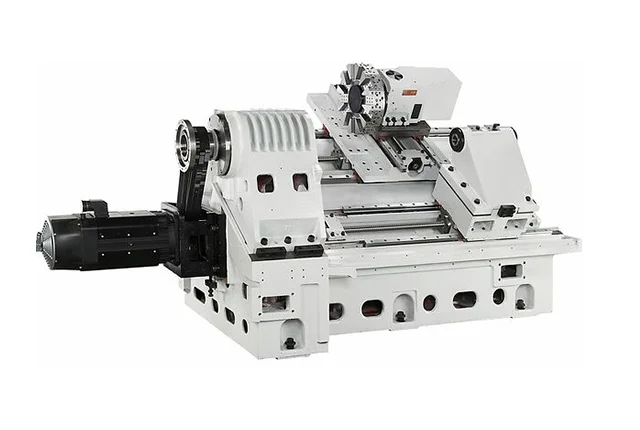
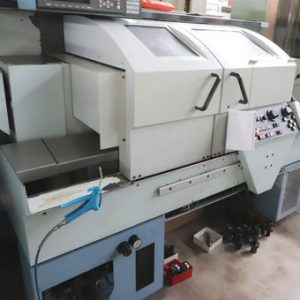
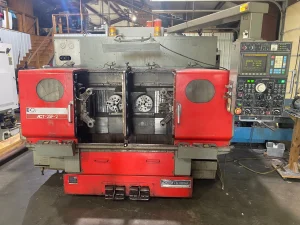
A CNC Inclined Bed Type Horizontal Lathe, also commonly referred to as a Slant Bed CNC Lathe, is a specialized computer numerical control (CNC) machine tool designed for precision turning operations on cylindrical or rotational workpieces. It belongs to the broader category of horizontal lathes, where the main spindle axis is oriented horizontally, but distinguishes itself through its inclined (or slanted) bed structure. The “bed” refers to the foundational casting or frame that supports the machine’s guideways, spindle, and tool carriage. Unlike traditional flat-bed lathes, the inclined bed is tilted at an angle—typically between 30° and 45° relative to the horizontal plane—forming a right-triangular cross-section when viewed from the side. This design enhances structural rigidity, chip management, and overall machining performance, making it ideal for high-volume, precision production in the CNC machine tools sector.In technical terms, this lathe operates on the principle of subtractive manufacturing via rotational machining, where a rotating workpiece is precisely shaped by cutting tools moving along controlled axes. The CNC system (often based on ISO G-code programming) automates multi-axis movements, enabling complex geometries such as threads, grooves, and contours. It is widely used for manufacturing fittings, shafts, gears, and other revolution parts in industries like automotive, aerospace, and metalworking.Structural CharacteristicsThe core innovation of the inclined bed design lies in its mechanical architecture, which addresses limitations of flat-bed lathes in terms of stability and efficiency. Key structural elements include:
- Bed Configuration: The bed is a one-piece cast iron or Meehanite casting, inclined at 30°–45° (with 45° being common for optimal chip flow). This creates an inclined plane for the guide rails, where the two parallel rails intersect the ground plane at the specified angle. From a side view, the bed resembles a right triangle, providing a larger cross-sectional area compared to flat beds of equivalent specifications. This geometry increases the moment of inertia, enhancing resistance to bending (under axial loads) and torsion (from off-center cutting forces). For instance, the bending resistance can be up to 20–30% higher than flat beds due to the wider base support.
- Guideways and Slides: Linear guideways (often VDI or bolted LM guides from manufacturers like Hiwin or THK) are mounted on the inclined bed. The Z-axis (longitudinal, parallel to the spindle) runs along the bed’s length, while the X-axis (radial, perpendicular to the spindle) traverses the slant. This setup allows for longer X-axis travel distances—limited only by the hypotenuse of the triangular bed rather than the horizontal depth of a flat casting—enabling larger swing diameters (up to 400–600 mm in mid-sized models).
- Spindle and Headstock: The horizontal spindle is typically belt- or direct-driven, with speeds ranging from 100–5000 RPM (stepless via inverter control). It supports chucks (hydraulic or pneumatic, e.g., 6–12 inch three-jaw) or collets (e.g., 5C type). The headstock is mounted at the higher end of the inclined bed, ensuring the spindle axis remains horizontal despite the bed tilt.
- Tool Turret and Tailstock: Equipped with a horizontal or vertical turret (8–12 stations, often servo-driven for rapid indexing). High-rigidity turrets minimize deformation during heavy cuts. A programmable hydraulic tailstock provides axial support for long workpieces, with travel up to 200–300 mm.
- Transmission System: Utilizes high-precision ball screws (e.g., C3/C5 grade) for X and Z axes. The inclined orientation aligns the X-axis ball screw such that gravity acts axially along the screw, preloading it and reducing backlash to near zero (often <0.005 mm). This contrasts with flat beds, where gravity acts perpendicularly, requiring additional anti-backlash mechanisms.
- Enclosure and Accessories: Fully enclosed with chip guards, coolant systems (flood or through-tool), and automatic chip conveyors. Thermal management features, such as spindle cooling jackets, minimize thermal expansion (e.g., <0.01 mm/°C drift).
The overall footprint is compact (e.g., 2–3 m in length for a 500 mm swing model), with both inch and metric threading capabilities for global compatibility.Technical Advantages in the CNC SectorIn the CNC machine tools sector, the inclined bed horizontal lathe excels in applications requiring high precision, productivity, and reliability. Its design provides several engineering benefits:
- Enhanced Rigidity and Stability: The triangular bed structure distributes cutting forces (typically 500–2000 N) more evenly, reducing deflection. During beveling or facing, the cutting force vector aligns closely with the workpiece gravity direction (due to the slant), minimizing spindle vibrations and resonance. This enables higher feed rates (up to 20 m/min) and depths of cut (5–10 mm) without chatter, achieving surface finishes of Ra 1.6–3.2 µm.
- Superior Chip Evacuation: Gravity-assisted chip flow down the incline (aided by coolant at 10–20 L/min) prevents accumulation on the tool or workpiece, reducing heat buildup and tool wear. This is critical for mass production, where downtime from chip-related issues can be minimized by 50% compared to flat beds.
- Improved Precision and Backlash Elimination: The slanted X-screw preload under self-weight ensures inherent zero-backlash transmission, improving repeatability to ±0.002–0.005 mm. Positioning accuracy is further enhanced by closed-loop servo systems (e.g., Fanuc or Siemens controls with absolute encoders), supporting tolerances down to IT6–IT7 grades.
- Vibration Damping and Thermal Stability: The larger bed mass and inclined layout dampen vibrations (natural frequency >50 Hz), while separated coolant/chip systems prevent thermal distortion. Measures like spindle oil chillers maintain axis alignment during prolonged runs (e.g., 8–12 hour shifts).
- Versatility for Mass Production: Suitable for batch sizes >100 parts, it handles materials like steel, aluminum, and titanium with operations including turning, boring, threading, and light milling (via live tools). Cycle times are reduced by 20–30% due to faster tool changes (1–2 seconds per station).
Compared to flat-bed lathes (better for heavy, low-speed jobs like large castings), inclined beds dominate modern CNC applications for their automation-friendly design, though they may require more initial investment (e.g., $50,000–$150,000 for mid-range models).Applications in the CNC Machine Tools SectorThese lathes are pivotal in sectors demanding high-throughput precision, such as:
- Automotive and Aerospace: Machining shafts, valves, and fittings with complex profiles.
- General Metalworking: Producing threaded components and revolution parts in series.
- Mold and Tooling: High-accuracy turning for prototypes and production runs.
In summary, the CNC Inclined Bed Type Horizontal Lathe represents an evolution in CNC turning technology, optimizing structural dynamics for superior performance in demanding industrial environments. Its inclined design not only boosts efficiency but also sets a benchmark for precision in the machine tools sector.