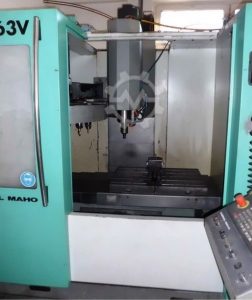
What is CNC 5-Axis Carbide Cermet Ceramic CBN PCD Insert Grinding Machine?

A CNC 5-Axis Carbide/Cermet/Ceramic/CBN/PCD Insert Grinding Machine is a high-precision, multi-axis computer-controlled grinding system designed for manufacturing and re-sharpening indexable cutting inserts used in CNC machine tools and the metalworking industry.
It is one of the most advanced machine types in the cutting tool production sector, capable of grinding extremely hard materials such as carbide, cermet, ceramics, cubic boron nitride (CBN), and polycrystalline diamond (PCD).
Below is a wide, technical, industry-focused explanation.
What the Machine Is (Technical Definition)
A CNC 5-axis insert grinding machine is a grinding center equipped with:
- X axis (in-feed)
- Y axis (oscillation/linear movement)
- Z axis (vertical or cross movement)
- B axis (insert rotation)
- C axis (swivel table or wheel head rotation)
These 5 controlled axes allow the machine to grind complex geometries, chip-breakers, clearance angles, K-lands, and precision edges on cutting inserts.
The machine uses:
- High-speed grinding spindle
- Diamond or CBN wheels
- Linear/rotary encoders
- Automatic dressing systems
- CCD vision inspection or AE acoustic monitoring
- Robotic loading/unloading systems
What It Produces
The machine manufactures indexable inserts used in:
✔ CNC turning (ISO inserts like CNMG, DNMG, TNMG)
✔ CNC milling (APKT, SEKT, LDMT)
✔ CNC grooving/parting
✔ High-precision PCD inserts for aluminum machining
✔ CBN inserts for hardened steels
✔ Ceramic inserts for high-temperature alloys
These inserts are used across automotive, aerospace, mold making, heavy machining, general machining, and medical machining.
Why 5 Axes Are Necessary
Grinding inserts is extremely complex. A single insert typically has:
- Top rake geometry
- Relief clearance angles
- Chamfers / K-lands
- Notches / edge prep
- Secondary edge geometries
- Chip breakers
- Different bevel angles
5-axis control allows:
✓ Precise orientation of insert relative to grinding wheel
The B- and C-axes rotate and tilt the insert for multi-angle grinding.
✓ Simultaneous multi-surface shaping
Allows contouring, profiling, and generating chip-breaker patterns.
✓ Achieving sub-micron accuracy
Essential for carbide and PCD insert edge quality.
✓ Grinding with minimum setup time
Automating complex geometries that used to require several different machines.
What Materials the Machine Handles
1. Carbide
Tungsten carbide is extremely hard (90+ HRA).
Diamond wheels are used.
Applications: steel machining, cast iron, general industry.
2. Cermet
Ceramic + metal blend, used for finishing.
Machine must handle low-heat grinding for best edge finish.
3. Ceramic Inserts
Used for high-temperature alloys (Inconel, aerospace parts).
Requires rigid spindle and stable thermal control.
4. CBN (Cubic Boron Nitride)
Second hardest material after diamond.
Used for hardened steels (55–70 HRC).
5. PCD (Polycrystalline Diamond)
Used for aluminum, copper, composites.
Grinding requires specific EDM or laser edges + fine diamond wheels.
Core Technical Systems Inside the Machine
1. Wheel Spindle
- 5–15 kW grinding motor
- Speeds typically 500–6000 rpm
- For PCD/CBN insert grinding, spindles often run at extremely high rigidity.
2. High-precision linear axes
- Linear motors or ball screws
- Absolute scales for ±1–3 micron positioning
- Smooth grinding feed for edge quality
3. Rotary axes (B/C-axis)
- Direct-drive torque motors
- 0.0001° resolution
- Needed for angular grinding operations
4. Automatic Dressing Device
Maintains diamond wheel sharpness and geometry.
5. Swiveling grinding head
Allows the wheel to attack the insert at multiple angles.
6. Loading/Unloading Robotics
- 6-axis robot arms
- Pallet systems
- Magazine systems
Used for mass production of inserts (thousands per shift).
7. Cooling & Filtration
Critical for carbide and PCD grinding:
- High-pressure coolant system (10–20 bar)
- Oil filtration 1–5 microns
- Temperature-controlled grinding oil
Why It’s Important for the Metalworking Industry
1. Precision Cutting Tools
Insert grinding machines produce the inserts that all CNC shops depend on.
2. High Productivity Manufacturing
- Automotive: turning brake discs, engine parts
- Aerospace: Inconel machining with ceramic inserts
- Die/Mold: carbide inserts for hardened steel turning
3. Reduced Tool Costs
Insert manufacturers and regrinding services decrease tooling costs dramatically.
4. High-Performance Machining
The geometry and finish of a cutting insert determine:
- Surface finish
- Tool life
- Cutting speed
- Chip control
Modern CNC machines rely on precision inserts for high metal-removal rates.
Advantages of CNC 5-Axis Insert Grinding Machines
✓ Extremely High Accuracy
Sub-micron positioning → perfect insert edge sharpness.
✓ Consistency
All inserts from batch 1 to batch 10,000 maintain identical geometry.
✓ Flexible Production
Change programs → switch from turning insert to milling insert quickly.
✓ Works With the Hardest Tooling Materials
Carbide, CBN, ceramic, and PCD require diamond wheels and precision axes.
✓ Automated Mass Production
Ideal for companies producing:
- OEM inserts
- Special inserts
- Form inserts
- PCD/CBN cutting tools
Where These Machines Are Used
✔ Cutting tool manufacturers
Sandvik, Kennametal, Kyocera, ZCC-CT, Korloy, Seco, ISCAR
✔ Custom tool grinding shops
PCD special tool makers
✔ Carbide manufacturing plants
Insert blank production and finishing
✔ CNC machining companies
That regrind or create custom chip breakers and edges
✔ Aerospace & automotive tool suppliers
High-performance insert suppliers
Summary
A CNC 5-Axis Carbide/Cermet/Ceramic/CBN/PCD Insert Grinding Machine is a precision machine tool designed to grind cutting inserts to micron-level accuracy.
It uses diamond wheels and advanced multi-axis motion control to generate complex geometries used in CNC lathes, milling cutters, and metalworking operations.
It is an essential machine for any cutting tool manufacturer serving the carbide tooling, PCD/CBN tooling, and metalworking industry.