CNC Specialist’s Guide: Selecting the Right Used, Surplus, Secondhand, Pre-Owned OKUMA & HOWA 2SP-V80 CNC Twin Spindle Vertical Lathe made in Japan
This is a detailed guide (in English) aimed at helping you evaluate, inspect, and purchase a used, surplus, second-hand or pre-owned Okuma & Howa 2SP-V80 twin-spindle vertical lathe. It assumes you are familiar with CNC machinery but want a systematic checklist, technical overview and key purchase tips to ensure you select the right machine for your operations.
1. Machine overview & key specifications
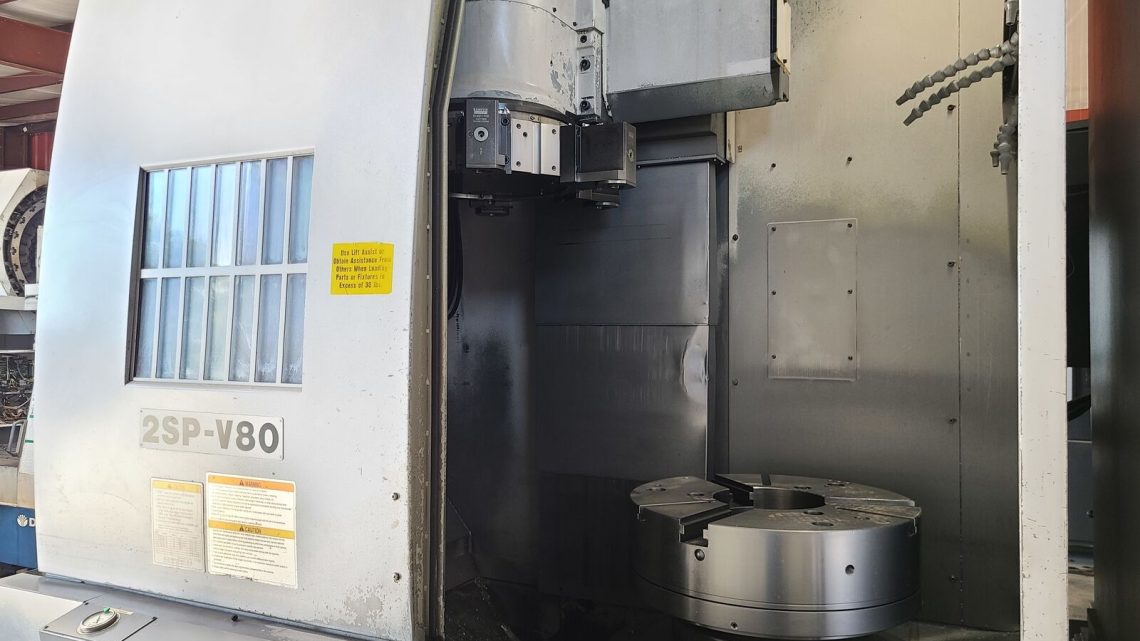
The Okuma & Howa 2SP-V80 is a heavy-duty twin‐spindle (two spindles + two turrets) vertical turning centre (VTL) built in Japan (Okuma + Howa joint machine tooling tradition). It is designed for productivity, rigidity and large part turning for automotive, aerospace or heavy machinery applications.
Key specifications (typical / from used machine listings):
- Max swing: approx. 39.37″ (≈ 1000 mm)
- Max turning diameter/cutting diameter ~31.5″ to 39.9″ (≈ 800 to 1015 mm) depending on chuck setup.
- Max turning length (Z axis) ~33.07″ (≈ 840 mm)
- Spindle speed: 10 – 1,250 RPM (two‐speed gearbox type)
- Spindle motor: ~40 HP (≈ 30 kW) two‐speed gear box version in many units.
- X axis travel: ~18.31″ (≈ 465 mm)
- Z axis travel: ~33.07″ (≈ 840 mm)
- Control: Often Fanuc 18i-TB or equivalent.
- Machine weight: ~50,600 lbs (~22,950 kg) in some listings.
- Physical footprint: e.g., ~116.9″ width × 92.5″ length × 119.6″ height in one spec.
Why this model is a noteworthy pick:
- Twin-spindle + twin-turret means you can do high throughput: one spindle working while the other loads/unloads, or two independent operations.
- Vertical turning centre design offers rigour for large swing diameters, stable cutting, less deflection than horizontal lathe in large part turning.
- Japanese build quality (Okuma/Howa) is well regarded for precision, longevity and service parts availability.
2. Checklist for evaluating used/surplus condition
When buying a used machine of this size and complexity, the condition, service history, and setup matter enormously. Here’s a systematic checklist.
A. Machine documentation & history
- Confirm year of manufacture and machine hours (cutting hours) if available. Some listings show 14,700 hours for one spindle.
- Review service logs: Has the machine had major rebuilds (spindle replacement, gearbox service, control upgrade)?
- Check for previous usage: What material was it cutting (aluminium vs hardened steel)? That impacts wear.
- Ask for previous tooling, chucking history, fixture usage (heavy/unbalanced loads cause extra wear).
B. Spindle / bearing & gearbox condition
- Twin spindles require both be checked: run‐out, noise, bearings.
- Check condition of two‐speed gearbox if fitted: smooth shift between ranges, no excessive backlash.
- Verify RPM range is correct (10-1250 RPM typical) and that both high/low ranges function.
- Check spindle nose (A2-11 in many cases) and condition of chuck mounting, jaw condition.
- Check for excessive axis deflection under load (can test with measuring device).
C. Turrets & tooling capacity
- The 2SP-V80 often has twin turrets (each turret servicing one spindle). Typical: V12 turret 12 station.
- Check turret indexing time, clamping force and tool holder condition.
- Verify tooling size capability (standard turning tool size ~1.25″ × 1.25″; boring bar size ~2.0″ & 2.5″).
- Confirm tool holders and turret tooling compatibility (especially if your tooling is specific).
D. Axes & motion system
- X and Z axis travel as specified (X ~18.31″, Z ~33.07″) for many units.
- Check ball screw condition (diameter, pitch, wear). Some spec list: X ball screw 1.57″/0.47″ dia/pitch, Z 1.97″/0.47″.
- Rapid traverse rates: e.g., 630 IPM in many machines.
- Slide ways: Check wear, lubrication system (some machines have forced oil for ball screws).
E. Control & electronics
- Confirm control type (Fanuc 18i-TB, or upgraded to 31i etc).
- Check all electrical cabinets for cleanliness, rust, smoke damage.
- Original manuals, wiring diagrams, parameter logs are beneficial.
- Ensure the interface suits your shop personnel (is language, backup available, etc).
F. Mechanical & structural condition
- Check machine bed, column, turret supports for cracks or damage. Vertical machine will have significant weight and rigidity – any structural deformation is significant.
- Condition of chucks: hydraulic chucks (3-jaw) appear in some listings (e.g., 24″ Samchully); condition of jaws, hydraulics.
- Chip conveyors, splash guards, doors: twin‐machine means two conveyors/chutes. Rear discharge conveyors are common.
- Coolant system, hydraulic system, filtration: check tanks, pumps, pipes for leaks, contamination.
G. Installation / space / utilities
- This machine is large (weight ~22-25 tons). Floor loading, crane capacity, rigging, transport need to be assessed.
- Power requirement: e.g., 85 kVA multi‐tap transformer mentioned in one spec.
- Floor footprint: e.g., ~117″ x 108″ (≈ 3m x 2.75m) for one machine. Height ~160″ (≈ 4.06 m). Plans must account for clearance and overhead cranes.
- Bed anchoring and leveling: ensure previous owner has proper leveling bolts, base plates etc.
H. Consumable parts & future serviceability
- Check availability of spare parts (bearings, belts, chips conveyor chains, hydraulics). Japanese machines usually have good parts support but ensure vendor/distributor for your region.
- Check tooling compatibility: Are your existing chucks and tool holders compatible or will you need adapters?
- Confirm service support for control (Fanuc/Okuma) in your region.
3. Key decision-factors for your purchase
Here are the strategic considerations you should weigh before acquiring this machine.
- Match machine capacity to your production needs. If you’re running large swing parts (~1000mm diameter) and need dual spindle throughput, the 2SP-V80 is a high-capacity option. If your parts are much smaller, you may be over-spec’ing (and paying more, needing more floor space/power).
- Balance price vs remaining life. Used machines may have many hours; check spindle bearings condition, turrets, and major wear items. A lower-hour machine (or recently rebuilt) may cost more but save in long-term maintenance.
- Spare parts & maintenance cost. Consider total cost of ownership: older machine may require more service, may have harder parts to source.
- Flexibility vs dedicated production. Twin spindle/twin turret machines like this are excellent for high-volume, repeat parts with minimal changeover. If you do many small runs, maybe a simpler machine makes more sense.
- Installation cost & infrastructure. Floor reinforcement, crane/rigging cost, power supply, chip handling/automation all add up.
- Resale value. Okuma/Howa have good reputation; ensure you can resell or repurpose the machine if your production changes.
4. Practical inspection & test run checklist
Before purchase, run the machine (if possible) under power, preferably with a representative test piece. Use this operational checklist:
- Run both spindles under no‐load, then under moderate load: listen for unusual noise, vibration.
- With full chuck and fixture in place, check spindle run‐out (e.g., with indicator). Should be within spec (often < ≈0.003″ for these machines).
- Run turrets: index each station, check tool clamping, positioning accuracy, vibration.
- Execute full axis travel: X and Z moves, rapid traverse, feedrates as rated (e.g., 630 IPM).
- Check for backlash in X/Z axes.
- Verify chuck clamping (open/close), direction change cylinder, proximity switch for open/close. These features are listed in spec.
- Test coolant/hydraulic systems: coolant pressure (spec mentions high pressure coolant 57 psi).
- Check chip conveyor(s): twin rear discharge models often; verify operation of each.
- Inspect electrical cabinet: look for burned components, proper labelling, clean wiring.
- Get temperature readings during test run (bed, spindle, motor) to detect overheating.
- Check tooling changeover times and turret indexing (spec ~0.7 sec).
- Verify machine leveling and anchoring: ask for laser‐alignment/leveling report if possible.
- Confirm documentation: operator manuals, wiring diagrams, parts lists, previous maintenance log.
5. Purchase negotiation tips
- Negotiate based on known wear items: spindle bearings, gearbox service, chuck refurbishment.
- Request a “power‐on” inspection with you or a trusted technician.
- Ask for historical cutting hours, type of materials cut (e.g., aluminium vs hardened steel) — harder materials wear machine faster.
- Include clauses: e.g., machine to be in running order at time of shipment, or discount if major service is required post-purchase.
- Consider cost of removal, shipping, re‐installation, training of your staff on this machine.
- Budget for re‐commissioning: leveling/reference, calibrations, safety door interlocks update if needed.
- Verify warranty on major components if vendor offers one (rebuilt spindle gearboxes etc).
- Ensure there are no hidden damages (floor anchor damage, misaligned bed, missing parts).
- Evaluate alternate machines (maybe newer or simpler) to ensure you are getting best value.
6. Fit for your application
Given your second‐hand machinery platform and likely resale use case (selling to heavy industrial buyers), here’s how to evaluate fit:
- If you are buying this machine for resale: ensure you can refurbish and present it with full specs, run-test and a documented condition report.
- If your buyers are machining large diameter heavy parts (automotive, aerospace, heavy machinery) then the 2SP-V80 is very aligned; your value‐add might be refurbish, load with fixtures/chucks and market it to high‐end shops.
- If your buyer base is smaller shops or job-shops with lower swing requirements, you might need to highlight the machine’s flexibility (twin spindle, twin turret) but also acknowledge floor/power/handling cost.
- Consider local transport to your region (EU) and compatibility with local voltage/frequency, spare parts shipping, service network.
7. Summary
In summary, the Okuma & Howa 2SP-V80 is a mature, high-capacity twin‐spindle vertical turning centre, ideal for serious industrial turning applications. When purchasing used, success depends on careful inspection, matching machine capacity to your needs, verifying major components (spindle, turret, axes), and accounting for installation/maintenance costs.