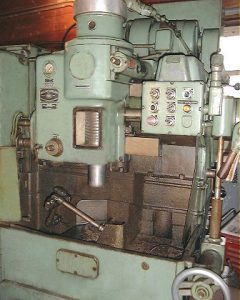
What is Accumulator Head Blow Molder Machine?

An Accumulator Head Blow Molder Machine (also known as an Accumulator Head Extrusion Blow Molding Machine) is a specialized type of intermittent extrusion blow molding equipment used in the plastics manufacturing industry. It is designed primarily for producing large-volume, hollow plastic products with high precision and efficiency, such as industrial containers, drums, fuel tanks, automotive parts, and large bottles (typically ranging from 20L to 120L or more in capacity). Unlike continuous extrusion blow molders, which extrude parison (the molten plastic tube) steadily, the accumulator head design allows for the accumulation and rapid discharge of molten plastic in batches, making it ideal for handling high-viscosity materials like high-density polyethylene (HDPE) and polypropylene (PP) in demanding, high-throughput applications.This machine operates on the principles of extrusion blow molding, where plastic resin is melted, formed into a parison, inflated inside a mold using compressed air, cooled, and then ejected as a finished hollow part. The “accumulator head” is the core innovation that differentiates it from other blow molders, enabling independent control over extrusion speed and cycle time, which results in better wall thickness distribution, reduced material waste, and the ability to produce complex or heavy-duty parts.Technical Working PrincipleThe accumulator head blow molder functions through a multi-stage process that integrates extrusion, accumulation, parison formation, blowing, and molding. Here’s a step-by-step technical breakdown:
- Material Preparation and Melting (Extrusion Stage):
- Plastic pellets (e.g., HDPE, PP, or other thermoplastics) are fed into a single-screw or twin-screw extruder. The extruder uses a rotating screw within a heated barrel to melt and homogenize the resin through shear heat and external heating bands (typically maintaining temperatures between 180–250°C, depending on the material).
- The molten polymer is pressurized (up to 100–200 bar) and continuously fed into the accumulator head at a controlled rate. This stage is adiabatic and high-efficiency in modern designs, minimizing energy loss and ensuring uniform melt flow. For instance, extruders in these machines often achieve throughputs of 100–500 kg/h, with energy consumption as low as 0.29 kWh/kg of HDPE per Euromap 46.1 standards.
- Accumulation in the Head:
- The accumulator head is a piston-cylinder assembly (or multiple pistons for multi-layer or multi-head configurations) attached to the extruder die. It acts as a surge chamber or reservoir, storing a precise volume of molten plastic (up to 12–15 kg per shot in typical models).
- As the extruder delivers molten material, a piston retracts within the cylinder, accumulating the parison material under controlled pressure. This decoupling allows the extruder to operate continuously at optimal speed, independent of the molding cycle, preventing sagging or uneven flow in large parisons.
- The head design often incorporates overlapping heart-shaped melt distributors or spiral channels (e.g., four-helix configurations) to ensure laminar flow, minimize weld lines, and reduce residual stress in the parison. This is crucial for maintaining material integrity in large parts. Variable speed hydraulic or electric drives control the piston’s movement, with advanced software for parison programming (e.g., 100-point thickness profiling) to adjust wall thickness dynamically.
- Parison Extrusion and Formation:
- Once the accumulator is filled to the required volume, the piston rapidly advances (in a shot-like manner, similar to injection molding), extruding the entire parison in a single, fast burst (typically 1–5 seconds). This intermittent extrusion allows for precise control over parison length and diameter (up to 500–1000 mm for large parts).
- A blow pin or manipulator arm positions the parison into the open mold cavity. In some designs, the extruder itself reciprocates backward and forward, mimicking an injection molder for alignment. For multi-layer products, co-extrusion heads can layer materials (e.g., barrier layers for chemical resistance).
- Blowing and Molding:
- The mold (clamped by a hydraulic or toggle mechanism with forces up to 50–100 tons) closes around the parison. Compressed air (20–40 bar) is injected through a blow pin, inflating the parison to conform to the mold’s internal contours. This expands the material radially, forming the hollow shape.
- Internal Blow Control (IBC) or parison sag compensation systems may be integrated to fine-tune thickness. Cooling channels in the mold circulate water or air to solidify the part (cycle times: 1–5 minutes for large parts).
- Ejection and Finishing:
- After cooling, the mold opens, and the part is ejected using robotic arms or manipulators. Excess material (flash) is trimmed, and the part may undergo secondary operations like leak testing or assembly.
- The cycle repeats, with the accumulator refilling during the blowing phase, ensuring high efficiency (up to 90–95% uptime).
Key technical parameters include:
- Head Capacity: 5–20 kg/shot.
- Clamp Force: 20–150 tons.
- Extruder Screw Diameter: 60–120 mm.
- Power Consumption: Optimized via variable-speed pumps and nitrogen accumulators for clamping, reducing energy by 20–30% compared to older models.
- Configurations: Single-station, double-station, single-head, or multi-head (up to 4–6 heads for parallel production).
Key Components and Design Features
- Accumulator Head: The heart of the machine; a hydraulic piston system with melt channels for uniform distribution. Proprietary designs (e.g., from Graham Engineering’s Hercules series) allow for quick color/material changes (as little as 1 hour) and processing of diverse resins.
- Extruder: High-efficiency adiabatic type with low shear for minimal degradation.
- Clamping Unit: Symmetric, closed-frame with double tie-bars; uses proportional valves for precise, high-speed movements.
- Controls: PLC-based with HMI interfaces, supporting data logging, trend monitoring, and automation (e.g., integration with Industry 4.0 for predictive maintenance).
- Safety and Efficiency Features: Hydraulically controlled blow pins with cooling circulation; energy-saving designs like variable-frequency drives.
Advantages and ApplicationsTechnically, this machine excels in producing large, heavy-walled parts with consistent quality due to the rapid parison discharge, which prevents gravitational sagging and enables precise thickness control. It supports mono-layer or multi-layer (up to 5–7 layers) constructions for enhanced properties like UV resistance or barrier performance. Applications include:
- Industrial packaging (drums, IBC totes).
- Automotive (fuel tanks, air ducts).
- Consumer goods (kayaks, playground equipment, trash cans).
- Technical parts (double-wall panels, filtration housings).
Compared to reciprocating screw machines (another intermittent type), accumulator heads offer higher shot volumes and better suitability for very large parts, though they may require more maintenance for the piston seals.In summary, the accumulator head blow molder represents a mature, high-capacity technology in plastics processing, continually evolving with electric drives and smart controls for sustainability and precision