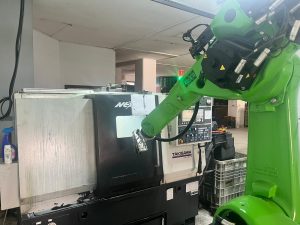
What Is a Crankshaft Internal CNC Milling Machine?

A Technical Explanation for the Metalworking and Engine Component Manufacturing Industry
1. Definition and Core Function
A Crankshaft Internal CNC Milling Machine is a high-precision, computer-controlled machine tool specifically designed to mill the internal crankpin and main journal surfaces of a crankshaft — one of the most critical rotating components in engines, compressors, and heavy machinery.
Unlike external crankshaft milling machines (which cut from the outside radius of the crank arm), internal crankshaft milling machines use a cutter inserted between the crank webs. This allows machining of inner crankpin journals from the inside of the crank throw with superior accuracy, surface finish, and cycle efficiency.
The goal:
✅ Mill each crankpin and main journal to micron-level accuracy in geometry and surface quality,
✅ Ensure perfect phase, angular position, and center offset of all crank throws,
✅ Maintain balance and dimensional stability even under large cutting loads.
2. Crankshaft Geometry Background
A crankshaft converts reciprocating motion (from pistons) into rotational motion.
It consists of:
- Main journals – support points rotating in main bearings,
- Crankpins (rod journals) – offset surfaces where connecting rods attach,
- Webs (arms) – connect mains and pins, forming the crank throw.
The offset (E) between main and pin determines the stroke and displacement of the engine. Machining these features demands eccentric precision — every crankpin lies on a different axis parallel to the main centerline.
That’s why specialized multi-axis synchronized CNC systems are used instead of standard machining centers.
3. Machine Construction and Components
A Crankshaft Internal CNC Milling Machine (such as the KOMATSU GPM-series) typically consists of the following main assemblies:
| Component | Technical Function |
|---|---|
| Base & Column | Heavy cast-iron or polymer concrete structure ensuring vibration damping and rigidity. |
| Spindle Units | 1 or 2 synchronized spindles, each carrying a circular cutter with replaceable carbide or cermet inserts. |
| Internal Cutter System | Cutter passes between crank webs, removing material from crankpins and journals internally. |
| Workholding / Fixtures | Crankshaft held between centers or chucks, sometimes with hydraulic or servo-driven indexing. |
| X / Y / Z Linear Axes | Enable precise positioning and depth control; axis synchronization ensures accurate eccentric cutting. |
| C-Axis (Rotation) | Rotates the crankshaft or cutter to correct angular positions of crank throws. |
| Coolant & Chip Removal System | Delivers high-pressure coolant directly to the cutting zone and evacuates heavy steel chips efficiently. |
| CNC Control Unit | Typically FANUC, Siemens, or proprietary Komatsu NTC system; manages multi-axis interpolation, feed rates, and tool compensation. |
4. Cutting Principle — Internal Milling Process
In internal milling, the cutter head (Φ150–330 mm) enters between two crank webs and mills the crankpin journal from the inside.
Key Process Characteristics:
- The workpiece (crankshaft) rotates slowly, while the cutter head rotates at high speed.
- The tool’s circular motion generates the journal’s cylindrical surface.
- Tool engagement is controlled by precise servo axes to maintain the exact offset (eccentricity).
- Both crankpin and main journals can be machined in one clamping with multiple synchronized spindles.
- The process uses indexing or continuous interpolation to move between throws.
- Feed rates and depth of cut are CNC-controlled for each crank throw.
- Machines often use multi-edge inserts (up to 8 corners per insert) to optimize cost and productivity.
This internal cutting method achieves superior roundness, concentricity, and surface finish compared to external milling or turning.
5. Technical Performance Highlights
| Parameter | Typical Range (KOMATSU GPM-series) |
|---|---|
| Workpiece length | 450 – 1,500 mm |
| Swing diameter | 145 – 320 mm |
| Machining capacity (E-d/2) | 25 – 45 mm |
| Spindle speed | Up to 6,000 rpm |
| Number of spindles | 1–2 |
| Cutter inner diameter | Φ150 – Φ330 mm |
| Accuracy | Roundness ≤ 5 µm, Journal spacing tolerance ≤ 10 µm |
| Surface roughness | Ra ≤ 0.8 µm (after milling) |
| Cycle time | 30 – 60 seconds per throw (depending on size) |
6. Industrial Applications
- Automotive crankshafts — passenger cars, trucks, motorcycles
- Marine and locomotive engines
- Compressor crankshafts
- Industrial diesel and gas engines
- Heavy-duty hydraulic pumps
Manufacturers such as Komatsu NTC, Toyota Machine Works, Nagase, Nissin, and Takisawa supply such specialized crankshaft production systems.
7. Advantages in Modern Manufacturing
✅ High Precision: Maintains exact crank throw eccentricity and phase alignment.
✅ Cycle Time Reduction: Two-spindle simultaneous cutting dramatically increases throughput.
✅ Rigidity and Tool Life: Heavy structure and optimized cutter design reduce vibration.
✅ Consistency: CNC automation ensures repeatable accuracy across thousands of parts.
✅ Integration Ready: Machines can be connected to robotic loaders, conveyors, and in-line gauging systems for mass production.
✅ Energy Efficiency: Internal milling removes less material per throw compared to traditional external turning.
8. Comparison: Internal vs External Crankshaft Milling
| Feature | Internal Milling | External Milling |
|---|---|---|
| Cutter position | Between crank webs (internal) | Outside crank arm (external) |
| Machining area | Crankpins and main journals | Outer surfaces and radii |
| Tool type | Internal ring cutter | End mill / disc cutter |
| Accuracy | Higher on journals | Moderate |
| Accessibility | Limited space, requires precise cutter design | Easier access |
| Application | Automotive, precision crankshafts | Large marine or industrial crankshafts |
9. Maintenance and Calibration Focus
When operating or purchasing a used internal crankshaft milling machine:
- Check spindle bearings and alignment for runout and heat deformation.
- Verify CNC axis synchronization (especially for eccentric phase movement).
- Inspect tooling arbor and cutter balancing.
- Confirm hydraulic and lubrication systems are leak-free.
- Calibrate rotary encoder and C-axis for accurate phase indexing.
- Check backlash compensation on feed axes (critical for journal roundness).
10. Future Trends
Modern internal crankshaft milling machines are evolving with:
- Digital twin simulation for toolpath optimization,
- Automatic adaptive feed control based on cutting load sensors,
- In-process measurement systems (laser or contact probes),
- Hybrid machining (milling + grinding in one setup),
- Integration with Industry 4.0 manufacturing cells.
In Summary
A Crankshaft Internal CNC Milling Machine is a purpose-built, ultra-rigid, precision tool engineered to machine the heart of an engine — the crankshaft — from the inside.
Its internal cutter system, multi-axis CNC synchronization, and high rigidity structure allow the production of crankshafts that meet the world’s tightest tolerances for power, efficiency, and reliability.