10/11/2025
What Industry Experts Recommend Before Purchasing a Pre-Owned, Second-Hand, Surplus, Used OKUMA LB 300 MY CNC Turning Center made in Japan?
Here’s the expert-recommended checklist for evaluating a Pre-Owned, Second-Hand, Surplus, or Used OKUMA LB 300 MY CNC Turning Center (Made in Japan).
1. Machine History & Usage
- Verify operating hours — both power-on and cutting hours. Cutting hours show true wear.
- Ask for maintenance and service logs — look for spindle rebuilds, servo replacements, or drive repairs.
- Confirm previous applications — light aluminum turning is different from heavy steel or cast-iron duty.
- Crash history — even a single crash can cause hidden geometric damage (spindle or turret misalignment).
- General condition — check cleanliness, rust, coolant leaks, missing covers, and any evidence of neglect.
2. Mechanical Condition
- Spindle bearings: Run at low, mid, and max rpm; listen for noise or vibration.
- Axis movement (X/Z): Jog each axis through full travel; check for smooth motion, no knocking or backlash.
- Turret & live tooling: Indexing must be accurate and smooth; confirm all stations engage properly.
- Ball screws & guideways: Inspect for scoring or uneven wear.
- Tailstock (if equipped): Check quill alignment and free travel.
- Hydraulics & lubrication: Ensure pumps, lines, and pressure levels are functional and leak-free.
3. CNC Control & Electronics
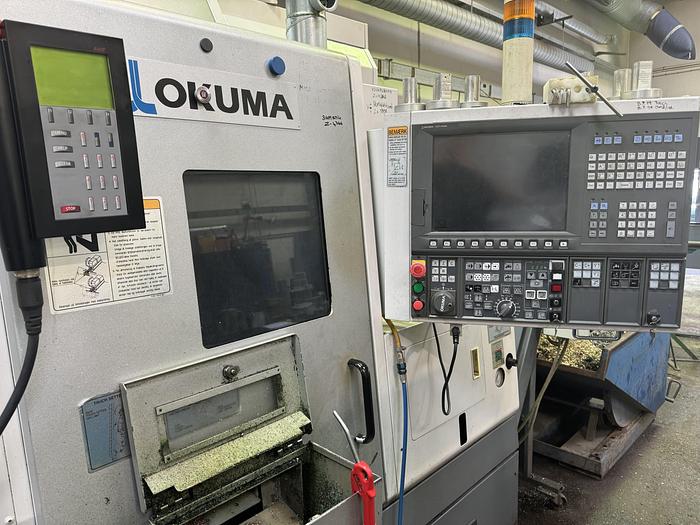
- Control type: Confirm which version of Okuma OSP control is installed; note software version.
- Operational status: All axes home correctly, no alarms, fans running quietly, and screen fully functional.
- Parameter backups: Ensure copies of system parameters, ladder, and part programs exist.
- Electrical cabinet: Clean interior, cooling fans running, and wiring properly labeled.
- Compatibility: Verify connection to your CAM or DNC network and check RS-232/Ethernet ports.
- Spare parts support: Check availability of boards, drives, encoders, and motors for that generation.
4. Accuracy, Precision & Test Run
- Alignment: Verify spindle centerline alignment and turret indexing accuracy.
- Test cut: If possible, perform a roundness/taper test on a sample part and measure repeatability.
- Axis backlash: Measure with a dial indicator; excessive backlash means worn ball screws or couplings.
- Thermal stability: Observe performance after the machine warms up — some wear shows only when hot.
5. Options, Tooling & Attachments
- Y-axis functionality: Confirm travel accuracy and servo smoothness (this is critical on LB 300 MY).
- Live-tool spindle: Test speed range, torque response, and noise level.
- Sub-spindle (if equipped): Check alignment and chuck actuation.
- Chip conveyor & coolant system: Verify operation and coolant pressure.
- Included tooling: List holders, collets, and special attachments — missing tooling adds hidden cost.
6. Infrastructure Compatibility
- Power supply: Match voltage and phase to your shop’s system (Okuma often uses 200 V 3-phase).
- Footprint & weight: Confirm floor loading and space for maintenance access.
- Foundation: Check if anchor bolts or leveling pads are required.
- Air & coolant requirements: Make sure your compressor and coolant filtration meet OEM specs.
7. Cost, Warranty & Documentation
- Total cost of ownership: Include transport, customs, rigging, installation, and training.
- Warranty: Some reputable dealers offer 30- to 90-day function guarantees — highly desirable.
- Documentation: Must include electrical schematics, operator manual, and maintenance records.
- Dealer reputation: Prefer sellers with verifiable references and after-sales support.
8. Japan-Built OKUMA LB 300 MY Specific Notes
- Build quality: Made in Japan Okuma machines are extremely rigid; check that rigidity hasn’t been compromised by crashes or poor maintenance.
- Control reliability: OSP controls are durable but should have battery-backed memory and current software versions.
- Parts sourcing: Okuma has global support, but confirm local Turkish or EU spare parts access.
- Resale value: The LB 300 MY holds strong resale value when properly maintained and documented.
Summary Recommendation
Before buying a used OKUMA LB 300 MY, always:
- Inspect the machine under power.
- Verify spindle health and axis smoothness.
- Obtain maintenance and crash history.
- Confirm control system functionality and backups.
- Perform a test cut or hire an independent inspector for precision verification.