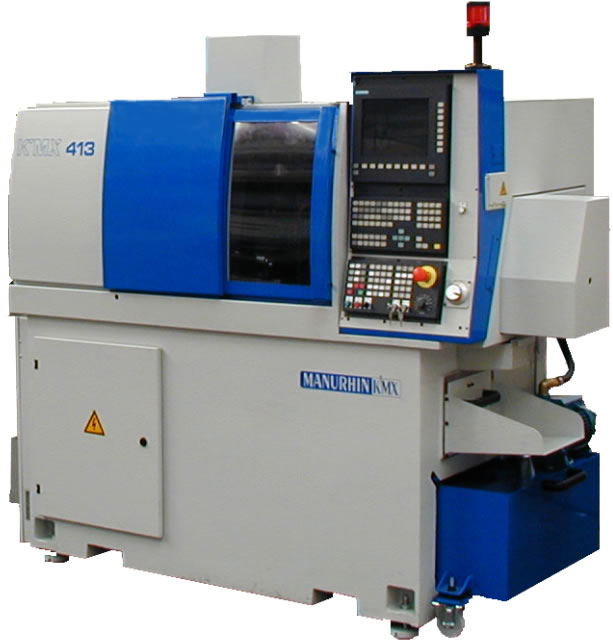
What Industry Experts Recommend Before Purchasing a Pre-Owned, Second-Hand, Surplus, Used Manurhin K’MX 413 CNC Swiss Lathe made in France
Here’s a detailed, expert-level guide / checklist you can use when evaluating a used / surplus Manurhin K’MX 413 CNC Swiss / sliding-head lathe (France / Swiss origin, Manurhin K’MX series). Because Swiss / sliding-head machines are precision machines with many interacting subsystems, defects or hidden wear can be costly. Use this as due diligence and bring along a seasoned technician with metrology tools.
What We Know About the Manurhin K’MX 413 — Reference Specs & Design Clues
Knowing the “nominal” specs helps you detect misrepresentation and spot overuse or modification. These are drawn from manufacturer and dealer sources:
- The Manurhin K’MX 413 is a sliding / Swiss-type machine designed for bar machining.
- Bar capacity: Ø 13 mm (standard), and optionally up to Ø 16 mm in prepared condition.
- Maximum spindle speed: 12,000 rpm on both main and counter / sub-spindle, in typical configurations.
- Spindle motor / electrospindle power: around 3.7 kW (100 % duty) / 5.5 kW (30 min rating) for main spindle.
- Spindle stroke (Z travel in headstock): ~ 130 mm.
- It is a dual-spindle (main + counter / sub-spindle) machine, enabling front ejection or backworking in many configurations.
- Tooling: in many machines, there are driven tools (live tools), fixed tools, C-axis capability, axial tool capability, etc.
- Machine configuration: often 4 linear axes (X1, Y1, Z1, Z2) + 2 rotary axes (C1, C2).
- The machine is purpose-built for high precision small-diameter parts, so geometric stability, tool interface integrity, and minimal backlash are essential.
Because these are “premium precision machines,” any deviation from specification or signs of abuse or neglect should weigh heavily in your evaluation and price negotiation.
Expert Checklist / Due Diligence for a Used K’MX 413
Below is a structured, staged inspection plan (pre-screening through load testing) to help reveal hidden issues, quantify wear, and assess risk.
| Stage | What to Inspect / Test | Why It Matters / Risk | How to Do It / Indicators / Acceptable Behavior |
|---|---|---|---|
| Pre-Visit / Documentation & Vendor Screening | • Ask for serial number, manufacturing year, and variant (K’MX 413) • Request maintenance / repair logs (spindle rebuilds, guide bushing replacements, tool holder repairs) • Ask for actual hours / cycles (power-on hours vs cutting hours) • Request videos / photos showing sliding head, sub-spindle, tool changes, axis motion • Ask which tooling, collets, live tools, fixtures, spare parts are included • Confirm utilities: power supply, coolant, compressed air, chip removal, filtration • Ask if the machine has been relocated or installed / reinstalled (alignment or damage risk) | Many problems originate from hidden modifications, repair history, or poor reinstallation. Having this background helps you validate or question what you’ll see in person. | Compare the vendor’s spec sheet vs what you find. Ask for a “motion test video” before traveling. Ensure the serial plate and documentation match. |
| Visual & Structural / Static Inspection | • Inspect castings (bed, headstock, carriage, cross slides) for cracks, welds, distortions • Check the sliding headstock beam and guide surfaces for damage, chipped edges, corrosion • Examine way covers, bellows, protective covers for damage, gaps, missing sections • Inspect guide bushing / guide block for signs of wear, misalignment, looseness • Inspect spindle nose, collet interface, taper surfaces for wear, damage, burrs • Inspect sub-spindle, pick-up spindle, coupling surfaces, alignment surfaces • Inspect pneumatic / hydraulic lines for leaks, abrasion, aging • Open electrical / control enclosures (if allowed) and look for burnt wiring, discoloration, chips, poor repairs • Check machine leveling / base: verify no loosened base bolts, no shifting, no reaction movement | Structural damage or misalignment at this level can degrade accuracy or require expensive rework. Missing covers or seals will accelerate the wear of internal components. | Use strong lighting, mirrors, small borescopes. Try rocking the machine base to see if loose. Photograph every suspicious area. Check that covers are complete and correctly installed. |
| Motion / Axis Tests (No Load / Jog Mode) | • Power up and jog each axis slowly (X1, Y1, Z1, Z2, sub-spindle) in both directions — detect smoothness, sticking zones, jerks • Perform small back-and-forth moves to detect backlash / lost motion • Execute repeated homing / reference cycles to test repeatability of zero return • Move axes toward travel limits and test limit switches or soft limits • Run the main spindle from low to moderate rpm and listen for noise, vibration • After spinning, test radial / axial play of spindle (via test bar / lever) • Extend / retract sliding head (if applicable) to verify smoothness without binding • If machine has tool turret or driven tools, cycle them to see if they behave smoothly | Any binding, rough zones, backlash, or nonrepeatability suggest wear or misalignment in screws, guides, bearings, or couplings. | Use dial indicator on test bar, sweep axes, repeat several cycles. Measure backlash magnitude. Note if specific zones feel sticky or rough. |
| Tooling, Interfaces & Live Tools | • Inspect collets, tool holders, tool interface surfaces for wear, scoring, burrs • Inspect drive spindles (driven tools) — spin them, listen for noise, check vibration • Check tool change / locking mechanisms for correctness and wear • If there is internal coolant / through-tool, test sealing and flow • Check the sub-spindle / pickup spindle’s interface (grip, alignment, coupling) | Tool interface wear or driven spindle defects degrade surface finish, increase run-out, reduce achievable precision | Mount a round test mandrel, check run-out, toggle tools through cycles. Inspect interface surfaces under magnification. |
| Control, Electronics & Wiring | • Boot the CNC control, check alarm / fault history • Test the control interface (keys, jog keys, soft keys, display) • Navigate through parameter menus, offsets, compensation, tool tables • Verify I/O diagnostics: tool clamp sensors, home sensors, axis feedback signals • Inspect internal wiring: check for cable chafing, burnt insulation, poor splices • Inspect servo drives, amplifiers, power modules, boards for overheating, discoloration, component damage • Ask to back up CNC parameters, tool tables, offsets | Even a well-mechanical lathe is compromised if the control or electronics are failing or unsupported. Poor wiring or workmanship is a red flag. | Request a dry program run, modify a parameter, see error response. Look for bulging capacitors, scorch marks, dirty boards. |
| Test Machining / Load Cuts | • Bring representative bar stock and run actual machining cycles (turning, drilling, milling, etc.) • Measure produced parts (diameter, tolerance, concentricity, surface finish) • Run multiple cycles to detect drift or variation • Machine at different positions in bar / different bar lengths • Use sub-spindle / backworking if available and test that path • Monitor spindle load, vibration, anomalies (chatter, torque fluctuation) • After extended runs, re-measure parts to check for drift or thermal effects | Real machining under load reveals defects in stiffness, backlash, thermal stability, resonance, or drive issues that no “dry test” catches | Use calibrated measurement tools (micrometers, CMM, gauge blocks). Run say 50 or more cycles continuously. Compare results across time and position. |
| Geometric / Metrology / Precision Checks | • Check spindle run-out radially and axially (with test bar and dial indicator) • Verify alignment of sliding head axis vs tool axes (squareness, perpendicularity) • Measure backlash quantitatively on all axes • Sweep a precision surface / test point across motions to detect nonlinearity, twist, or sag • After thermal stabilization (warm-up), repeat key measurement to detect drift • Check flatness / leveling of base, verify no tilt or distortion | These measurements produce quantifiable “error maps” you can compare to your tolerance budget. Significant deviations may render the machine unusable for your parts. | Use precision instrumentation, repeat tests multiple times, record and analyze trends. |
| Auxiliary Systems, Lubrication & Consumables | • Inspect coolant / lubrication systems: pumps, filters, tanks, lines for leaks, contamination • Run coolant / lubrication systems and check flow, pressure, consistency • Inspect chip guards, protective covers, chip evacuation paths • Check pneumatic / hydraulic circuits (clamps, slides) for leaks, pressure consistency • Evaluate condition of seals, hoses, gaskets • Ask about spare parts (filters, seals, hoses, sensors) | Auxiliary systems are often neglected — failures here cause collateral damage and degrade reliability | Run coolant pump, gauge flows, check for leaks, cycle clamping systems and check for consistent behavior |
| Risk Assessment, Repair Estimate & Negotiation | • Capture all deviations, wear items, parts needing repair or replacement • Research availability of spare parts (especially for Manurhin / K’MX series, control modules, spindles, drive electronics) • Estimate refurbishment cost: re-grinding / aligning guides, spindle bearing overhaul, control repairs • Factor in rigging, transport, reinstallation, leveling, calibration costs • Use your “punch list” of defects as negotiation levers rather than a fixed discount • Where possible, try to negotiate a short acceptance period or partial warranty, especially on spindles, axes, and alignment | The stronger your documented defect issues, the more justified your price adjustment will be. Without this, buyers often overpay for machines that require major rehab. | Prepare a defect cost spreadsheet, compare with quotes for refurb / alignment, use that to push for a fair price or fallback |
| Documentation & Transfer / Title | • Ensure transfer of original manuals: mechanical, electrical, control parameters, parts lists • Confirm the machine’s serial / ID plate matches internal / documentation references • Get backups of CNC parameter sets, offsets, tool tables, calibration data • Ensure that tooling, fixtures, spare parts (collets, live tools, bushings) are formally transferred • Have a formal purchase agreement that specifies condition, acceptance period, defects, warranty (if any) | Lack of documentation is a major disadvantage — you want the machine’s “soul” (parameters, offsets, history) along with it | Cross-check serial numbers, confirm that all attachments are included, and get digital backups of CNC data and wiring diagrams |
Specific Risks & Red Flags for Swiss / Sliding-Head Lathes (Especially Manurhin K’MX Systems)
Because of the special nature of Swiss-type / sliding-head lathes, certain failure modes are especially damaging or costly. Be extra vigilant about these:
- Guide Bushing Wear or Misalignment
The guide bushing is central to quality: wear, looseness, or misalignment here reduces concentricity, increases vibration, and degrades finish. - Bar Feed / Feeding Slippage Under Load
Even slight slippage or inaccuracy in the bar feed system (especially under turning load) leads to length errors or scrap. - Spindle Bearing, Imbalance, or Run-Out Issues
Because speeds are high, bearing degradation or spindle defects have outsized impacts on part quality and tool life. - Synchronism between Slide Motion & Bar Feed
Sliding head mechanisms must coordinate motion (slide + feed) precisely. Any lag, backlash, or mismatch can cause over- or under-cutting. - Thermal Drift
Tight tolerances may shift as the machine temperature changes. If accuracy varies over a cycle, that’s a warning. - Control / Electronics Obsolescence or Customization
If the machine’s control or electronics are rare, obsolete, or heavily customized, sourcing spares or maintaining the system may be risky. - Chip / Coolant Ingress due to Missing Seals or Covers
Missing or damaged seals, covers, or bellows allow chips and coolant to invade motion areas, accelerating wear. - Hidden Modifications / Non-OEM Retrofitting
Swiss lathes are often retrofitted in the field; modifications that are poorly done can create long-term reliability problems. - High Cumulative Use or Harsh Operating History
A machine used heavily or constantly (especially in abrasive or tough materials) may have wear beyond what superficial inspection reveals. - Refusing Motion Tests, Tool Trials, or Internal Inspection
A seller who does not permit full axis tests, live machining, or opening enclosures for inspection is a major red flag; such restrictions often hide serious defects.