What Industry Experts Recommend Before Purchasing a Pre-Owned, Second-Hand, Surplus, Used CHIA LERN CH-CM01-5 CNC Carbide Cut-Off Machine made in Taiwan
Here is an expert-level due-diligence / inspection guide you can use when considering a used / surplus CHIA LERN CH-CM01-5 CNC Carbide Cut-Off Machine (or equivalent carbide cut-off / bar cutting machine). Because it’s a specialized machine (cutting hard materials like carbide, with fine tolerances), you must scrutinize mechanical, control, tooling, and auxiliary systems carefully. I’ll also include some specifics I discovered about this model to tailor the checklist.
What we know about CHIA LERN CH-CM01-5
These details will help you set expectations, spot mismatches, and form your inspection plan:
- The CH-CM01-5 is intended for automatic cut-off of carbide and high-speed steel (HSSE) bars.
- Its stated tolerance on length is ±0.05 mm.
- The cut-off diameter range is Ø1.4 mm up to about Ø35 mm (some sources say up to Ø40 mm)
- Length range for bars is ~80 mm to 400 mm for standard configuration.
- Its machine footprint is about 2000 × 1210 × 1900 mm, weight ~800 kg, 3-phase power (220 or 380 V), motor power ~5 hp spindle.
- It uses an automatic bar feeding and automatic clamping system.
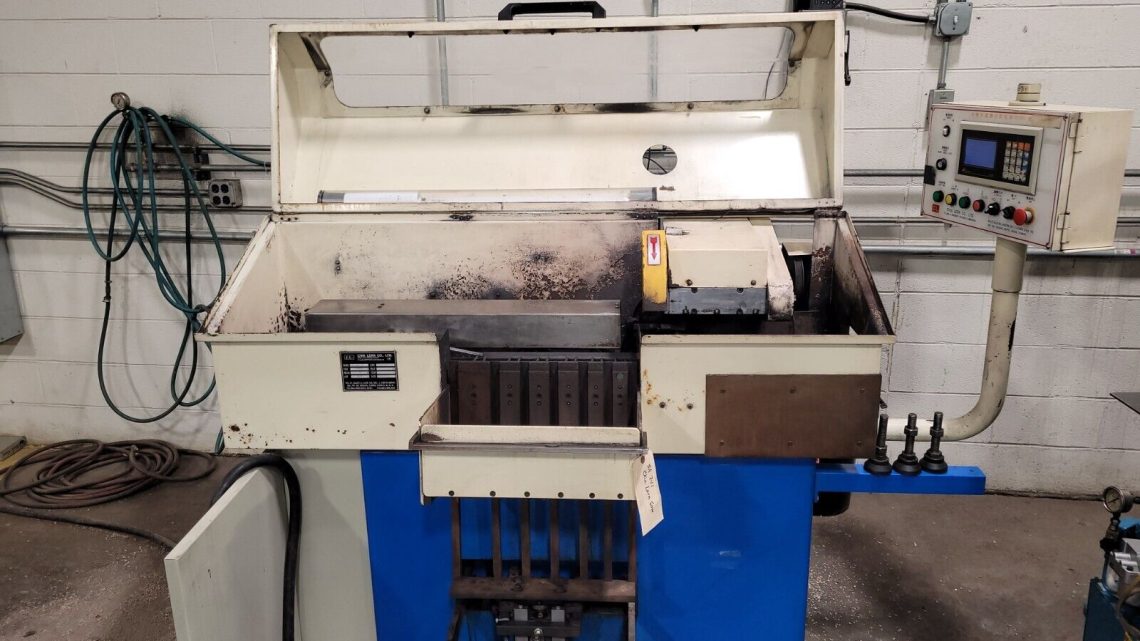
- In one used listing, it is equipped with Micro Trend UT-735 control with touchscreen interface, twin pneumatic clamps, wheel sensor for automatic compensation, and automatic magazine loader.
- Production of this model is indicated as suspended (so parts might be rarer).
Because this machine is fairly specialized and likely of limited production, used units may have idiosyncrasies, custom modifications, or parts that are difficult to source. So your inspection should be thorough. Below is a structured checklist / approach.
Expert Checklist Before Buying a Used CH-CM01-5 (or Equivalent Carbide Cut-Off Machine)
Use this in stages: pre-visit screening, static inspection, mechanical & dynamic testing, control / electronics, test cutting, risk & negotiation.
| Stage | What to Inspect / Test | Why It Matters / Risk | How to Do It / Acceptable Behavior |
|---|---|---|---|
| Pre-visit / Screening | • Ask for serial number, build year, documentation (manuals, electrical, parts lists). • Request machine videos: bar feeding, cut cycles, control screens. • Ask for maintenance logs, parts replaced (like clamps, feeds, spindles). • Ask what tooling, diamond wheels, fixtures, bar loaders or magazines are included. • Confirm power requirements, utilities, chip handling, coolant supply. • Ask for known issues, modifications, spare parts availability. | Some used units may have hidden repairs, nonstandard upgrades, or customizations that complicate parts replacement or control matching. Knowing the history helps you detect mismatches or “cover-ups.” | Confirm that claimed specs (range, tolerance) align with what you later measure. See if video shows smooth motion, no jerky feed, consistent cycle. |
| Visual / Structural / Static Checks | • Inspect machine frame, bed, column, supports, mounting surfaces for cracks, weld repairs, distortions. • Check guards, covers, enclosures, protective shields for missing or damaged parts. • Check way covers, bellows, bar feed guides for damage or misalignment. • Inspect clamping mechanisms (pneumatic clamps, jaws, holding fixtures) for wear, leaks, damage. • Examine the spindle nose, taper, mounting area for corrosion, wear, chipping. • Inspect hydraulic / pneumatic lines, hoses, fittings for leaks or compromised condition. • Check coolant tanks, pumps, plumbing for corrosion, leaks, sludge. • Open control / electrical cabinets (if allowed) and check wiring, dust, signs of overheating, modifications. | Structural defects, misalignment, bent frames, or damaged clamps can degrade cutting accuracy, cause failures, or require expensive repairs. Missing guards or damaged covers increase risk of chip ingress and wear. Leaky pneumatics, hydraulics, or wiring problems often manifest later. | Use strong lighting, mirrors, borescopes. Check for plumbness, whether machine rocks or is unlevel. Photograph suspect areas. Check that all guards and covers are in place. |
| Motion / Mechanical / No-Load Tests | • Power up (if permitted) and jog / move axes (bar feed axis, cut axis, any cross axes) at slow and moderate speed. Look for binding, sticking, jumps, jerks. • Command small reverse moves to detect backlash / lost motion. • Run reference / home cycles multiple times; check repeatability of returned home position. • If there is compensation or length compensation motion (wheel compensation, bar length mapping), test those motions. • Start the spindle (diamond wheel) at low speed, then ramp up (if safe) to working speed; listen for unusual noise, vibration, or imbalance. • After running, test radial / axial play on spindle (if possible using test mandrel or indicator). • Test the bar feeding / magazine mechanism without a bar (dry) — does it feed rods smoothly, index properly, clamp/unclamp consistently. • Test the clamping jaws / mechanism (pneumatic / hydraulic) cycling, pressure if measurable, and ensure secure grip. | Worn guides, bearings, or screws can show as rough motion, binding, backlash, or nonuniform behavior. Spindle issues (imbalance, bearing wear) impact cutting quality, vibration, and chatter. Faulty bar feed or clamp mechanism will cause miscuts, slippage, or broken bars. | Use a dial indicator where feasible for small moves. Jog several cycles to check consistency. Note any zones of rough motion or “dead spots.” |
| Control, Electronics & Wiring | • Power up the control — check boot-up, alarm logs, error messages. • Test interface: buttons, touchscreen, jog keys, display. • Browse parameters, compensation tables, length/diameter presets, wheel offset compensation routines. • Check wired I/O status (clamp feedback, sensor signals, limit switches). • Inspect wiring inside cabinets: clean routing, no chafed cables, no burned insulation or overheated terminal blocks. • Inspect servo drives, control boards, I/O modules for damage, blown components, or signs of repair/modification. • If possible, backup the control parameters or program memory to external media. | A failing, corrupt, or unsupported control can cripple the machine; parts may not be available. Poor wiring or previous “jury-rigged” repairs are weak points for failures. | Ask the seller to run a simple cut program, check whether compensation works, clamping cycles respond. Try to navigate menus, see if parameter entries are intact. |
| Test Cutting / Actual Bar Cut Trials | • Bring sample bars of the size the machine is supposed to cut (within its Ø1.4–35 mm or 40 mm range). • Run a cut cycle and measure output length accuracy (target vs actual), repeatability, burr formation, surface finish of cut face. • Run multiple cycles to test stability, drift, whether error accumulates. • Test bar feed / magazine function under load — loading, indexing, rejecting misfeeds. • Test automatic compensation of wheel wear, if the machine supports that, to see whether the system keeps lengths stable over many cuts. • Vary bar diameter and length positions (short, long, near max limits) and test accuracy and feeding consistency. • Monitor spindle motor load, vibration during cut, any anomalies (chatter, vibration peaks). • After an extended run, re-measure a cut to see whether thermal or wear drift affected results. | A cut-off machine must maintain tight length tolerances and consistent performance. Any drift, slippage, or variation is a red flag. Failures in bar feeding under cut load or clamp slippage lead to scrap or tool breakage. | Measure cut lengths with precise instruments (micrometers, calipers). Run maybe 50+ cycles continuously to observe drift. Check whether the wheel compensates, and whether clamp hold remains firm. |
| Geometric / Metrology / Precision Checks | • Check alignment: whether the clamping jaws and spindle axis are concentric, whether bars feed in straight line without deflection. • Check perpendicularity if there is any cross-axis or angle between feed and cut axis. • Check backlash (lost motion) numerically in feed axis(s). • If possible, mount a test bar and sweep a dial indicator during axis movement to detect “wobble” or vibration. • Leveling and flatness: check that the machine bed or support surfaces are level, no distortion under load. • If the machine has length measuring scales or encoders, check their accuracy against a reference measurement. | Because cut-off machines operate with tight length tolerances and rigid clamping, any misalignment, deflection, or backlash directly degrades precision and increases scrap rates. | Use an indicator, calibrated test bars, precision gauges. Compare readings at multiple positions and after movement. |
| Auxiliary Systems & Consumables | • Check diamond wheel condition: check for wear, cracks, run-out, mounting integrity • Check wheel mounting hardware (flanges, nuts, sockets) for damage or alignment. • Inspect coolant / cutting fluid system (if used): pump, lines, filters, cleanliness, leaks • Inspect chip collection / extraction systems, guards, conveyors. • Check pneumatic / hydraulic supply integrity (air lines, pressure regulators, valves, seals) that power clamps or feed systems. • Spare parts: ask whether extra wheels, clamps, flanges, gaskets, O-rings, sensors are available or included. | In a cut-off machine, the diamond cutter and its wear / alignment is critical — if those are compromised, machine worth is severely diminished. Aux systems failing cause downtime or reduced precision. | Visually inspect wheel, try to spin it (if low speed) to see run-out. Run coolant / fluid flow. Cycle clamps / feed under pressure. |
| Risk / Repair Cost Assessment & Negotiation | • Document all observed wear, deviations, and defects. • Ask or research spare parts availability (especially for CHIA LERN parts, diamond wheels, control modules). • Estimate cost to refurbish: replace clamps, wheels, bearings, align axes, recalibrate. • Factor in transport, rigging, reinstallation, leveling, control backup/restoration. • If the machine has had custom modifications, assess whether they are well integrated or may complicate maintenance. • Negotiate discount based on the cost of needed repairs or parts, rather than an arbitrary “percent off new.” • Where possible, seek a short acceptance period or warranty (for spindle, clamp system, cutting accuracy) after commissioning. | Even a “good” used cut-off machine might require thousands in refurbishment. The more you know the defects, the better your negotiating position. | Build a “punch list” and assign estimated costs. Use comparable quotes for new or refurbished machines to benchmark. |
| Documentation & Transfer | • Ensure you receive original manuals: mechanical, electrical, control / parameter lists, parts lists. • Verify machine serial / ID plate matches documentation and internal references. • Get any backup programs, parameter files, compensation tables. • Confirm that all tooling, clamps, wheels, spare parts, attachments, etc. are transferred. • Have a written purchase agreement stating condition, acceptance terms, defects, warranty (if any). | Without documentation (especially for a model whose production is suspended) future service, tuning, or replacement becomes very difficult. | Cross-check serial numbers. Ensure all attachments / accessories are listed. Get parameter backups in digital form if possible. |
Red Flags & “Deal Killers” Specific to CH-CM01-5 / Carbide Cut-Off Machines
Here are things that, if present or suspected, should heavily devalue the machine or make you reconsider purchase:
- Diamond wheel run-out or mounting damage — a misaligned wheel gives poor cuts, vibration, scrap.
- Worn or sprung clamps (pneumatic/hydraulic) — slippage under cut load is dangerous and wastes material.
- Bar feeder / magazine misfeeds or inability to feed bars reliably.
- Spindle bearing noise, excessive vibration or play — bearing failures are costly to repair.
- Inaccurate length control, drift in repeated cuts, lack of wheel wear compensation functioning.
- Cracks, weld repairs, distortions in frame, especially around the cutting head or support.
- Obsolete or unsupported control electronics — since production is suspended, finding spares may be hard.
- Modifications or non-OEM parts that degrade performance or complicate repair.
- Inadequate cooling or chip control — chips interfering with motion or damaging surfaces.
- Missing or damaged protective covers or seals — enabling chip ingress and wear.
- Major repairs needed for mechanical drives, linear guides, screws, or feeding systems.
- Lack of documentation, parts list, electrical schematics, or parameter backups.