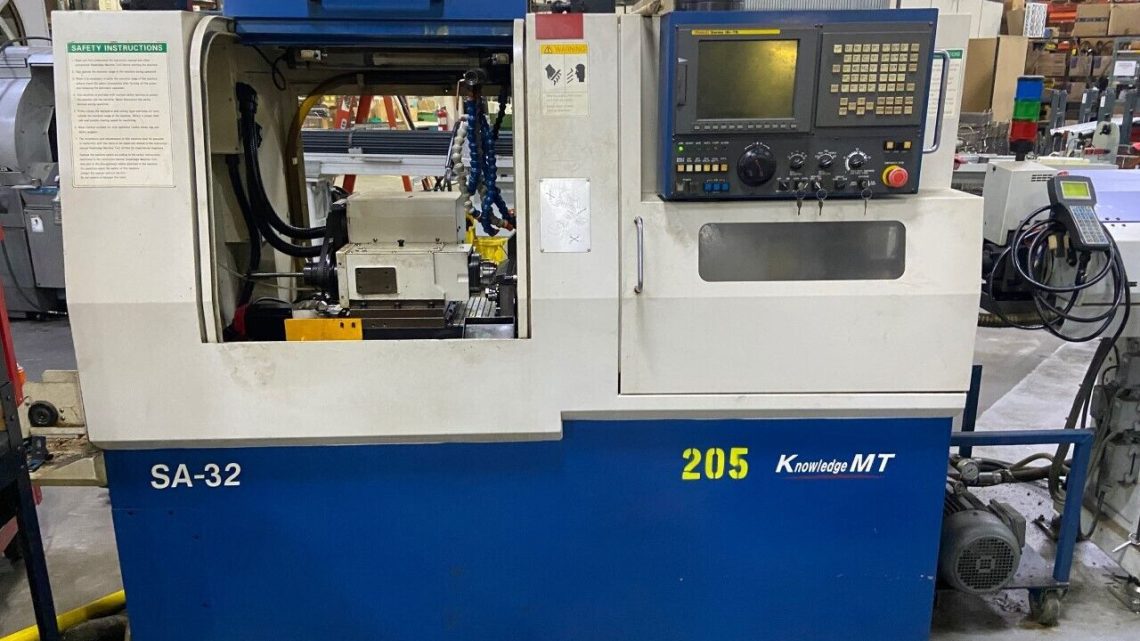
What Do Buyers Look for Before Investing in a Pre-Owned, Used, Secondhand, Surplus CNC Equipment Before Purchase Knowledge MT SA-32 CNC Swiss Bar Capacity Ø32mm made in South Korea
When evaluating a pre-owned / used / surplus Knowledge MT SA-32 (or equivalent 32 mm bar Swiss-type lathe from South Korea) for purchase, you should apply a detailed due diligence process. Swiss-type machines are among the most delicate and precision-sensitive CNC machines, so hidden wear or subtle faults can substantially reduce their utility or cost far more to repair.
Below is a comprehensive checklist of what buyers should examine, test, and negotiate when considering an SA-32 (or similar) machine. After the checklist, I’ll highlight critical red flags and strategic tips.
Background & Typical Specs to Know (Benchmarks)
Before going onsite, arm yourself with expected/nominal specs so you know how far “off spec” a machine might be, and where high risk areas are.
From general product info on similar machines:
- Knowledge / Nexturn offers SA-12 / SA-20 / SA-32 Swiss lathes in their product stack.
- The “32” in SA-32 indicates a bar capacity Ø = 32 mm, meaning the largest bar material the machine is intended to support.
- These machines are often built for ultra-precision machining, combining guide bushing support, multiple axes (X, Z, sometimes Y, live tooling, C-axis) in Swiss design.
- Expect that the machine may have both “guide bushing” mode and possibly “non-guide / collet” mode, depending on configuration.
- The control / tool capacity, spindle speed, number of axes, turret / live tooling options will vary by unit (so always get the exact variant).
Knowing these helps you recognize when a candidate machine is underperforming or has drifted beyond usable tolerance.
What Buyers Must Inspect / Test — Detailed Checklist
Below is a structured checklist, organized by subsystem, with what to check, how to test, and what to watch out for. Bring measuring instruments (micrometers, test bars, dial indicators, run-out gauges), and if possible, someone experienced with Swiss lathes.
| Subsystem / Area | What to Inspect / Test | Reason / What to Watch Out For |
|---|---|---|
| Machine History & Documentation | • Total “power-on” hours, ideally “cutting hours” (time under load) • Maintenance logs: lubrication, calibration, spindle rebuilds, guide bushing replacements • Crash history or mechanical collisions • Modifications / upgrades / non-original parts • Reason for sale | A well-documented machine is less of a risk. No history is a red flag. |
| Structural / Frame / Base & Alignment | • Check for frame warpage, cracks, weld repairs, structural distortions • Verify machine is leveled, mounted solidly • Inspect bed, saddle, support surfaces, castings for fatigue or visible cracks • Check alignment of spindles, guide bushing mounts, datum surfaces | Even small structural misalignments or distortions degrade accuracy severely in Swiss machines |
| Guide Bushing System | • Inspect guide bushing sleeve for wear, scoring, ovality, looseness • Check whether oversized or compensated bushings were ever used • Test alignment: whether the bushing is still concentric with the spindle bore • If machine supports non-guide mode, see whether it was used (which may stress the sliding parts) | In Swiss lathes, the guide bushing is critical to maintain cutting stability and precision. Once it is worn, parts quality suffers dramatically. |
| Sliding Headstock / Main Spindle / Bar Feed Path | • Examine the interior of the sliding headstock for wear, scratches, corrosion • Run spindle at various speeds (idle and light cutting) and listen/feel for vibration, roughness • Measure radial and axial run-out using precision indicators • Check spindle bearing play or looseness • Bar feed path alignment: check for binding, smooth entry/exit, straightness • Back spindle (if present): test its performance and synchronization | Spindle errors or misalignment directly translate to part errors—and repair is costly. |
| Axes, Drives, Motors, Backlash | • Move X, Z (and Y, if present) over full travel, both directions — check for smoothness, stiction, binding • Measure backlash, hysteresis, repeatability in axes • Inspect ball screws, linear guides, couplings, motor couplings • Monitor motor current or drive load (if you have that access) • Encoders and feedback systems: test signal integrity, resolution, noise | Worn axes or drives degrade repeatability, surface finish, and dimensional control |
| Tooling / Turret / Live Tooling / Tool Changes | • Inspect turret / tool posts for wear, indexing accuracy, backlash • Run several tool change cycles (front and possibly rear) under operation to detect mis-indexing, delay, or chatter • Examine tool holders, grippers, sensors, offsets • Test live tooling (if installed): check rotational quality, run-out, motor bearings • Inspect tooling access, tool change paths for collisions or interference | Tooling subsystem problems are frequent sources of defects and downtime |
| Control / CNC / Electronics / Wiring | • Identify the control model, software version, license for axes, modules • Check program backups, alarm history, diagnostics, error logs • Inspect control cabinet(s): wiring condition, signs of overheating, dust, corrosion • Test connectivity, I/O modules, servo drives, boards, spares • Confirm whether replacement electronics or modules are still available | Electronics are often expensive to replace or repair—obsolete controllers are a big red flag |
| Thermal Drift / Warm-Up Behavior | • Run the machine for an hour or more to reach thermal equilibrium • Perform repeated positioning tests over time to observe drift • Do trial cuts early and late in the warm-up cycle and compare results • Check whether any thermal compensation features are operational | Even a geometrically accurate machine may drift when it heats up, impairing precision |
| Accuracy / Repeatability / Test Cuts | • Command multiple returns to the same coordinate (repeatability) and measure dispersion • Execute circular interpolation or other geometric tests to check roundness, taper • Run actual machining tests across the envelope (different diameters, lengths, positions) and measure parts • Check edge cases—near limits of axes, near extremes of bar diameter • Use calibrated test bars or reference gauges to detect deviations | These are your proof-of-performance tests. If the machine can’t meet your tolerances under realistic conditions, it’s not adequate |
| Auxiliary Systems: Coolant, Chip Handling, Lubrication | • Inspect coolant pump, filters, nozzles, piping, leaks, contamination • Check chip removal systems, conveyors, guarding • Verify lubrication / grease systems, oil lines, automatic lubrication where applicable • Examine enclosure, guarding, seals, door integrity • Pneumatic systems (if used) for chucks or actuators: test for leaks, responsiveness | Perfect mechanics will degrade if coolant or lubrication systems fail |
| Spare Parts / Maintenance Support / Obsolescence | • Ask for part numbers of wear parts (guide bushings, spindles, tool changers, electronics) • Check whether parts are still manufactured or available in aftermarket • Ask about the service network, whether local or regional support exists • Request list of replaced parts (and when replaced) | A machine is only as good as its maintainability and parts support over its remaining life |
| Electrical / Wiring / Power Systems | • Inspect wiring, power panels, cable insulation, terminal blocks • Look for burned wires, rerouted wiring, evidence of repair • Confirm power compatibility (voltage, phases, frequency) with your shop • Check grounding, shielding especially in sensitive signal cables | Electrical faults or mismatches can damage components or cause erratic behavior |
| Safety & Compliance | • Check guards, covers, interlocks, emergency stops • Safety around sliding head, moving parts, access doors • Check for adherence to applicable safety and electrical codes • Evaluate if any modernization required to meet your region’s safety standards | Safety compliance is non-negotiable; retrofitting later can be costly |
| Logistics / Installation / Commissioning | • Disassembly / transport / rigging costs • Facility prerequisites (floor strength, crane or lifting, clearance, access) • Installation, leveling, alignment, calibration, verification at your site • Time for warm-up, break-in, tuning, trial runs • Utility compatibility (electric power, cooling, air, exhaust) | These hidden costs often eliminate the “bargain” advantage of a used machine |
Critical Red Flags & Deal-Killers
When inspecting a candidate SA-32 or equivalent Swiss lathe, here are warning signs that should either disqualify the machine or force a steep discount:
- Severe or localized wear in the guide bushing that cannot be compensated by replacement sleeves.
- Spindle vibration, noise, or high run-out values beyond acceptable tolerances.
- Tool change cycles failing (mis-index, drop tools, slowness) or live tooling faults.
- Axes exhibiting large backlash, binding, or irregular motion.
- Electronic / control modules obsolete or unrepairable, missing, or heavily modified.
- Thermal drift so high that geometry cannot be maintained through warm-up.
- Poor wrap-up, collisions, or interference between tooling / fixtures when tools near extremes.
- Missing or broken auxiliary systems (coolant, lubrication, chip handling).
- The seller refuses to allow test cuts, internal cabinet access, or opening for inspection.
- Lack of spare parts availability, or key parts already heavily worn or replaced many times.
- Structural damage (cracks, frame distortion) that impairs alignment.
Strategy & Tips for Inspection & Negotiation
- Bring a machinist or technician experienced with Swiss lathes to help spot subtle wear.
- Insist on live test cuts with representative parts under load — not just air moves.
- Run the machine for an extended period (1–2 hours) before doing final accuracy checks, to let it reach thermal stability.
- Test the machine across its full travel envelope, not just in “sweet spots.”
- Ask for any spare parts the seller can include (nozzles, guides, electronics).
- Build in a refurbishment / contingency budget to replace critical wear parts immediately.
- Try to negotiate a limited acceptance period (a “test-run” clause) to verify performance after installation.
- Verify the machine’s compatibility with your facility (power, space, utilities) before committing.