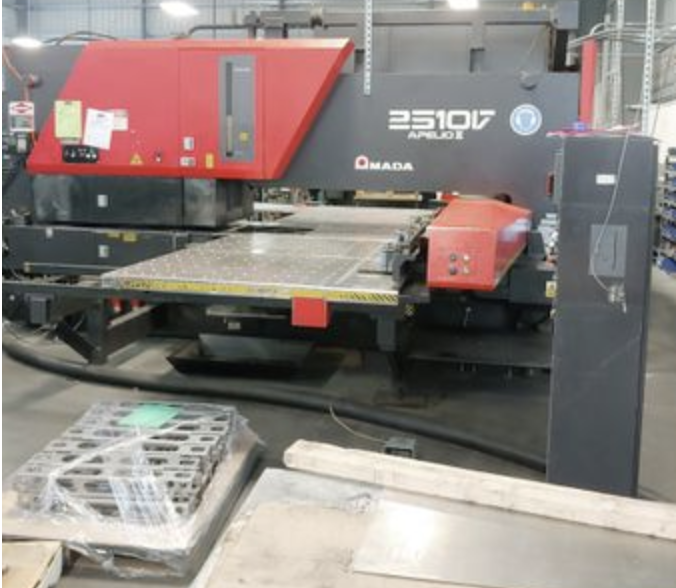
What Do Buyers Look for Before Investing in a Pre-Owned, Used, Secondhand, Surplus CNC Equipment Before Purchase AMADA AP3 2510V CNC Punching Machine made in Japan?
Buying a used or surplus CNC machine — in your case a AMADA AP3 2510V CNC Punching Machine (or similar used equipment) — can be a cost-effective way to expand capacity, but it requires due diligence. Below are the main things that buyers should check/verify before investing. Many of these apply broadly to used CNC (or punching / forming) machines.
Key Things to Check Before Buying a Used CNC / Punching Machine
1. Machine Condition & Maintenance History
- Visual check of frame, body, housing — look for cracks, dents, mis-alignment, weld repairs or patch work. Structural integrity is critical: any prior crash or heavy knocks may cause misalignments or hidden stress.
- Signs of rust, corrosion, leaks — check for rust on metal surfaces, coolant/hydraulic/oil leaks, coolant trays, seals, and way covers. Leaks or rust often hint at poor maintenance or neglected lubrication/hydraulic systems.
- Wear and tear on critical moving parts — pay special attention to components such as bearings, guides/ways, ball screws (if applicable), spindle, tool holders/changers, hydraulics, lubrication systems. Excessive wear on these parts may degrade accuracy or lead to future breakdown.
- Evidence of heavy or abusive use — locations with paint worn off (e.g., same spot repeatedly used), battered guards, patch-ups — may indicate intensive prior service (e.g., same part run over and over) or abuse. This isn’t necessarily a deal-breaker but should factor into price and expected maintenance.
- Maintenance and service records — ask the seller for logs: frequency of maintenance, previous repairs or part replacements, coolant/hydraulic/lubrication changes, any upgrades or refurbishments done. Regular documented maintenance is a good sign of care.
2. Operational and Performance Check
- Test run (dry run and actual operation) — if possible, see the machine running empty (dry run) and under load (actual punching or forming). Listen for unusual noises (grinding, knocking, vibration), check for smooth axis movement, look for jerks, hesitation, or irregular motion.
- Spindle / punch head condition — since spindle/punch mechanism is “heart” of machine, inspect for wobble, excessive play, bearing noise, overheating during use. These are expensive to repair.
- Accuracy, repeatability, and precision — if possible, run a sample part or test cut/punch, then measure critical dimensions. Repeated accuracy and surface/edge quality are good signs. Any drift, misalignment, or inconsistent results are red flags.
- Smoothness of axis / tool changer (if applicable) — ensure that all axes move smoothly throughout full travel, without binding or excessive backlash. If there is a tool changer, test that it works reliably and repeatably.
3. Control System, Electronics & Software / Compatibility
- CNC controller & software condition — verify that the control system works reliably: no error messages, stable boot up, all buttons/switches/controls responsive, display functional. Older or discontinued controllers may pose issues with programming, parts, or repairs.
- Compatibility with your workflow — ensure the machine (controller, software, I/O, capabilities) matches your production needs. For example: workpiece size, punch/forming capacity, interface with CAM/CAD or job preparation workflow, ease of programming, existing tooling compatibility.
- Availability of spare parts and support — older or discontinued models may have limited parts availability. Confirm that spare parts (mechanical, electronic, hydraulic) are still obtainable (from manufacturer, aftermarket, broker), or that used parts are viable. This affects long-term maintenance cost and downtime risk.
4. History of Use: Workload, Hours, Duty Cycle, Application
- Operating or cutting hours (or punching cycles) — a key metric. Just like “mileage” in used vehicles, punch count or working hours give insight into remaining life. A machine with very high usage may have much of its service life consumed — but usage context matters.
- Type of work done previously (heavy duty vs light duty, repetitive parts vs varied parts) — continuous production of heavy or high-force punching/forming jobs is more taxing than occasional light work. Heavy prior workload may accelerate wear on mechanical components (frame, spindle, bearings), lowering expected lifetime.
- History of repairs or modifications — have any major components (spindle, bearings, hydraulic units, control system) been replaced, upgraded, or repaired? Refurbishments or upgrades can be a plus — if done well and documented.
5. Safety, Compliance, and Documentation
- Safety guards, interlocks, emergency stops, shields, covers — ensure all safety features are intact and functional. Missing guards or faulty safety systems are a risk and might require costly retrofits.
- Manuals, schematics, wiring diagrams, maintenance logs — having original documentation, electrical schematics, maintenance history, and spare parts lists significantly helps for future maintenance and troubleshooting. Absence might make upkeep difficult or expensive.
- Transfer / supportability of software / control programs — older machines may use obsolete control software or storage media (e.g. floppy disks, legacy controllers). Ensure program transfer is possible (to modern media), and that you can integrate with your shop’s CAD/CAM or data-flow systems.
6. Economics: Total Cost of Ownership
When buying used, consider not only the purchase price, but also:
- Cost of transport, installation, alignment, commissioning — moving and reinstalling a heavy machine (like a punching press) can be expensive.
- Expected maintenance / refurbishment costs — belt/gearbox/spindle overhaul, bearing replacement, re-alignment, hydraulic repairs, re-wiring etc — these should be estimated upfront.
- Availability and cost of spare parts — if parts are rare or expensive, long-term costs go up.
- Downtime risk — older machines may have higher failure risk. Factor in downtime cost, especially if you depend on reliability for production.
- Resale or salvage value — in case you need to replace or scrap the machine — is there a reasonable residual value?
These cost/benefit considerations often help decide whether used is truly “cost-effective.”
Specific Considerations for a Punching Machine (e.g. AMADA AP3 2510V)
While much of the general CNC-machine checklist applies, punching machines have their own nuances. For a used punching machine you should pay extra attention to:
- Frame integrity and alignment — punching involves heavy forces; any misalignment or fatigue in frame/base can cause degraded accuracy, uneven punching force, or premature wear.
- Punching head / slide mechanism wear — bushings, bearings, slide guides in the punching head must be checked. Over time, these wear out especially if lubrication was insufficient or heavy work done.
- Die/punch tooling history and condition — tools wear, get chipped or misaligned over time. Ensure that tooling is in good condition or that replacements are available. Also check tooling holders, clamps, alignment.
- Hydraulic or mechanical drive (if used) — many punching machines use hydraulic or mechanical drives to generate punching force; check for leaks, pressure loss, wear, smoothness of action.
- Precision and repeatability under load — when punching under load (with actual sheet metal, thickness, tooling), test whether holes or shapes come out within tolerance repeatedly — punching often requires tight positional accuracy.
- Control interface and part programming compatibility — make sure punching program control (CNC controller) works, that old punched-part programs can be loaded and modified, and that the control isn’t obsolete or unsupported.
- Availability of spare components for wear-prone parts — springs, dies/punches, hydraulic seals, slide bushings etc must be available. For older Japanese machines, this can sometimes be challenging depending on age, but often parts markets or rebuilders exist — you need to verify.
What Buyers Should Request / Actions Before Purchase
Before finalizing purchase, you should:
- Request full maintenance & repair history, including servicing frequency, parts replaced, downtime incidents.
- Observe the machine running (dry run + real operation) — not just power-on, but actually punching sheet metal under load to test performance, accuracy, and detect problems (noise, vibration, misalignment, inconsistent punching quality).
- Measure actual output — if possible, run a test job (or your typical job) and measure precision, alignment, hole shape, repeatability.
- Check control system & software — ensure controller boots up, all I/O works, any CNC programs can be loaded/transferred, and that the control is user-friendly and usable long-term.
- Ensure documentation & spare-part availability — manuals, wiring diagrams, parts lists, hydraulic schematics, etc. Check whether spare parts are available (new, used, or aftermarket).
- Perform a cost-benefit calculation — include purchase price, transport, installation, potential refurbishment, spare parts, expected maintenance, depreciation, and opportunity cost (downtime risk, reliability).
- If uncertain, bring an expert or technician — someone familiar with punching machines or CNC equipment; having an experienced technician inspect helps identify issues that might be invisible to untrained eyes (e.g. minor misalignment, wear in slides, impending spindle head issues).
Red Flags That Should Make You Hesitate
Here are some common red flags when evaluating a used CNC / punching machine:
- Spindle or punching head making unusual noises (grinding, knocking, excessive vibration) during run.
- Excessive play or wobble in spindle, punch head, bearings; worn or scored spindles, guides, slides.
- Visible structural damage, cracks, heavy weld repairs or patchwork on frame/body — may indicate previous mishaps or heavy abuse.
- Missing or incomplete documentation — no manuals, no wiring schematics, no service history — makes future maintenance, repairs or even safe operation more difficult.
- Obsolete or unsupported control systems — especially if you rely on current CAD/CAM workflow or have limited ability to maintain/control older systems.
- Poor or inconsistent output during test run — misalignment, inaccurate punching, inconsistent hole quality or positional errors.
- Difficulty in obtaining spare parts (especially for older, less common models).
How to Decide If It’s Worth Buying (for You)
Given all the above: a used machine like AMADA AP3 2510V (or other used punching/CNC machines) can be a good investment if:
- It passes a thorough inspection (mechanical, CNC control, structural, tooling).
- It still delivers the required precision and repeatability for your work.
- Spare parts and service support (either OEM or aftermarket) are reasonably accessible.
- The total cost (purchase + transport + refurbishment + expected maintenance) remains significantly lower than a new machine — and the downtime risk is acceptable.
- You (or someone in your team) have the capability to maintain and service a used machine (or you have a service partner who does).
Used doesn’t mean “bad,” but you must treat it like a used car — with inspection, history check, and clear expectations.