Technical Evaluation Guide: How to Identify a Quality Used, Secondhand, Pre-Owned, Surplus TSUGAMI B038TE CNC Swiss Bar Capacity Ø38mm made in Japan
Reference / Baseline Specifications & Key Features (What You Should Expect)
Before you inspect, secure the original factory spec sheet or build sheet for that specific unit (serial #). Use that to cross-check what you observe. Below are typical published specs for the TSUGAMI B038TE (or very closely related B038T / B038 series) that form your baseline “red-line” expectations:
| Parameter | Typical / Published Value | Notes / Source |
|---|---|---|
| Maximum bar stock (bar diameter) | Ø 38 mm | (“Max. Bar Stock 38 mm”) |
| Number of axes / CNC axes | 9 axes (including front/back turrets, gang slides, C-axes) | (“9-AXIS” listing) |
| Tool positions / turret + gang capacity | Up to ~ 45 tool positions (total) | (“Tool Positions … 45 Max”) |
| Live tool / rotary tool capability | ~ 8 live tool positions (rotary / driven tools) | (“Live Tool Positions … 8”) |
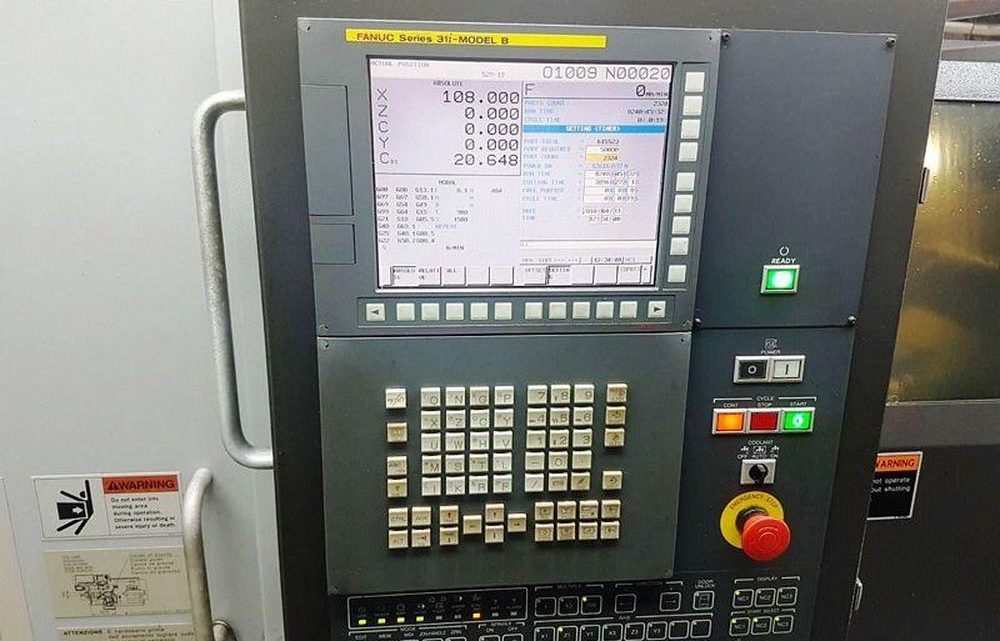
| Control system | FANUC 31i-B | (common spec) |
| Main spindle speed | 200 to 5,000 rpm | (“Main Spindle Speed 200-5,000”) |
| Sub (back) spindle speed | 200 to 7,000 rpm | (“Sub Spindle Speed 200-7,000”) |
| Live tool / milling spindle speed (rotary axes) | Up to ~ 8,000 rpm | (“Live Tool Speed 200-8,000”) |
| Spindle motors / power | Main: ~ 7.5 / 11 kW ; Back: ~ 3.7 / 5.5 kW | (some listings) |
| Stroke / bar feed / headstock travel | Z1 stroke with guide bushing ~ 250 mm | (“Z1 with bushing 250 mm”) |
| Machine weight & footprint | ~ 6,200 kg weight; footprint about 3,247 × 1,875 × 1,840 mm | (approx) |
| Rapid traverse / feed rates | ~ 24 m/min in axes (X, Y, Z) | (“Rapid traverse 24 m/min”) |
These are target benchmarks. If the machine you inspect differs significantly (e.g. much lower spindle speed, substantially fewer tool positions, missing live tooling capability, or obviously undersized motors), that might indicate it is a downgraded variant, or that components have been removed or degraded.
Also note that even well-maintained Swiss / sliding-head / gang-type machines are sensitive to wear, alignment, thermal drift, dynamic rigidity — so your inspection must be thorough.
Inspection / Evaluation Protocol
Below is a recommended sequential inspection protocol. You may adapt depending on machine condition, access, safety, and what the seller permits.
A. Documentation & History Review
Before or during the factory visit, gather and validate documentation. A strong, credible history lowers risk significantly.
- Factory / build sheet / specification document — confirms exactly what configuration (tooling, live tooling, optional axes, spindle speeds, motors) was delivered.
- Maintenance logs — record of preventive lubrication, spindle rebuilds, alignments, sensor calibrations, part replacement, toolchanger overhauls.
- Operating / runtime hours — ask for total operating hours, and ideally cutting / loaded hours vs idle.
- Repair / modification history — any crash incidents, structural repairs, retrofits, spindle or turret swaps, control replacements.
- Calibration / alignment / metrology reports — previous laser alignments, ballbar reports, straightness / flatness measurements.
- CNC / control backups and error logs — to see stability, alarm history, parameter changes, and whether backups are available.
- Parts & consumables records — whether original parts / OEM replacements or cheap alternatives were used.
- Tooling, attachments, accessories — what comes with the machine (chuck, adapters, collets, bar feeder interface, tooling, etc.).
If the seller cannot or will not provide credible documentation, that should factor into your price negotiation or decision.
B. Visual & Structural / “Cold” Inspection
With machine unpowered or safe, perform a careful external structural and component check.
- Machine frame / casting / bed / base / support structure
- Look for cracks, weld repairs, distortions in castings, frames, bed, supports.
- Check for corrosion, pitting, rust, especially in sheltered or recess areas.
- Verify that protective covers, guards, chip shields, way wipers, bellows, and enclosures are intact (or the extent of damage). Missing covers often indicate chip ingress, which accelerates wear.
- Guideways, slides, linear ways, sliding surfaces
- Inspect for scoring, scratching, corrosion, chipped edges, gouges or localized wear.
- Verify that slide surfaces look uniformly worn, not having “track marks” or uneven wear patterns which could indicate misalignment or irregular loading.
- Spindle housing & spindle nose
- Inspect the spindle nose / taper area for pitting, discoloration, corrosion, burn marks, dents.
- Check for flattening or damage on taper contact surfaces.
- Turret, tool posts, gang slides, back tool post, live tool hubs
- Check turret surfaces, pocket seats, indexing surfaces for wear, misalignment, damage.
- Inspect for mechanical play or looseness in tool slides, grippers, cams, linkages.
- Look at live tool hubs / motor housings: cooling ducts, wiring, lubrication paths should be intact and clean.
- Fasteners, access covers, electrical panels, wiring
- Check that structural bolts and mounting hardware appear original, fully tightened, not loose or mismatched.
- Access doors / panels should open cleanly; hinges and seals should be in good condition.
- Check wiring harnesses, cable carriers, conduits: look for chafing, exposed wiring, heat discoloration, repairs or splice joints.
- Fluid systems, coolant, lubrication, piping, hoses
- Examine coolant pumps, piping, valves, hoses for leaks, residue, corrosion, poor fittings.
- Examine lubrication system (oil / grease lines) — is the tubing intact, non-blocked, and showing evidence of past use.
If you see significant structural damage, missing critical covers, or signs of severe abuse, those are serious red flags.
C. Mechanical / Kinematic / Static Checks (Safe / Low-Speed Moves)
Assuming it is safe and permitted to jog the machine (in manual / slow mode), proceed to test mechanical movement and check for deviations, binding, backlash, and basic integrity.
- Axis motion (X, Y, Z, and any additional axes)
- Jog each axis through full travel slowly. Feel for binding, gritty motion, sticking points, uneven resistance, jerks.
- Reverse direction at several points and note backlash (lost motion). Use a dial indicator to quantify.
- Use test indicators to check linear straightness or pitch error over travel segments.
- Confirm that ball screws (if applicable) are clean, undamaged, and that ball nut assemblies show no looseness or wobble.
- Spindle / toolholder play & runout check (cold / idle)
- Mount a precision toolholder or test bar (clean, well seated). Gently twist or tap and detect any axial or radial slop. There should be minimal or none.
- Using a dial indicator, measure runout at the tool tip / taper surface.
- Use a marking compound / dye contact test: apply a thin film of dye to the taper or contact surface, seat the toolholder lightly, rotate slightly, and examine the contact patch. Uniform contact is ideal; partial or uneven contact indicates wear or misalignment.
- Turret indexing / tool change static check
- Manually or via slow jog, index the turret through all pockets. Check for hesitation, binding, misindexing, mechanical play, or misalignment.
- Inspect gripper arms, locking elements, indexing cams, sensors, limit switches for smoothness and mechanical integrity.
- Back spindle / sub-spindle / back tool post checks
- Perform similar play, runout, and alignment tests for the sub-spindle or back tool post.
- Ensure it is aligned coaxially with the main spindle (if the machine supports handoff).
- Fluid / lubrication / coolant systems (static checks)
- Check coolant system: pump, piping, nozzles, filters, hoses, sumps for cleanliness, leaks, corrosion.
- Check lubricant / oil supply lines: verify oil / grease flows, check for blocked lines or dead zones.
- Inspect hydraulic / pneumatic systems (if present) for leaks, hose integrity, valves, pressure lines.
If any axis binds, shows significant backlash or mechanical play, or you detect toolholder slop, you should dig deeper or demand repairs or discount compensation.
D. Power-On / Dynamic / Functional Testing
Once confident in safety and basic mechanical integrity, power up the machine and perform dynamic / operational tests.
- Control & CNC system test
- Power on CNC, observe initialization, error / alarm logs, parameter warnings, disabled axes, memory status.
- Test operator interface: keys, overrides, MPG, jog / manual / program modes.
- Run homing / referencing cycles for all axes.
- Execute a simple motion program (no load) with combined axis movements to test smoothness, no stalls, no alarms.
- Check limit switches, safety interlocks, emergency stops, door sensors.
- Axis motion under power
- Run “box move” or ladder patterns in X, Y, Z axes and measure (via indicator or laser) whether program cycles return accurately and repeatably.
- Test acceleration / deceleration behavior: look for overshoot, stalling, jerk, or vibration.
- Under light cuts (soft material), run a simple machining routine (e.g. facing or small depth pass) and observe stability, chatter, noise, spindle behavior.
- Spindle & live-tool / driven-tool performance
- Ramp up spindle from low to maximum rpm (e.g. up to 5,000 rpm) and listen for abnormal vibration, bearing noise, growl, whine.
- Monitor spindle housing or bearing zone temperature over time.
- Run live tool / rotary tool operations (if installed) at various speeds and under light load, checking for vibration, irregular torque, or stability issues.
- Test sub-spindle (if present) similarly, and test handoff / transfer operations if applicable.
- Tool change / turret cycle test
- Execute full tool change cycles via program: index turret, change tools, etc. Observe speed, smoothness, repeatability, any stalls or misloads.
- After multiple tool changes, test whether tool offset or length stays consistent (i.e. low drift).
- Check that coolant / chip blow-off during tool change functions correctly.
- Repeatability / return accuracy
- Move to specified coordinates and return repeatedly, measure deviation.
- For multiple axis combinations, confirm that return-to-zero (or reference) is precise.
- Thermal drift / long-run stability test
- Let the machine run continuously (spindle, movement) for a defined period (e.g. 30–60 minutes). Then re-check key dimensions (e.g. a reference distance) to see how much drift has occurred.
- Monitor temperature of spindle, motors, drives, and check whether the machine’s geometry changes over time.
E. Metrology / Geometric / Alignment Verification
To determine the usable precision of the machine, you need metrology checks. Use precision equipment (laser interferometer, ballbar tester, autocollimator, granite reference surfaces) as available.
- Straightness & linearity: over axis travel, measure deviations, linearity error, pitch / yaw.
- Squareness / perpendicularity: between axes (e.g. X–Z, Y–Z) to confirm right-angle relationships.
- Taper / coaxial alignment: check alignment between main and sub spindles (if machine supports handoff).
- Table / bed flatness / surface plate checks (if applicable) or reference fixtures.
- Toolpoint locus accuracy: measure imaginary sphere centered at spindle to test radial and axial consistency.
- Deflection under load: apply known loads and verify how much bending or deflection occurs (particularly at working extension lengths).
- Thermal drift repeat checks: compare measurements before and after thermal warm-up.
- Tool change repeatability: measure tool point location after tool change cycles to see whether offsets remain stable.
Compare your metrology results to original factory tolerance thresholds (if known). Deviations within a small margin may be acceptable; large, inconsistent errors are red flags.
Red Flags & Warning Signs
Here are specific red flags you should treat seriously or demand explanation / repair for:
- High backlash or slop in axes, tool slides, turret indexing that exceed acceptable tolerances.
- Significant scoring, pitting, gouging of guideways, slide surfaces, tool slides.
- Spindle play or wobble under static tests, or abnormal bearing noise / vibration at rpm testing.
- Uneven or partial taper contact on the spindle (dye test indicates nonuniform contact).
- Tool change / turret misindexing, tool drop from pockets, hesitation in cycles.
- Control / CNC instability, frequent alarms, parameter corruption, memory faults.
- Excessive thermal drift, geometry shifting significantly during warm-up.
- Missing / damaged protective covers, bellows, wipers leading to contamination.
- Weld repairs, structural modifications, frame distortion — indicates prior damage or repair.
- Oil / coolant leaks, contaminated fluid, dirty / metallic sludge in coolant or lubrication oil (indicative of poor maintenance).
- Hydraulic / pneumatic system problems (leaks, pressure fluctuation, slow response) (if machine uses them).
- High tool offset drift after multiple cycles — shows instability in toolholding or turret movement.
- Non-OEM or undocumented modifications (removal of options, substituted parts) without traceable records.
- Lack of or suspicious maintenance history — absence of logs in a precision machine is a risk.
- Hard-to-replace spares or obsolete electronics / control components — may hamper future support.
If you observe many of these red flags, the machine is risky unless heavily discounted or repaired.
Repair / Refurbishment Cost Estimation & Risk Buffer
Even a well-maintained used Swiss / multi-axis machine often needs refresh or partial rebuild. When bidding, include line items and contingencies for:
- Spindle bearing replacement or full spindle rebuild.
- Replacing or regrinding ballscrews / nut assemblies.
- Re-scraping or refurbishing guideways, slide surfaces, tool slides.
- Turret / tool post overhaul (indexing cam surfaces, bearings, grippers, servo drives).
- Replacement of covers, wipers, bellows, cable carriers.
- Control / CNC / drive / servo electronics refurb or replacements.
- Full geometry alignment, calibration, laser metrology, certification.
- Installation, foundation, leveling, alignment at your site.
- Shipping, rigging, insurance.
Include a healthy contingency (10-20 % or more) for surprises (hidden wear, misalignment, damage inside castings, internal corrosion).
Acceptance & Contract Safeguards / Test Protocols
To protect your purchase and ensure you’re getting what was promised, include the following in your contract or purchase agreement:
- On-site / in-factory test run (“burn-in”) period: e.g. require the machine to be operated under light production for a certain number of hours before final acceptance.
- Acceptance criteria & tolerance sheet: define allowable values (backlash, runout, repeatability, positioning, metrology tolerances).
- Sample workpiece / test part: bring your own part or standard test geometry; the seller should run it and you measure results.
- Independent inspection clause: allow a third-party machine-tool / metrology expert to verify your test results and claims before final payment.
- Warranty / guarantee period for critical components (spindles, toolchanger, axis drives) post-installation.
- Retention / hold-back of payment until acceptance is achieved.
- As-is / condition disclosures: require the seller to disclose known wear, repairs, modifications, crash history, parts replaced.