10/10/2025
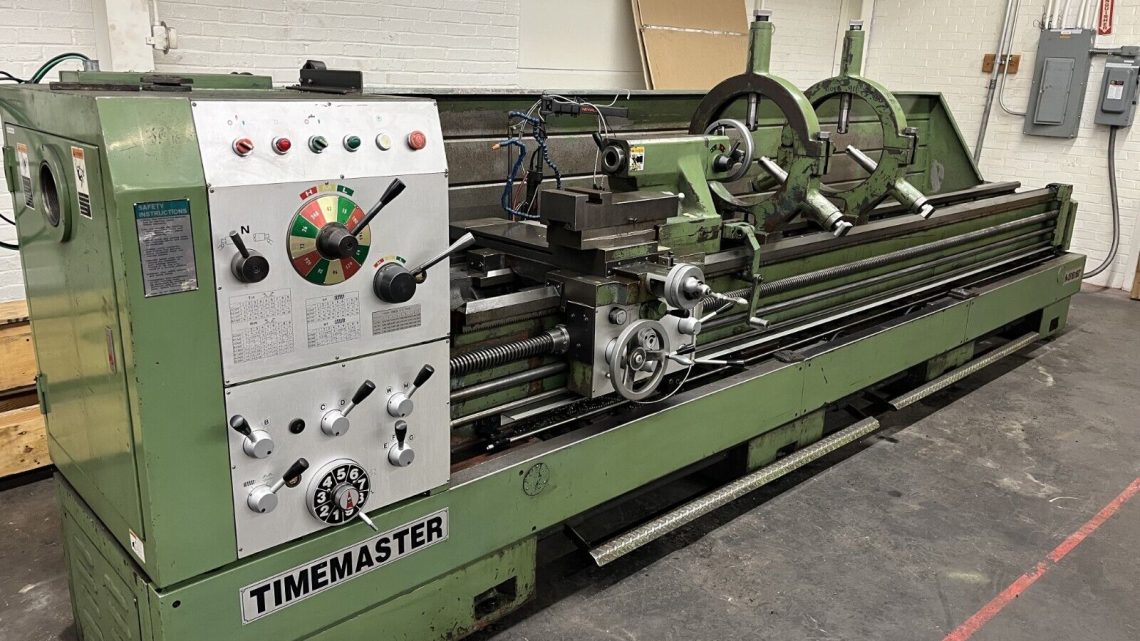
Technical Evaluation Guide: How to Identify a Quality Used, Secondhand, Pre-Owned, Surplus TIMEMASTER N-2618 Engine Gap Bed Lathe
1. Pre-Inspection / Documentation & History
Before actually touching the machine, collect as much background data as possible. A well-documented machine is far less risky.
| What to Ask / Request | What to Look For / Why It Matters |
|---|---|
| Nameplate / data plate / serial number / model number | Check for manufacture origin, capacity, serial codes that help trace factory or production batch. |
| Factory manuals, parts lists, schematics | Essential for maintenance, repairs, ordering parts, and understanding tolerances. |
| Maintenance / service records | Regular upkeep (lubrication, alignments, part replacement) is a strong positive. |
| Repair history or crash / accident history | Damage, repairs or misalignment caused by accidents are long-term risks. |
| Usage history (hours, types of work, materials) | Heavy duty use (e.g. cast iron, high feed cuts) wears components more than light duty. |
| Spare parts inventory included | Having spare chucks, gears, leadscrews, belts, etc. reduces risk. |
| Warranty / terms / return / walk-away clause | Even used machines sometimes are sold with limited guarantee; that is safer. |
The absence of any useful records should make you extra cautious.
2. Visual / Structural Inspection
This is your “walkaround” phase, inspecting the machine with the power off. Many defects show up visually.
Bed, Base & Castings
- Inspect the bed casting for cracks, welds, repairs, or distortions. Check for warpage or twist.
- On a gap bed lathe, verify that the removable portion (gap insert) and its mounting are solid, with no excessive wear or looseness.
- Check the ways (bed rails) along the full length of travel for scratches, gouges, pitting, rust, wear.
- Check where the carriage travels across the gap region—look for alignment or stepped wear at the gap boundaries.
- Inspect mounting feet or base—if the base is bent or the feet are warped, leveling / alignment will be hard.
Carriage, Cross Slide, Saddle & Apron
- Look at the carriage saddle for smoothness, wear, corrosion, or uneven surface.
- Inspect the cross slide and compound: examine the dovetail slides, gib strips, locks, and fasteners. Any looseness or visible wear or play is a red flag.
- Check for missing or loose covers, guards, handwheels, knobs.
Headstock, Spindle & Chuck Mounting
- Inspect the headstock casing for cracks, damage, or loose bolting.
- Check the spindle nose and bore for damage, corrosion, burrs, or wear.
- Examine how the spindle drive (gear train, belts, motor coupling) connects—look for wear, looseness, or misalignment.
- Verify whether the chuck mounting is secure, not deformed or damaged.
Tailstock
- Inspect the tailstock body, quill, and Morse taper for wear, smoothness, and straightness.
- Move the tailstock quill in and out; check for binding, play, or wobble.
- Check that the tailstock can be locked solidly to the bed and aligned to the spindle axis.
Leadscrews, Feeds & Gears
- Inspect the leadscrew(s) and feed screw(s): look for wear, scoring, threads in good shape, no major damage.
- Check all gear train housings, shafts, and associated bearings for play, cracks, or oil leakage.
- Examine the change gear sets (if available): teeth should be sharp, no chipped or broken gear teeth.
Belts, Pulleys, Couplings & Motor
- If belt drive is used, inspect belts (cracks, wear, fraying), pulleys (groove wear, alignment), and tensioners.
- Check motor coupling or direct drive connection: coupling should show minimal backlash, secure fasteners, alignment.
- Inspect motor housing, fan, cooling vents, wiring, and mounts.
Controls, Handwheels & Dials
- Examine handwheels, knobs, dials, levers: are they present, functional, not cracked or broken?
- Check the dials or scales (if present) for readability, calibration markings, damage.
- Ensure locking mechanisms (for feeds, quick slides, stops) function properly.
Cleanliness, Corrosion & Maintenance Level
- A machine that’s very dirty, with heavy oil / swarf accumulation, signs of rust, or neglect likely indicates poor maintenance.
- Examine corners and hidden places (under covers, inside compartments) for signs of damage, prior repair or corrosion.
- Check for signs of prior welding or modifications that might have affected structural integrity.
3. Mechanical / Motion Testing (Powered / Unpowered Movements)
With the machine powered (if possible) or carefully testing motions, detect problems in movement, backlash, binding or noise.
Carriage / Cross Slide / Compound Motion
- Jog carriage, cross slide, and compound slide through full travel slowly: feel for smoothness, binding, jerks or irregular motion.
- Reverse direction and test for backlash and “play” — measure with a dial indicator if possible.
- Engage feeds (if the lathe has power feed) and test under different speeds: watch consistency, noise, vibration.
Spindle Rotation / Runout
- Run spindle up through its speed range. Listen for unusual noises (bearing rumble, grinding, knocking).
- Use a test bar or dial indicator to check spindle runout (radial runout) at various points along the spindle.
- Monitor spindle temperature after prolonged running—excessive heat in bearings is a warning sign.
Tailstock Movement & Alignment
- Move the tailstock quill in/out with the machine powered (if possible) and under no load; check for binding or irregular motion.
- Use test setup to check tailstock alignment to spindle axis: mount a test bar and see whether tip runs true when supported by tailstock.
Gear / Lead Drive / Feed Gearboxes
- Engage feeds or lead screw drives: listen for gear noise, chatter, popping, or mis-engagement.
- Test gear shifting (if multiple feed speeds): the shift should be smooth and accurate, without skipping or sudden jolts.
- Under slow feed, check consistency of motion, absence of slips or interruptions.
Reverse / Backlash & Repeatability
- Move axis to a point, reverse direction, and return; see whether you get consistent accuracy (measure via indicator).
- Repeat a few cycles and see if there’s drift, hysteresis, or inconsistent behavior.
4. Accuracy, Calibration & Performance Checks
To quantify remaining life and suitability, carry out measurable tests and compare with expectations for a machine of this type.
- Backlash measurement: use a dial indicator to measure backlash on carriage, cross slide and compound. Compare to what’s acceptable for engine lathe (e.g. 0.002″ or better, depending on class).
- Surface finish / test turning: mount a test bar (e.g. hardened ground bar) and make finishing cuts. Inspect surface finish, straightness, and taper.
- Roundness / Runout: measure turned diameter at multiple points (front/back, sides) and check for taper, runout.
- Thermal drift: let the machine run for some time and see whether cuts shift or dimension changes drift due to heat expansion.
- Depth of cut / load handling: perform a more aggressive cut to see whether machine stalls, vibrates, or responds poorly under load.
- Spindle/ chuck consistency: after removing and remounting a workpiece or in a multi-step job, see whether setup repeatability is preserved.
5. Wear / Expected Lifespan & Component Condition
You need to assess how much “life” remains in key wear components.
- Ways / rails: compare wear marks to original dimensions or manufacture data (if available). Deep wear or uneven profiles suggest regrinding needs.
- Gap insert edges: often these see concentrated wear; if the gap edges are heavily worn or uneven, repair may be costly.
- Gear sets / change gears: worn or chipped teeth reduce accuracy; major sets may need replacement.
- Lead / feed screws: threaded wear (looseness, rounding of threads) reduces precision.
- Bearings: in headstock, spindle, tailstock – if they’re nearing end-of-life, replacement can be expensive.
- Couplings / universal joints: excessive play there reduces positional accuracy.
- Motor / drive motor condition: if motor is old, overheated, noisy, or underpowered, performance will suffer.
- Lubrication systems: check whether oiling pipes, reservoirs, oil pumps, grease lines are intact, not throttled or blocked.
6. Hidden Risks, Red Flags & Deal-Breaker Signs
Particularly when buying used, some warning signs should make you think twice:
- Cracks, weld repairs, structural deformation in bed, base or headstock.
- Gap bed misalignment or sloppy/gap interface wear.
- Excessive backlash, play, or jump in motion axes.
- Poor spindle condition: noise, heat, runout, bearing play.
- Gearbox or feed drive irregularities, noise, slipping gears.
- Binding or jerkiness in slides, cross slide, or compound.
- Missing accessories, guards, covers, handwheels or parts.
- Major corrosion, rust, or neglect.
- Inoperative or missing lubrication systems, pipes, or oil lines.
- Improper or sloppy wiring, motor modifications, undocumented changes.
- Seller refusing or resisting motion tests, live runs, or only allowing “visual inspection” is risky.
- No spare parts, no documentation, or manufacturer support lacking.
- Price seems too good to be true—often hides problems.
7. Practical & Commercial Considerations
In addition to technical evaluation, consider:
- Ease of transport / installation / foundation: gap bed lathes may require sturdy base, leveling, anchoring.
- Commissioning / alignment: plan for alignment, calibration, and test cutting after installation.
- Operator skills / training: ensure your team knows how to service and operate this model.
- Parts lead time & availability: especially for custom parts (gap insert, feeds, lead screws, gear sets).
- Lifecycle / resale viability: is demand for this model good, or will you have difficulty reselling?
- Warranty or conditional acceptance: negotiate a short warranty or ability to reject after trial period.