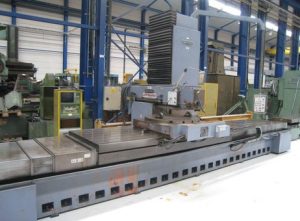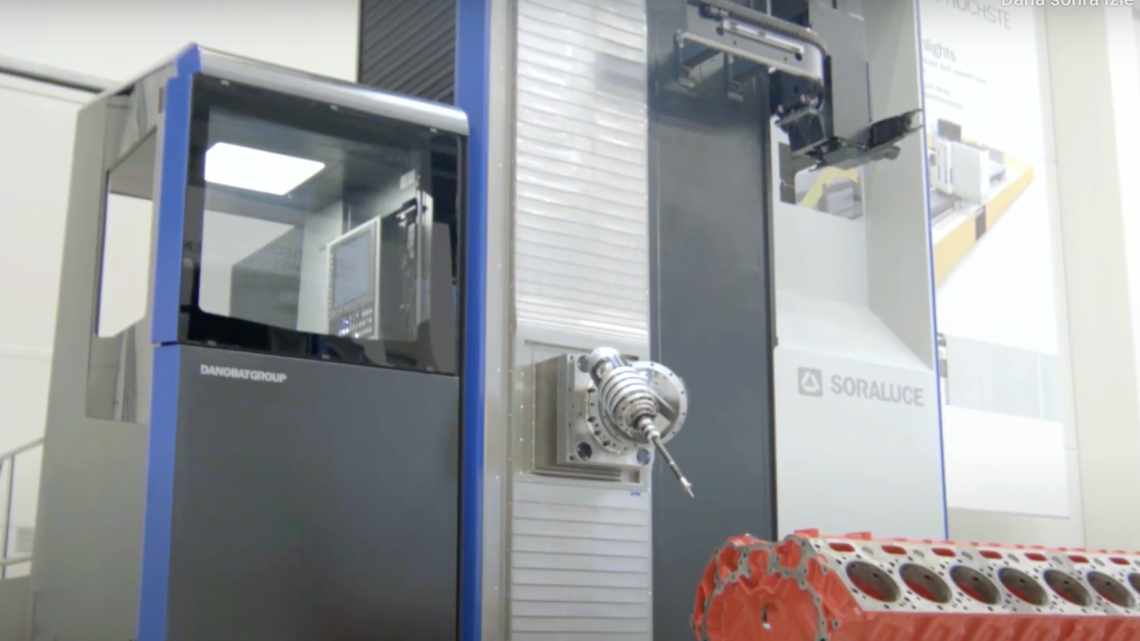
Technical Evaluation Guide: How to Identify a Quality Used, Secondhand, Pre-Owned, Surplus SORALUCE FP 8000 CNC Traveling Column Floor Type Boring Milling Machine made in Spain
1) Reference Specifications & Benchmark Values
Before you inspect the machine, obtain the machine’s build sheet. Here are typical specs for a SORALUCE FP-8000 unit (sometimes used by sellers) to use as benchmarks:
| Parameter | Typical / Published Value |
|---|---|
| X (longitudinal) travel | 8,000 mm |
| Y (transverse) travel | 1,500 mm |
| Z (vertical) travel | 2,600 mm |
| Table length × width | 4,000 × 2,500 mm |
| Max workpiece load (table) | ~ 40,000 kg |
| Spindle power | 32 kW (often) |
| Spindle speed range | 40 – 4,000 rpm (stepless) |
| Rapid traverse (X, Y, Z) | ~ 35,000 mm/min (35 m/min) |
| Tool magazine | 40 tools (mounting on traveling column) |
| Heads / milling head indexing | automatic orthogonal milling head, indexing ±1° or similar |
| Control & measurement | Heidenhain iTNC530 for many units |
| Machine footprint & weight | ~ 14.5 × 6.0 m footprint; weight ~ 40,000 kg |
These are just guide values. A used unit will typically deviate somewhat due to wear or prior modifications, but large deviations should raise concerns.
2) Pre-Inspection Document Request
Before you visit, request the seller to provide:
- Complete build / configuration / option sheet (traverses, head types, tool magazine, retrofit history)
- Serial number, build year, and machine revision records
- Maintenance logs (spindle rebuilds, head servicing, way & guide replacement)
- Alignment / calibration / level / geometry / test reports
- CNC parameter backups, compensation tables, tool offset archives
- Electrical / hydraulic / pneumatic / schematic diagrams
- Tooling list (milling heads, boring heads, fixtures, probes)
- Any records of crashes, collisions, or rebuilds
- Spindle and head overhaul history if available
These documents serve as your baseline to compare on-site measurements and detect hidden defects.
3) Visual / Static Inspection (Machine Powered Off)
Begin with a systematic walk-around:
- Frame / Base / Castings: Look for cracks, repair welds, distortion, sagging over long spans.
- Travelling Column & Cross Rails: Inspect for straightness, damage, wear, or misalignment.
- Table & Bed Surfaces: Check T-slot surfaces for wear, gouges, flatness.
- Spindle Housing / Milling Head / Quill: Inspect taper faces, housing surfaces, exposed bearings, cracks or signs of impact.
- Guideways / Rails / Linear Guides: Search for scoring, pitting, rust, uneven wear or slack zones.
- Tool Magazine / Turret (if on column): Open and check pockets, grippers, indexing surfaces, looseness or play.
- Heads & Head Index Mechanism: Inspect indexing ring, clutches, Hirth rings (if used), pivot surfaces.
- Cable Trays / Drag Chains / Hoses: Check insulation, broken links, chafing or prior repairs.
- Electrical Cabinet: Open and check wiring, discoloration, burned insulation, board condition, cleanliness.
- Plumbing / Coolant / Lubrication Lines: Inspect for leaks, corroded fittings, brittle hoses, patch repairs.
- Platform / Safety Guards: Verify access platforms, guards, interlocks, covers are intact.
Take detailed photos of all wear, repairs, suspicious zones, especially near ends of travel and load-bearing areas.
4) Installation & Alignment Verification
If the machine is already in place:
- Verify foundation, anchorage, leveling — a machine of this size must sit on a stable, rigid base.
- Use a precision straightedge, granite rail, or laser alignment tool to check column / cross-rail straightness over full travel.
- Mount a test bar or indicator in spindle and test radial runout at several positions across the table (long travel).
- Jog X / Y / Z axes in small increments in different zones to sense binding or nonuniform motion.
- Command head indexing, and measure index repeatability / position error of the head.
- At several table positions, test for squareness / parallelism to the spindle axis using dial gauges or autocollimators.
5) Power-On / Dynamic Motion & Functional Tests
With power and safety precautions:
- Warm-up motion: jog all axes for 20–30 minutes to stabilize lubrication, temperature.
- Home / reference cycles: repeat and confirm steady, error-free references.
- Axis stroke test: jog X, Y, Z at varying speeds (slow → high), check for jerk, vibration, inconsistent speed.
- Head indexing cycles: repeatedly index the milling head (if automatic) and check for mis-index or hesitation.
- Spindle ramp: accelerate to rated RPM and monitor for vibration, noise, stability.
- Tool change cycles: cycle magazine/tool changes to test reliability and repeatability.
- Coolant & lubrication systems: activate and observe flow, pressure, leaks, and response in all zones.
- Control / alarms: check for servo faults, limit trips, parameter warnings; review fault history.
- During motion, monitor encoder feedback signals or digital readbacks to detect intermittent dropouts or anomalies.
6) Accuracy, Repeatability & Metrology Tests
These tests will show whether the machine is still capable for precision work:
- Use laser interferometer or precision gauge to check linear accuracy / straightness in X, Y, Z axes across full travel.
- Perform backlash / reversal error tests by moving ±0.01 mm and measuring direction reversal difference.
- Repeat to a point (e.g. 10×) to evaluate repeatability error.
- Index head repeatedly and measure the angular repeatability / positioning error of the milling head.
- Run a combined interpolation move (e.g. diagonal or curved motion) and compare actual tool path vs programmed.
- After sustained operation (1 hour or more), recheck the same reference points to quantify thermal drift.
- Perform hysteresis tests (move, dwell, return) to see if the machine returns accurately.
7) Spindle, Head, Tooling & Wear Checks
- Mount a precision test bar / arbor and measure radial runout of spindle or quill.
- Use vibration analysis or careful listening at intermediate RPM to detect bearing noise or resonance.
- Monitor spindle temperature over a 30-minute run.
- If the head has clamping or indexing, test the locking force / retention strength.
- Dye / “blue” contact test between mating surfaces to see if taper or surface contacts are even.
- Cycle tool changes (if head or magazine is tool-changing) and test tool offset repeatability.
- Check for head tilt, swivels, any play or slack in angular axes.
8) Lubrication, Cooling & Auxiliary Systems
- Confirm lubrication oil / grease delivery to linear guides, ballscrews, head bearings—check for blockages or dry spots.
- Run coolant supply system: check pump pressure, flow, leak points, cleanliness, filtration.
- Inspect coolant tank, filters, separators for clogging or contamination.
- Cycle chip conveyors, removal paths, flush channels.
- Test any hydraulic / pneumatic actuated systems (clamps, head locks, actuators).
- Verify control cabinet cooling, fans, heat sinks – ensure no overheating, stable electronics.
9) Common Wear Modes / Red Flags to Watch
- Excessive wear on guideways, especially near ends of travel
- Slop or play in head indexing, clutches, or pivots
- Spindle bearing degradation: vibration, heat, noise
- Tool magazine wear or mis-indexing
- Loss of lubrication, contaminated oil causing early wear
- Coolant leakage into critical mechanical spaces
- Control / servo drive faults, failing boards, frequent alarms
- Encoder feedback errors or dropout during motion
- Cable chain failures, brittle wiring, connector corrosion
If you see multiple serious issues, the machine is risky without refurbishment.
10) Acceptance Criteria & Sample Tolerances (Benchmarks)
Below is a sample tolerance / pass-fail table you may adopt or adjust based on spec sheet:
| Parameter | Target / Acceptable Tolerance |
|---|---|
| Linear axis accuracy (X, Y, Z) | ± 0.010 mm over long travel (or better, depending on spec) |
| Backlash / reversal error | ≤ 0.01 mm |
| Repeatability | ± 0.005 mm |
| Head indexing / angular repeatability | ≤ 0.005° (or better) |
| Spindle / quill radial runout | ≤ 0.005 mm |
| Thermal drift over 1 hour | ≤ 0.02 mm (or ≤ ~5 µm per m) |
| Tool change / head repeatability | ≤ 0.01 mm deviation |
| Servo / current stability | Smooth traces, no sudden spikes |
| Noise / vibration at spindle rpm | Minimal, no bearing whine |
| Coolant / lubrication consistency | No significant pressure / flow drop under load |
If a unit fails more than a few of the critical benchmarks (especially in spindle, guideway, or head indexing), the value will be significantly reduced unless refurbished.
11) On-Site Quick Inspection Checklist
Use this as a field “cheat sheet” when you visit the machine:
- Verify serial number, build spec, option list
- Compare spec sheet vs actual travels, head type, spindle power
- Perform visual inspection: frame, ways, heads, wiring
- Jog axes (X / Y / Z) to sense motion issues
- Index milling head repeatedly
- Ramp spindle, measure runout & listen for noise
- Tool change / head change cycles, repeatability checks
- Metrology / accuracy / repeatability tests
- Run coolant & lubrication systems; check leaks or starvation
- Review control boot-up, alarms, backup parameters
- Walk away or negotiate strongly if multiple serious defects