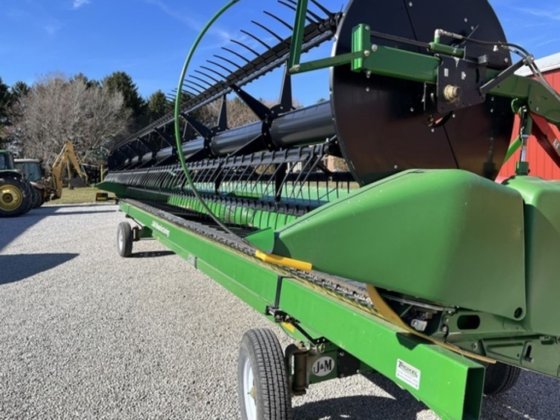
Technical Evaluation Guide: How to Identify a Quality Used, Secondhand, Pre-Owned, Surplus John Deere 635FD Agricultural Harvester Headers made in USA
1. Preparatory / Documentation Review
Before inspecting in person, request documentation and history from the seller. Good documentation often correlates with better condition.
| Document / Information to Request | What to Look For / Why It Matters |
|---|---|
| Serial number, model designation, manufacturing date | Helps confirm exactly what header you are evaluating, check for parts compatibility, identify revision changes over years. |
| Original factory manuals, parts/service schematics, wiring/hydraulic diagrams | These are invaluable for repair, servicing, and parts replacement. |
| Service & maintenance records | Frequent, scheduled maintenance (knife lubrication, draper belt tensioning, reel bearings, hydraulic servicing) indicates a cared-for unit. |
| Repair history, damage / crash reports, refurb work | Previous accidents or repairs may have introduced hidden stress or misalignment. |
| Hours / acres harvested (if tracked) | Gives an idea of usage severity — headers cutting abrasive crops (e.g. grain with sand, weeds, heavy stalks) wear faster. |
| Spare parts included | Replaced or wear parts like knives, draper belts, bearings, belts, wear plates, skid shoes — having these helps reduce future downtime. |
| Warranty, purchase terms, demurrage / return allowance | Even used units with limited return rights or short guarantee reduce risk. |
If the seller cannot provide reasonable history or documentation, treat that as a red flag.
2. External & Structural Inspection
Start with a detailed walk-around, looking for signs of damage, wear, misalignment, or poor maintenance.
Frame, Header Frame & Main Structure
- Check the main frame rails, header backbone, cross-members for cracks, bends, weld repairs, or deformations. Structural damage is difficult to fully repair precisely.
- Look for bent or twisted elements, especially near the ends or midspan of the draper header (where stress is greatest).
- Confirm that all mounting brackets, hitch points, couplers, and pin holes are intact (not elongated, cracked, or distorted).
Draper Belts / Conveyor Belts / Fabric Belts (if applicable in “FD” models)
- Inspect the draper belts (or flexible conveyor belts): check for wear, cuts, fraying, cracking, or uneven elongation.
- Examine the belt edges and splice / seam joints: watch for weak or deteriorated joints.
- See if the belt tracking (alignment) mechanisms are in place and intact (adjusters, edge guides, tensioners).
- Check for sagging, slack, or belt tension irregularities. Uneven tension can cause performance issues.
Draper Bar / Paddles / Flights
- If the header uses paddles or flights over the draper, inspect for broken, bent, or worn flights.
- Check attachment points and fasteners (bolts, rivets) for looseness or fatigue.
Knife System & Cutterbar
- Inspect each knife section, guard (finger), and shear / cutterbar assembly:
- Are the knife blade edges in reasonable condition (no severe nicks, bending, or missing sections)?
- Are the knife bolts / mounting hardware tight, not corroded or absent?
- Check the guards (fingers): are they straight, not cracked, and properly secured?
- Look for bent guard fingers, missing guards, or “splayed” guards (a sign of impact or rough field conditions).
- Examine cutterbar supports, the shear bar(s), and mounting points for bending, wear, or looseness.
Reel & Tines / Fingers
- Inspect the reel frame, arms, tines or fingers:
- Are the reel arms straight, not bent or cracked?
- Check tines / fingers: are any broken, missing, bent, or severely worn?
- Check fasteners, joint joints, bearings in reel hubs.
- Check reel height adjusters, speed adjustment mechanisms, and hydraulic cylinders (if applicable) for leaks, damage, or binding.
Hydraulics, Cylinders & Linkages
- Inspect hydraulic cylinder bodies, rods and seals: look for pitting, scoring, leakage, or corrosion. Extend / retract the rods to check smooth motion.
- Inspect hoses, fittings, valves: check for leaks, damage (abrasion, cracks), replaced or non-OEM parts.
- Look for hardened or welded repair patches or mismatched parts (potentially nonstandard replacements).
Skid Shoes, Fairleads, Wear Plates
- Skid shoes / skid plates (on the bottom edges) should be examined: are they worn flat, excessively thin, or missing?
- Inspect wear plates over the floor, underside, and sidewalls — heavy wear or pitting indicates abrasive material exposure.
- Check fairleads, side panels, end shields, dividers for damage or deformation.
Header Drive Gearboxes / Drives & Couplings
- Inspect all gearboxes, chains, driveshafts, couplers, universal joints, belts:
- Look for evidence of oil leaks, crack in housings, missing seals or plates.
- Check whether couplings or splines show wear or play (looseness).
- Check that seals are in place and not leaking.
Overall Cleanliness & Corrosion
- Evaluate the header’s general cleanliness: excessive buildup of crop residue, rust, or corrosion suggests neglect.
- Look for paint wear / chipping / corrosion especially around moving parts, welds, and edges.
- Inspect for previous repairs or patches, which might hide structural issues.
3. Mechanical & Functional Testing (Motion, Operation)
If possible, power or simulate motion of the header (on the combine or test stand) to test functional components.
Draper / Conveyor Motion
- Run the draper belts (or equivalent) under no load:
- Listen and feel for squealing, slippage, mis-tracking, belt “shudder,” or hesitation.
- Watch for smooth, consistent motion over full length; no “snagging” or sudden velocity changes.
- Under slight load (simulate crop flow or material), test belt grip, torque, and endurance.
Knife Drive / Cutting Action
- Engage the knife (or cutterbar) drive (if possible) at moderate speed (no load first):
- Listen for abnormal vibration, gear whine, knocking, or chatter.
- Check that the knife system starts and ceases reliably, with smooth engagement / disengagement.
- If safe and feasible, perform a test cut in mild vegetation or light crop:
- Check that the cutterbar cuts cleanly, no excessive deflection, no stalling.
- After cutting, inspect the cut edge for quality (cleanness, missed sections, bending).
Reel / Pickup / Feed Mechanism
- Operate the reel (arms moving) through full range:
- Check for binding, jerky motion, slack, vibration, or audible clues of bearing wear.
- Test speed adjustment of the reel if variable; verify smooth adjustment.
- Test fore/aft reel motion (if adjustable) and ensure no binding.
- Under light load (simulate crop flow), see whether the reel holds crop properly (not overspinning or “throwing”).
Hydraulics & Cylinder Function
- Cycle hydraulic cylinders (reel lift, fore/aft, header float, tilt) through full travel:
- Verify smooth motion, no binding or lag.
- Monitor for leaks during pressure hold.
- Check speed consistency and response to control signals.
- Observe the pressure levels if gauges are available; see whether they hold steady under load.
Couplers, Gearboxes, Drives Under Load
- Under operation, monitor gearbox temperatures, vibration, and noises.
- If there is a drive loading test, gradually increase cutting / feeding load and observe component behavior (e.g. drivetrain, belts, couplers).
- Check for play (backlash) or looseness in gearboxes, couplings, shafts.
4. Accuracy, Tolerances & Wear Assessments
To quantify condition, you’ll want measurement checks and wear tolerances.
- Belt alignment / tracking: measure drift or lateral shift. Excessive misalignment suggests worn guides or structure.
- Belt tension / elongation: compare measured belt tension (if instrument available) to OEM spec, check for nonuniform tension across width.
- Knife / guard gap / contact: measure knife-to-guard clearance consistency across the bar. Irregular gaps may show warpage or bending.
- Knife guard finger alignment: check straightness and consistent spacing across the header width.
- Reel arm geometry: measure whether arms are true, not bowed or drifted.
- Wear of wear plates / underside: measure remaining thickness compared to original spec (if known). Excessive loss may weaken structural rigidity.
- Bearing play / shaft runout: use dial indicators (if possible) on shafts, bearings or couplings to measure runout or axial play.
- Hydraulic cylinder rod straightness: visually or with measuring tools check if rods are straight and free of bend or scoring.
If possible, compare these measurements to OEM specifications or tolerances (from the parts manual or manuals).
5. Electrical / Sensors / Control Components (if applicable)
Modern headers often incorporate sensors, control electronics, height sensing, etc. Check these carefully.
- Inspect cabling, harnesses, connectors, connectors’ seals for corrosion, cracks, fraying, or missing shielding.
- Test height sensors, limit switches, position sensors (if incorporated) for responsiveness and stability.
- If the header includes electronic modules (e.g. draper belt control, sensor feedback), test those modules and confirm they still function.
- Inspect control junction boxes and circuit boards (if present) for water ingress, corrosion, insect damage, or prior repairs.
- Check whether the wiring harness is well supported and protected (not zip-tied loosely, not rubbing edges).
6. Hidden Risks, Red Flags & “Deal Breakers”
While inspecting, be alert for these warning signs. A unit with multiple red flags may not be a safe buy.
- Significant structural cracks, weld repairs, or deformation in frame or header structure.
- Severely worn or damaged draper belts (tears, frays, patchwork repairs).
- Missing or broken knife sections, guards, or severely bent guards.
- Reel arms or fingers badly bent or fatigued.
- Hydraulic cylinders that have leaking seals or scored rods.
- Gearbox housings with fluid leaks, cracks, or evidence of overheating.
- Excessive play or looseness in couplings, shaft joints, or drive systems.
- Belt slippage, motion irregularities, or misalignment under test motion.
- Binding, jerky motion, or noise in reel, belt, or knife drive systems.
- Inoperative or imprecise sensors, wiring damage, poor electrical integrity.
- Excessive corrosion, neglect, or accumulation of debris — indications of poor maintenance.
- Mismatched parts, non-OEM replacements, or ad hoc repairs (unless verified by a trusted technician).
- Lack of spare parts availability for critical components (draper belt, sensors, gearboxes).
- Seller forbidding live tests or only offering “visual inspection only” is a red flag.
7. Field / Cutting Trial Test
If the seller allows, perform a real cutting trial to see the header behavior under real load.
- Use a representative crop type (grain, beans, light stalks) at a safe location.
- Observe how the header behaves: does it follow ground contours, maintain cut depth, avoid plugging or stalling?
- Check for uniform feeding across the entire width (no zones dropping off).
- Monitor for vibration, chatter, belt slip, or movement anomalies.
- After trial, inspect the header components for signs of distress (belt damage, guard damage, loosened fasteners).
- Measure finished cuts (e.g. straightness, missed sections) and compare with expectations.
8. Spare Parts, Repairability & Support
Even a nicely functioning header will eventually need replacement parts or repairs. Ensure you have a favorable outlook for ongoing maintenance.
- Check parts availability for draper belts, sensors, hydraulic seals, bearings, knives, guards, gearboxes, etc.
- Check pricing / lead time for critical parts (if items are imported, duty, shipping, availability).
- Determine whether local service / dealers can support this header model (hydraulics, electronics, repairs).
- Assess how easy it is to disassemble, rebuild, or source spare modules.
- Check whether firmware or sensor calibration procedures are documented or available.
9. Summary: Key “Must-Pass” Criteria
When evaluating a used John Deere 635FD or equivalent header, you should insist on passing these critical checkpoints to consider the unit a good purchase:
- Structural integrity — no major cracks, bends, or distortions in frame or header skeleton.
- Draper belt / conveyor condition — belts in good shape, well tracked, no significant damage or slack.
- Knife / cutterbar & guards — knives straight and intact, guards aligned, hardware secure.
- Reel mechanism — reel motion smooth, tines intact, bearings in good condition.
- Hydraulic systems — cylinders and linkages operate smoothly, no leaks, responsive.
- Drive gearboxes & couplings — no leaks, minimal play, consistent power delivery.
- Electrical / sensors & controls — cabling, sensor modules, control elements function correctly.
- Functional motion tests — draper, knife, reel operate without binding or abnormal noise.
- Field trial performance — under load, the header performs uniformly, without slipping, stalling, or uneven feed.
- Parts & support viability — spare components available; technical support feasible in your region.
If a candidate header checks off most of the above and has decent maintenance history, it is likely a sound acquisition.