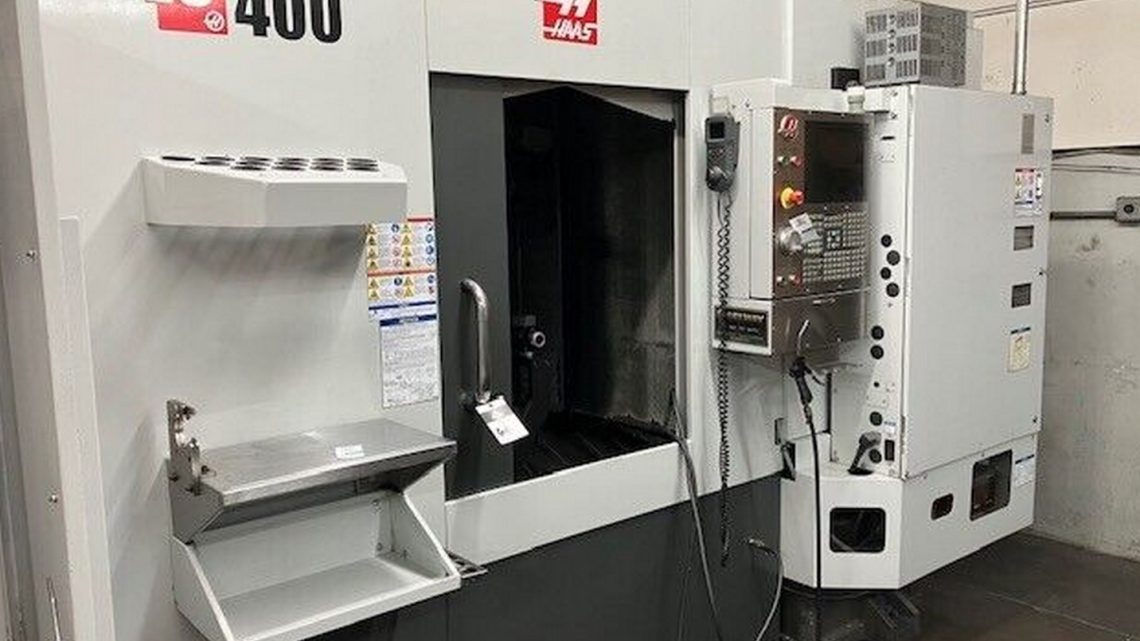
Technical Evaluation Guide: How to Identify a Quality Used, Secondhand, Pre-Owned, Surplus Haas EC-400PP CNC Horizontal Machining Center made in USA?
Below is a professional, factual, SEO-safe technical evaluation guide tailored for assessing a used / second-hand / pre-owned / surplus Haas EC-400PP CNC Horizontal Machining Center (made in USA).
The focus is inspection logic, risk points, and verification steps.
Technical Evaluation Guide
How to Identify a Quality Used Haas EC-400PP CNC Horizontal Machining Center (USA)
1) Machine Identity & Documentation
Start with traceability before touching the machine.
- Serial number & build year: Cross-check the Haas serial plate with control startup screen.
- Configuration sheet: Confirm pallet pool size, spindle options, coolant-through-spindle (CTS), and probing.
- Service history: Look for spindle replacements, ball-screw work, pallet changer service, and control updates.
- Manuals & backups: Electrical diagrams, ladder, parameters, and recent backups reduce commissioning risk.
Why it matters: EC-400PP machines vary widely by options; value and capability depend on what’s actually installed.
2) Spindle Assembly & Drive
The spindle is the costliest risk item.
- Warm-up behavior: Run the spindle through ranges; listen for bearing noise or vibration.
- Thermal stability: Check spindle growth compensation and temperature alarms during extended run.
- Tool retention: Measure drawbar force if possible; inspect taper condition for fretting or bell-mouthing.
- CTS integrity: Verify pressure, filtration, and leaks at unions.
Red flags: Audible rumble at speed, taper fretting, inconsistent drawbar force.
3) Axes, Ball Screws & Linear Guides
Horizontal accuracy depends on axis health.
- Backlash & repeatability: Use laser/ball-bar or dial checks on X/Y/Z.
- Way lubrication: Confirm oil delivery to trucks and screws; inspect metering units.
- Servo tuning: Watch following error under rapid moves and heavy interpolation.
Tip: Palletized horizontals often show more Y-axis wear due to fixture mass—inspect closely.
4) Pallet Pool & Indexing System (PP)
This is the EC-400PP’s defining feature.
- Pallet clamp force: Verify consistent hydraulic/pneumatic clamping.
- Index accuracy: Check 0°/90° repeatability and encoder health.
- Transfer reliability: Cycle all pallets; watch sensors, stops, and interlocks.
- Hydraulics: Inspect pumps, accumulators, hoses, and leak history.
Failure impact: Any PP fault directly reduces unattended productivity.
5) Tool Magazine, ATC & Tool Management
- Pocket condition: Inspect grippers, Geneva, and pocket alignment.
- Change time consistency: Watch for hesitations or recovery alarms.
- Tool length limits: Confirm compatibility with your longest tools and fixtures.
6) Control, Software & Electricals
- Haas control version: Verify firmware supports your probing/macros and pallet scheduling.
- I/O health: Test door locks, pallet sensors, tool breakage, and probing inputs.
- Cabinet condition: Look for heat damage, fan filters, and clean grounding.
Best practice: Power-cycle tests and simulated pallet jobs reveal latent faults.
7) Coolant, Chip Handling & Thermal Control
- Chip evacuation: Inspect augers/conveyors for wear; horizontals generate heavy chip loads.
- Coolant system: Tank condition, tramp oil control, filtration, and pump noise.
- Chiller function: Stable spindle and coolant temperatures are critical for accuracy.
8) Geometry, Squareness & Cut Test
- Geometry checks: Verify squareness between axes and pallet face.
- Test cut: Run a representative part—face milling, pocketing, and drilling—then measure size and finish.
9) Safety, Compliance & Installation Readiness
- Guards & interlocks: Confirm intact and functional.
- Power requirements: Match voltage/phase; review transformer taps.
- Foundation & footprint: Ensure floor load and anchoring are suitable for palletized operation.
10) Commercial Risk Considerations (Non-Pricing)
- Spare parts availability: Haas support is strong in the USA—confirm regional service coverage.
- Downtime risk: Identify any deferred maintenance that could delay startup.
- Training & handover: Availability of parameters, offsets, and prior programs shortens ramp-up.
Summary Checklist (Quick Pass)
- ✔ Verified serial, options, and service history
- ✔ Quiet, stable spindle with healthy drawbar
- ✔ Tight axes with proper lubrication
- ✔ Reliable pallet pool indexing and transfer
- ✔ Clean ATC operation
- ✔ Updated control, healthy I/O
- ✔ Effective chip/coolant management
- ✔ Successful test cut and geometry checks
A well-maintained Haas EC-400PP should deliver repeatable accuracy and high unattended uptime. The key is validating spindle health and pallet pool reliability, as these dominate both performance and lifecycle cost.