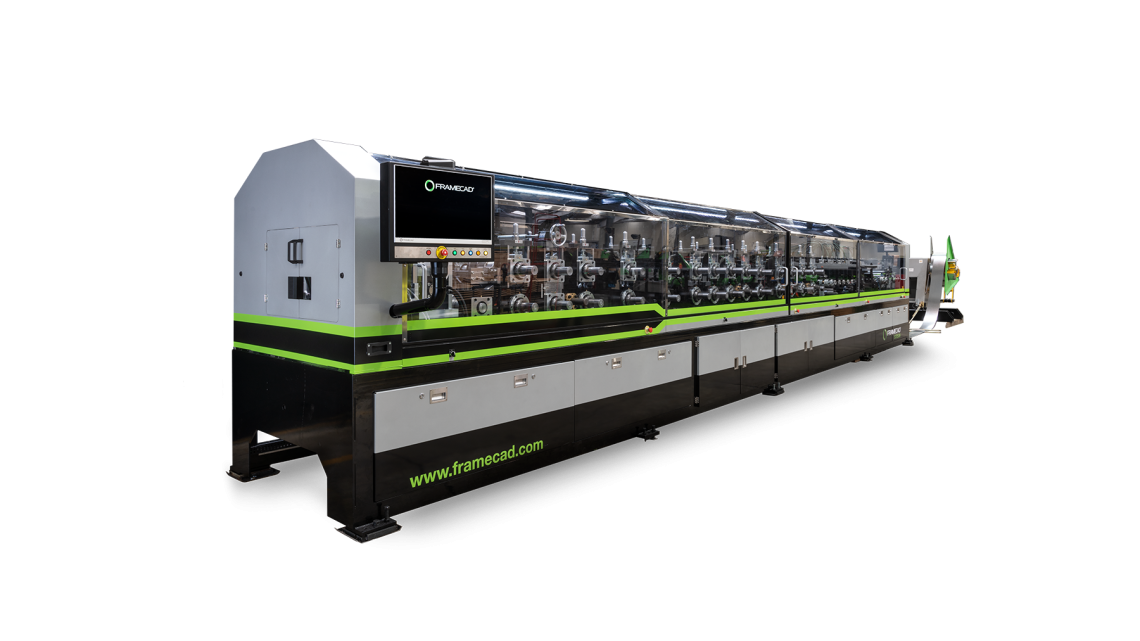
Technical Evaluation Guide: How to Identify a Quality Used, Secondhand, Pre-Owned, Surplus FRAMECAD ST925iT CNC Automated Roll Forming Machine for Multi-Profile Construction Projects made in New Zealand
Reference Specifications & Key Features (Baseline Expectations)
Before inspection, have the manufacturer’s spec sheet for that particular unit (serial number). Use it to benchmark deviations. Below are typical published specifications / features for the ST925iT system:
| Parameter | Typical / Published Value | Source & Notes |
|---|---|---|
| Material thickness range | 0.95 mm – 2.0 mm (approx. 20 – 14 gauge) | FRAMECAD official spec for ST925iT |
| Max line speed (plain C / U profile) | up to ~ 1,680 m/hr (≈ 5,400 ft/hr) | ST925iT datasheet |
| Profile width (web) | ~ 3½″ to 12″ (≈ 89 mm to 305 mm) | listing for ST925iT |
| Profile flange / height | ~ 1.2″ – 2″ (≈ 30 – 50 mm) | listing |
| Number of roll forming stations | ~ 13 adjustable stations | Industry listing for ST925iT |
| Punch / Tooling stations | ~ 10 punching stations (frame & truss tool set) | Industry listing |
| Main drive / motor power | ~ 13.6 kW | ST925iT listing |
| Hydraulic power / pump | ~ 15 kW | ST925iT listing |
| Decoiler capacity | ~ 3,000 kg coil (6,600 lb) | ST925iT listing |
| Machine weight | ~ 10,000 kg | ST925iT “weight approx.” listing |
| Footprint / dimensions | ~ 9.1 m × 1.75 m × ~2.2 m (height) | ST925iT listing |
| Gauge changeability / adaptability | Quick gauge change / servo-driven raft for profile adjustment | ST925iT spec mentions automated raft for rapid profile change |
These specs define the “design envelope.” If your candidate machine is far outside that (e.g. fewer roll stations, much lower drive power, limited punching stations, reduced coil capacity), that may indicate it is a stripped or partial configuration, or heavily modified — not necessarily bad, but you’ll need to check whether the missing parts are serviceable, replaceable, or compromised.
Also note: roll forming machines wear over time — rollers, tooling, guides, hydraulic circuits, servo systems degrade. Having a margin for refurbishment is prudent.
1. Documentation & History Review
Start by demanding and reviewing documentation before physical inspection. Good records reduce risk.
- Original build / manufacturing / configuration drawing: the as-delivered set-up: roll station count, punch tooling, motor ratings, coil capacity, control system version, servo/PLC specification.
- Maintenance / service logs: regular belt/chain servicing, roller polishing, lubrication logs, punch / die tool changes, hydraulic maintenance, filter changes, alignment checks.
- Operating hours & usage profile: how many hours run, total coil throughput, shifts, idle vs loaded time.
- Repair / upgrade / modification history: whether roll stations or tooling have been replaced, modified, repaired; whether the control / servo / PLC has been upgraded; whether structural changes were made.
- Calibration / metrology / roll-profile reports: test reports of profile quality (dimensional measurements vs nominal), straightness, profilometry, rolling tolerance tests from past operations.
- Control / software / parameter backups / logs: version of the control software, parameter files, alarms or error logs, event logs.
- Tooling / spare parts inventory: what punch sets, die sets, spare rollers, spare motors, spare hydraulics are being included.
- Coil / material history: what kinds of steel, thicknesses, coating, tensile strengths were processed historically.
If documentation is missing, vague, or inconsistent, discount accordingly, and plan to rely more heavily on empirical testing.
2. Visual & Structural / Cold Inspection (Power-off)
Next, do a careful visual inspection. Many problems show up in wear, alignment, and condition of the mechanical framework, rollers, guides, and tooling.
Frame, Base, Structural Integrity
- Inspect the machine frame, base, support structure for cracks, weld repairs, distortions, twist, sag. In roll formers, the alignment of the frame matters highly because roll station alignment builds the profile.
- Look for corrosion, pitting, rust especially in lower frames, cross members, weld joints, and under covers.
- Check gussets, stiffeners, bracing — ensure none are missing or weak.
- Look for missing or bent covers, safety guards, chip shields. Missing guarding suggests parts might have been damaged or exposed.
Roll Stations & Rollers
- Examine each roll station: the rollers themselves (top & bottom halves) should be smooth, free of deep gouges, scoring, pits, or corrosion. Such damage leads to profile defects.
- Rollers should rotate freely (if checking by hand) without stick/slip or misalignment.
- Check for runout or wobble in roller shafts. Excessive wobble means worn bearings or misalignment.
- Examine the roll stand faces, supports, and guide rails for wear, scoring, or misalignment.
- Check the central shafts, bearings, pillow blocks, lubrication in roller bearings.
Punch / Die / Tooling Assemblies
- Inspect punch tooling (frame / web / lips / dimples / holes) for wear, breakage, tool edge rounding, chipping, or misalignment.
- Check alignment of punch die / punch face with roll path.
- Examine punch drive assemblies (hydraulic cylinders, servo actuators, cams) for leakage, damage, wear, or misadjustment.
- Inspect die holders, alignment features, and mounting hardware (bolts, clamps) for tightness and no looseness.
Guides, Supports, Material Infeed / Outfeed
- Check material infeed guides, side guides, leveling units — look for wear, misalignment, looseness, damage.
- Inspect outfeed straighteners, support rolls, side supports — misaligned or worn supports can “steer” profile out.
- Check for uniform clearance and symmetric geometry in guiding path.
Hydraulic / Pneumatic Lines & Components
- Inspect hydraulic hoses, pipes, fittings for leaks, abrasion, kinks, bulging, corrosion.
- Check pumps, reservoirs, valves, manifolds: look for evidence of weeping, seepage, welded repairs, or patched parts.
- Inspect control valve blocks, manifold surfaces, seals.
Bearings, Gearboxes, Couplings
- Inspect drive gearboxes, coupling joints, chain / belt drives, servo drive couplings. Look for looseness, vibration damage, wear, cracked couplings.
- Check that all covers to gear / coupling housings are present; missing covers may allow contamination.
Electrical / Control / Cabling
- Open control / PLC enclosures: check for wiring cleanliness, no burned insulation, no excessive wiring modifications or splices, no signs of overheating or cooling damage.
- Cable carriers, trailing cables: check for broken links, exposed wires, routing issues, slack, bends beyond allowable radius.
Decoiler & Recoiler Unit
- Inspect the decoiler mandrel mechanism: check for straightness, mandrel rods, bearings, expansion mechanisms, locking mechanisms, whether the decoiler is robust and well aligned.
- Inspect payoff drive, dancer arm, tension control elements, brakes, clutch, coil supports.
- For recoiler (if present), examine rewind mandrel, motor or drive mechanism, winding alignment, tension control.
3. Mechanical / Kinematic / Static Checks (Safe / Manual Movements)
If safe and permitted, perform some manual or jog-mode movements to sense mechanical integrity, backlash, stiffness, and misalignments.
Roll Station / Roller Movement Tests
- Slightly rotate rollers (if possible manually or via slow jog) to check for smooth rotation, no binding, no jerk or stuck points.
- Reverse direction and check for mechanical backlash in roller bearings or shafts.
Punch / Die Actuators
- Manually actuate (if possible) or command punch / die movements in manual mode. Observe how smoothly punches engage and retract. Any jerky, lagging, or hesitation is suspect.
- Check alignment: do the die and punch surfaces align squarely, no tilt, no skew?
Infeed / Outfeed Carriage
- Jog infeed / side guide / leveling carriages in lateral direction: watch for smooth motion, no binding or stick-slip behavior.
- Reverse direction, measure any backlash.
Drive Train & Gearboxes (Static Checks)
- Turn drive shafts/couplings by hand (if physically possible) to sense binding, stiff zones, backlash in gearboxes or couplings.
- Listen for noise or feel for roughness.
Decoiler Manual / Brake Check
- Check that the decoiler expands / contracts mandrel properly, locks securely, and is free of wobble.
- Check tension control elements, dancer arm movement, brake / clutch functionality in static mode.
If any of these manual checks reveal excessive binding, backlash, misalignment, or mechanical play, those are warning signs calling for deeper scrutiny.
4. Power-On / Dynamic / Functional Testing
With safety precautions and power available, run dynamic tests to assess real performance under motion, load, and control.
Control / PLC / Servo System
- Power up PLC / servo / control system. Observe boot-up, error logs, alarm history, parameter warnings, any disabled axes.
- Open control interface: run diagnostics, check for fault codes, event / alarm logs.
- Test operator interface: jog, manual / automatic modes, override, incremental commands.
- Engage Homing / reference cycles for axes (roll axis position, punch axis reference, infeed axes) and ensure homing operations are repeatable and stable.
Roll Forming Motion Test (No Load)
- Run a roll-forming pass without material (or very light test strip). Observe motion, acceleration, deceleration, smooth transitions.
- Listen for abnormal noise: chatter, bearings, gear whine, motor humming, vibration.
- Watch the synchronization of rolls: all roll stations should rotate in phase, no mis-tracking or slippage.
- Observe servo response: whether axes respond smoothly to commands with no lag or oscillation.
Punching / Tooling Motion Under Control
- Activate punch / die operations (with no or light material) in sequence. Check for smooth, synchronized motion, no jerk, misfire, misalignment.
- Verify that the punch return, die retraction, synchronization with roll forming is correct.
- Check whether the punch timing matches the roll forming feed precisely; any lag or deviation affects profile accuracy.
Profile Production Test (Under Material Load)
- With a suitable test coil (within acceptable material range), run actual roll forming and punching to produce a profile sample length (e.g. a few tens of meters or more).
- Inspect the produced profile:
- Measure critical dimensions (web width, flange, lip, hole positions) vs nominal tolerances.
- Check for roundness, twist, warpage, straightness along length.
- Inspect punch holes / dimples: clean edges, correct positioning, no distortion.
- Check edge quality: burrs, edge deformation, lip cut, flange cuts and chamfers.
- Monitor system during production: servo power / current draw, hydraulic pressure stability, motor temperatures, vibration, noise.
Repeatability & Return Accuracy
- Stop and restart the machine, or move to defined positions, then resume forming: check whether the system returns accurately and maintains continuity.
- Perform multiple short runs interrupted and resumed: check transition consistency.
Thermal / Warm-Up Drift Test
- Operate for an extended period (e.g. 30–60 min or longer). Then measure reference sample dimensions before and after warm-up to detect drift.
- Monitor motor / drive / hydraulic / gear head temperatures and observe whether temperature gradients affect geometry or precision.
Stress / Overload Behavior (if safe)
- Slightly stress the machine (within safe limits) to see how it behaves under near-maximum load: look for signs of slippage, overload alarms, servo instability, or inaccuracy creeping in.
5. Metrology / Precision & Profile Verification
To validate quality, you must perform dimensional metrology and profile testing.
- Use calipers, micrometers, profile gauges, CMM (if available) to measure produced profile dimensions over length (start, middle, end). Look for deviation, taper, drift.
- Straightness / runout: place straight-edge or reference and measure deviation of flanges or web along length.
- Flatness / twist: check if profile is twisted or not planar.
- Hole / dimple position accuracy: measure distances of punched holes or features from datum to check tolerance compliance.
- Repeatability: produce same profile in separate runs, compare results.
- For critical profiles, perform cross-sectional measurement at intervals (e.g. every meter) to check uniformity.
- For roll stations, check roll-to-roll alignment by measuring key reference roll axes with dial indicators or laser alignment tools (if available).
- If possible, measure backlash, pitch error, servo response under load cycles.
6. Red Flags & Warning Indicators
Watch carefully for these signs — any of them should raise concern, demand explanation, or be grounds for negotiation.
- Severe wear or damage to rollers (gouges, pitting, scoring) — directly degrade profile quality.
- Roller wobble or misalignment — indicates worn bearings or shaft issues.
- Punch / die tooling damage or misalignment — chipped edges, mis-seated punches, worn punch edges.
- Hydraulic leakage — hoses, valves, cylinders, seals.
- Control / servo faults, frequent alarms, unstable performance.
- Excessive vibrational noise / gear whining / servo hunting during motion tests.
- Material feed / infeed guide misalignment or damage — leads to skewed profiles.
- Decoiler problems: mandrel wobble, mis-expansion, brake / clutch drift.
- Thermal drift: major dimensional shifts after warm-up.
- Tooling drift / punch offset variation after runs.
- Structural repairs, welds, frame distortion especially around roll station mounts.
- Missing or damaged safety covers, guards, machine protection — may hint at past damage or neglect.
- Poor or no maintenance records — in a precision forming machine, lack of service history is high risk.
- Hard-to-find spare parts, obsolete control modules — if critical parts cannot be replaced, machine lifespan is limited.
If you see multiple red flags, weigh whether repair cost justifies acquisition.
7. Refurbishment / Repair Cost Estimation & Risk Buffer
Even a well-preserved machine may require replacement or refurbishment of critical subsystems. In your offer or budget, include:
- Roller refinish or replacement if worn.
- Bearing replacement in rollers, punch / die shafts, gearboxes.
- Punch / die tooling renewal or precision regrind.
- Hydraulic pump / valve overhaul or replacement.
- Servo / motor rebuild or replacement (drive ends, coils, bearings).
- Decoliler / mandrel maintenance or repair.
- Alignment, calibration, test forming, metrology verification.
- Electrical / control system repairs or updates.
- Replacing or repairing covers, guards, cabling, sensors.
- Recommissioning, installation, leveling, alignment in your site.
- Contingency for hidden issues (10-20 % margin or more).
8. Contract & Purchase Safeguards / Acceptance Protocols
To protect your investment, insist on these contract/test items:
- Acceptance / test run clause: operate the machine for a defined hours / production length in your facility (or during site visit) before final acceptance.
- Tolerance / performance criteria schedule: define allowable tolerances in profile dimensions, repeatability, rolling precision, punch accuracy, control stability.
- Sample profile test: bring test coil / standard profile design to produce in situ; measure the output and compare to spec.
- Third-party inspection clause: allow a roll-forming specialist or metrology firm to validate your test results before closing the deal.
- Warranty / guarantee (for critical subsystems) for a short period: roller bearings, punch drives, servo / control parts.
- Holdback / escrow: retain portion of payment until acceptance.
- Disclosure clause: seller must disclose known wear, repairs, quirks, or modifications.