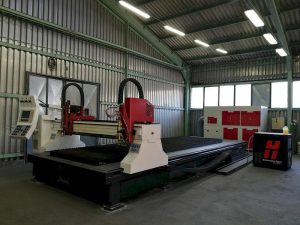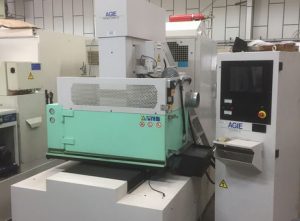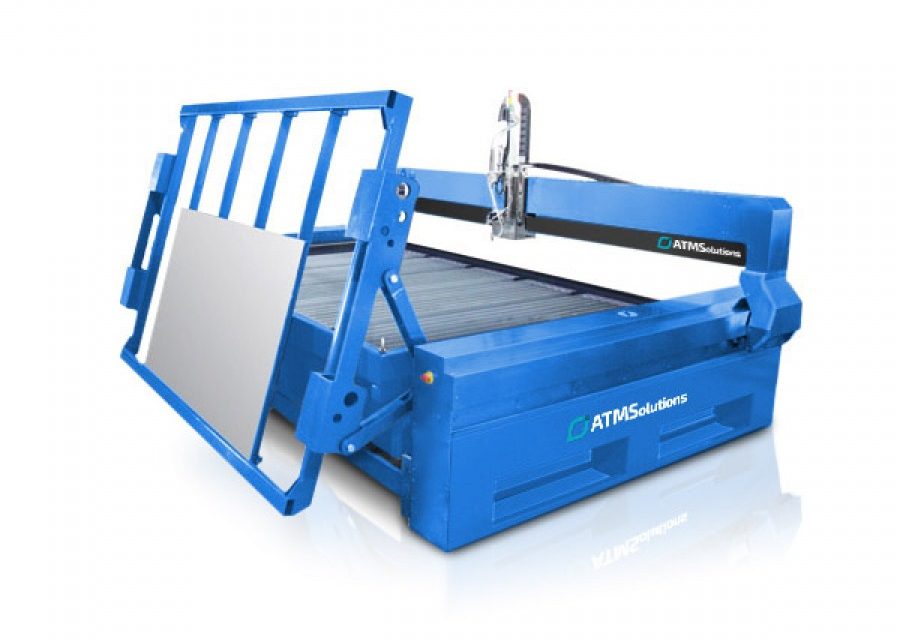
Technical Evaluation Guide: How to Identify a Quality Used, Secondhand, Pre-Owned, Surplus ATMSOLUTIONS 2060-B ATMS CNC WaterJet made in Poland
1. Baseline / Reference Specifications & Features
Before inspection, ask the seller to provide the original spec sheet / build sheet for that specific unit. Use it to benchmark what you see. Meanwhile, here are published specifications of the ATMS 2060-B WaterJet that serve as useful reference points:
- Working / cutting area: 2000 × 6000 mm (2 m × 6 m)
- High pressure / velocity: uses an efficient pump capable of generating high pressure, with water exit speed up to ~ 4,000 km/h (used to express jet velocity)
- Manufacturer: ATMSolutions, Poland (Polish CNC machine tool builder)
- Machine family: ATMS offers WaterJet machines in multiple working area sizes (from 500×500 mm up to 6,000×12,000 mm) in series (portal / B-series etc.)
- Materials capability: the machine is advertised to cut a wide range of materials (metals, glass, composites, aluminum, etc.)
Because the 2060-B is a large-format machine, rigidity, stability, pump health, abrasive wear, cutting head integrity, and motion precision are critical.
2. Documentation & History Review
Before or during your inspection, collect all possible documentation. Good records help verify condition and reduce risk.
- Original build / factory specification sheet — including pump type, max pressure, nozzle / orifice size, abrasives used, abrasive flow systems, motion control specs, gantry design (bridge, single-arm, etc.).
- Service / maintenance logs — record of pump servicing, seal replacements, nozzle / orifice changes, abrasive system (abrasive hopper, abrasive feed, mixing chamber) maintenance, alignment checks, motion system maintenance.
- Operating hours & usage profile — total runtime, hours under cutting vs idle, material types processed, abrasive volumes passed through.
- Repair / modifications / upgrade records — whether the pump / intensifier has been rebuilt, heads replaced, control electronics updated, gantry re-leveling, structural repairs.
- Calibration / alignment / test cut records — past cutting tests with dimensional measurement, straightness / planarity checks, motion compensation logs.
- Parts / consumables inventory — spare nozzles, orifices, mixing tubes, abrasive feed parts, high-pressure seals, pump spare parts.
- Control / CNC / motion controller backups / logs / software versions — motion parameters, cut programs, error histories.
- Electrical & hydraulic schematics / piping diagrams — expect pump / intensifier circuits, high-pressure piping, resonant vibration dampers, etc.
If documentation is lacking or sketchy, you must rely more heavily on hands-on tests and demand stronger guarantees or price mitigations.
3. Visual & Structural / Cold Inspection (Machine Unpowered)
With the machine off, visually inspect structure, mechanical parts, alignment, condition of components — many signs of abuse or wear show up outwardly.
Frame, Gantry, Support Structure
- Check the main frame, gantry (bridge or portal), cross beams, support legs for cracks, weld repairs, distortions, bending. Large format machines are sensitive to structural misalignment.
- Inspect for corrosion, pitting, rust, especially in lower beams, corners, welded joints, underside, or in areas where water / abrasives may collect.
- Confirm that covers, walking platforms, protective guards, spray curtains, splash shields are present and intact. Missing guards might indicate prior damage or removal.
- Inspect structural joints, anchor points: no looseness or gaps.
Rail / Guideways, Linear Motion Systems
- Examine linear rails, guideways, box ways or linear bearings along gantry travel axes for signs of scoring, wear, rust, pitting, misalignment.
- Check lubrication wipers, bellows, protective covers over rails; if these are damaged, abrasive contamination is likely inside.
- Look at carriage / saddle surfaces (gantry carriage) for wear.
Cutting Head / Nozzle Assembly
- Inspect the nozzle head, mixing chamber, abrasive feed line, orifice and mixing tube installation area. Look for signs of leakage, erosion, pitting, damage at exit geometry.
- Inspect seals, bearings or pivots on the head (if the head can tilt / rotate), check for play or looseness.
- Check optical / sensor ports (if any) and their seals.
Pump / Intensifier / High-Pressure Piping
- Inspect high-pressure pump or intensifier unit: housing, seals, mounting. Look for signs of leakage, past repairs, cracks, stress marks.
- Check high-pressure piping, hoses, couplings, fittings: look for external damage, fatigue, corrosion, weld repairs, or leakage hints.
- Inspect the mounting foundation for pump: ensure rigid mounting, no deformation.
Abrasive Feed / Hopper / Delivery System
- Inspect abrasive hopper, feed lines (dry / slurry), valves, feeders, chutes. Look for wear in linings, wear patterns, erosion damage.
- Check abrasive metering valves, control systems, and hopper supports for structural integrity.
Water / Catchment / Sump / Plate / Table
- Examine the table, cutting bed, slats or catch plate area: wear, misalignment, damage, corroded supports.
- Check for leaks in table drainage, catchwater tanks, sump walls, joints.
- Verify that the draining / filtration / recycling system (if present) shows no signs of neglect, corrosion, or leaking.
Electrical Cabinets, Wiring, Controllers
- Open cabinet enclosures: inspect wiring, terminations, power modules for signs of overheating, discoloration, moisture damage, corrosion, loose wires.
- Check cable tracks, control cable routing, connections to motion axes and head.
- Inspect any control panels, displays, operator interfaces for wear, damage, missing parts.
4. Mechanical / Static / Kinematic Checks (Manual or Slow Jog)
If safe to jog axes (in manual / low speed mode) or move them slowly, test mechanical smoothness, alignment, backlash, stiffness.
Axis Movement & Carriage / Gantry Travel
- Jog the gantry / X-axis and Y-axis (if applicable) slowly over parts of travel. Feel for binding, stick/slip, jumps, gritty zones, uneven resistance.
- Reverse direction and measure backlash / dead zone via dial indicator (± small commands).
- At multiple positions along travel, place a test indicator to check for vertical deflection or sag across span of travel.
Cutting Head Motion (Z-axis, tilt / rotation, or swiveling mount)
- Jog the Z vertical axis (if independent) and check for smoothness, no binding, consistent resistance throughout.
- If head has tilt / swivel, jog those motions and observe if movement is smooth, with minimal play or hysteresis.
Orifice / Nozzle Assembly Play
- With the head in a stationary pose, attempt small movements or simulate lateral loads to sense looseness or backlash in mounting or pivot joints of head. Any play is adverse to precision cutting.
Pump / Pressure Static Check
- If possible (without full pressure), turn the pump in safe idle mode and observe whether it starts smoothly, has vibration or unusual noise.
- Check for leaks in pump housing, couplings, or connections under static rotation.
Abrasive Feed System
- Cycle the abrasive feed / metering mechanism in manual mode (if safe). Inspect for smooth valve action, consistent flow, leakage, jamming points.
Table / Bed Static Checks
- Check table flatness, structural alignment of supports, wear or sag of slats.
- Inspect catchment slats or grate for straightness, warpage, damage.
5. Power-On / Dynamic / Operational Tests
With power, and under safe / controlled conditions, perform motion, pump, head, and cutting trials (if possible). These tests reveal how the machine behaves when “working.”
Control / CNC / Motion Setup
- Power on the controller, watch boot-up, error or warning logs, parameter initialization.
- Test the control UI, jog / manual modes, axis move commands, motion overrides.
- Run homing / referencing cycles for gantry axes, Z axis, head orientation axes. Confirm consistent referencing.
- Execute a motion-only program (no cutting) that moves gantry, head, Z, tilt, etc. through composite paths to test coordination, detect collisions or stalls.
Axis Motion Under Power
- Run gantry / X / Y moves at various speeds, observe vibration, resonance, smoothness, and synchronization.
- Test return-to-zero / reference accuracy: move to a known point and return repeatedly; measure deviation.
- During motion, use external and internal sensors (if available) to detect drift, axis error, oscillations.
Pump / Pressure / Cutting Readiness Test
- Ramp the pump (or intensifier) slowly to intermediate pressure (if safe without full abrasive). Listen / feel for pump smoothness, vibration, pulsation.
- Monitor pressure gauge, fluctuations, leaks under pressure.
- If safe, bring pump to full pressure (if testing conditions allow) but without abrasive, check high-pressure system integrity.
Cutting Test (with material & abrasive)
- If acceptable and safe, run a cutting trial with material representative of intended work (thin steel, aluminum, composite, etc.), within machine’s specified envelope.
- Observe cutting behavior: smoothness, cut quality, speed, kerf consistency, edge finish, taper, dross.
- Measure the cut part dimension and compare to programmed path, checking deviation.
- During cutting, monitor pump pressure consistency, head stability, motion axes’ load, vibration, current draw on motion axes.
Repeatability / Multi-Cut Stability
- Run multiple cuts (same shape) sequentially, without resetting start reference. Check whether each part aligns / matches the previous within tolerance.
- Stop machine mid-cut, resume: check alignment / seam matching consistency.
- Test cornering / direction change behavior of gantry and head to see if corners are sharp or show lag / rounding.
Warm-Up / Thermal Drift
- Run the machine (pump + motion) continuously for a period (30–60 min or more), then re-check cut alignment, reference moves, dimensional drift.
- Monitor component temperatures (pump head, gantry bearings, linear guides) and observe whether temperature rise correlates with drift in geometry or cut quality.
6. Metrology / Alignment & Performance Verification
To confirm true viability, perform dimensional / metrology checks and performance trials.
- Straightness / linearity: over gantry travel, measure deviations from ideal straight path (e.g. between two points).
- Flatness / planarity: across the table or cutting bed (if planar), check that surface is flat and level.
- Positioning repeatability: command same point repeatedly and measure deviation.
- Cut-path accuracy: for a test geometry, measure deviations of cut edges from intended paths.
- Head alignment / angle accuracy: check tilt or rotation axis accuracy by cutting reference patterns (if head orientation involved).
- Thermal repeatability: compare measurements before and after warm-up to see geometry drift.
- Edge quality and kerf uniformity along cut: measure width variation, taper, and dross.
Use high-precision measuring tools (CMM, laser tracker, coordinate measuring arms) where possible, or precision gauges, micrometers, calipers if necessary.
7. Key Red Flags & Warning Signs
During your inspection, particular signs should raise alarms. Be wary of:
- Cracks, weld repairs, or frame distortions in gantry / frame structure.
- Severe wear, scoring, rust, or misalignment in linear guides / rails.
- Head oscillation or play in tilt / swivel axes.
- Erosion, pitting, or inconsistency around nozzle / orifice area, indicating improper maintenance.
- High-pressure piping leaks, weakening of couplings, corrosion at joints.
- Pump / intensifier excessive vibration, noise, pulsation, or past repair evidence.
- Abrasive feed system jamming, uneven flow, wear in metering valves.
- Poor cut quality in test, large deviations, edge taper, dross accumulation.
- Inconsistent pressure during cut, pressure drop spikes.
- Poor repeatability between sequential cuts or after machine warm-up.
- Control / motion errors, axis stalls, servo instability.
- Missing protective covers, exposure to spray, poor guarding.
- Corroded, damaged, or missing wiring, control modules.
- Lack of maintenance history or missing critical spare components.
Any of these points significantly increase risk and should push you to demand repairs, discounts, or walk away.
8. Refurbishment / Risk Buffer & Cost Estimate
Even a “good” used waterjet often requires reconditioning or replacement of critical parts. Before purchase, allocate budget items like:
- Pump / intensifier overhaul (seals, pistons, valves) or replacement if worn.
- Replacement of nozzle, orifice, mixing tube and head internals.
- Repair or replacement of high-pressure piping, couplings, fittings.
- Re-alignment or refurbishment of gantry rails, linear guides, bearings.
- Head joint / pivot / tilt axis rebuild or bearing replacement.
- Abrasive feed system refurbishment (hopper liners, metering valves, chutes).
- Control system / servo / drive electronics overhaul.
- Calibration, alignment, test cuts, metrology validation after installation.
- Replacing covers, guards, cable carriers, wiring repairs.
- Rigging, installation, leveling, foundation work at your site.
- Contingency buffer (10–20 % or more) for hidden internal wear or issues.
9. Contract / Acceptance Safeguards & Test Protocols
To protect your investment, ensure your purchase agreement contains the following:
- On-site test / burn-in clause: allow you to run the machine (pump + motion + cuts) for a defined number of hours or produce a test workpiece after installation before final acceptance.
- Acceptance criteria / tolerance schedule: define acceptable ranges of deviation for dimensional cuts, positioning, repeatability, drift.
- Sample cut test: bring your test materials / part program so you can generate a reference cut and measure it.
- Independent inspection clause: allow a third-party metrology / machine-tool specialist to verify performance before final payment.
- Warranty / guarantee on key subsystems (pump, head, motion axes) for a limited period after acceptance.
- Retention / hold-back: retain part of payment until acceptable performance is demonstrated.
- Disclosure requirement by seller: mandate that seller reveal known conditions, repairs, modifications, and wear issues.