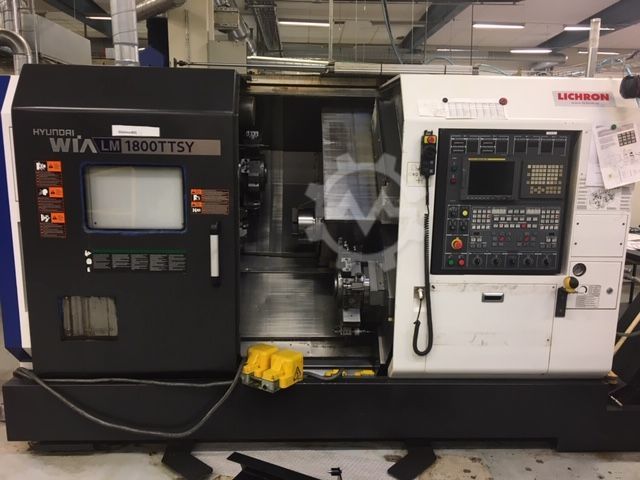
Technical Buyer’s Handbook: Assessing Pre-Owned , Used , Secondhand, Surplus CNC Machines Before Purchase Hyundai LM1800TTSY CNC Turning Center made in South of Korea
Here is a Technical Buyer’s / Due-Diligence Handbook / Inspection Checklist for assessing a pre-owned / used / surplus Hyundai WIA LM1800TTSY CNC turning center (made in South Korea). Use this as a template; adapt tolerances, weightings, and priorities to your shop’s size, material, and precision needs.
0. Reference / Benchmark Specifications (LM1800TTSY)
Before arriving at the site, collect or confirm the spec sheet for the exact machine (serial number, options) so you know your target benchmarks. Below are typical published specs found in sales / OEM literature:
| Parameter | Typical / Published Value |
|---|---|
| Maximum turning diameter | ~ 230 mm (≈ 9.1 inch) |
| Maximum turning length | ~ 673 mm (≈ 26.5 inch) |
| Swing over carriage / cross slide | ~ 289 mm (≈ 11.4 inch) |
| Chuck size (Main / Sub) | 8″ / 8″ |
| Spindle speed (max) | 5,000 rpm |
| Spindle motor power | 30 hp (≈ 22.4 kW) on main, lower continuous rating possible |
| Bar capacity (main / sub) | ~ 65 mm (≈ 2.6 in) |
| Axes travels (X1/X2, Z1/Z2, Y) | X1 ≈ 165 mm / X2 ≈ 195 mm; Z1 ≈ 700 mm / Z2 ≈ 720 mm; Y ±50 mm (3.9″) |
| Rapid traverse rates | X axes: ~ 20 m/min; Z axes: ~ 40 m/min; Y axis: ~ 7.5 m/min |
| Tool turret / stations | 2 × 12 tool stations (standard) |
| Floor space / weight | Approx. 3,660 × 2,000 mm footprint, weight ~ 8,000 kg |
| Control / features | Fanuc / customizable CNC; twin-spindle, dual turret, Y-axis live tooling possible |
These are reference benchmarks. A used unit will deviate; your job is to evaluate whether deviations are acceptable or repairable.
I. Pre-Inspection / Remote Phase
Before visiting, gather as much documentation, photos, and clarifying data as possible:
- Request documentation
- Mechanical, electrical, hydraulic (if any), lubrication manuals
- Wiring diagrams, I/O maps, CNC parameters, axis compensation files
- Maintenance / repair logs: spindle rebuilds, turret repairs, axis overhauls
- Calibration / alignment / inspection certificates
- Retrofit / option history (Y-axis addition, live tooling, control upgrades)
- Spare parts list / BOM
- Get photos & videos
Ask for images or video of:- Entire machine (front, sides, back)
- Spindle area, turrets, tool holders
- Axis guide rails, ball screws, ways
- Control cabinet, drive modules, wiring
- Motion demonstration (jog X, Z, Y, turret indexing)
- Key questions to ask
- Year, serial number
- Total spindle / machine running hours
- Operating history (load, materials, shops)
- Reason for sale
- Known faults, collisions, repairs
- Options installed (Y-axis, live tooling, sub-spindle, tailstock)
- Control software version, backups
- Bring inspection / measurement tools
- Dial indicators, test bars, micrometers
- Straight edges, granite plates
- Laser alignment devices (if possible)
- Thermography / IR camera
- Vibration sensor / accelerometer
- Tools to open panels
- Logistics & site assessment
- Rigging plan, crane / hoisting access
- Foundation / floor strength, flatness
- Power supply (voltage, kVA, phases)
- Coolant, chip removal systems, ventilation
- Clearance around machine
II. Visual & Structural / Static Inspection (Power-Off)
Do a methodical walk-around before powering the machine.
1. Frame, Bed, Structure
- Inspect casting, bed, base, column for cracks, welds, distortion
- Look for evidence of foundation settling, shim changes
- Check for corrosion, coolant damage, pitting around slideways
- Examine covers, guards, bellows, way covers, seals
2. Linear Axes, Guideways, Ball Screws
- Inspect guide surfaces for wear, scoring, pitting
- Check carriage blocks / turrets for looseness or play
- Inspect ball screws, nuts, coupling connections for wear or backlash
- Manually (if safe) slide axes to sense friction or binding
- Lubrication system check: lines, blockages, leaks
3. Spindles & Turrets (Upper / Lower)
- Inspect spindle noses, tapers, clamping surfaces
- Check for signs of overheating, discoloration, oil leakage
- If possible, mount test bar for static spindle run-out check
- Inspect turret indexing mechanisms: locking, backlash, gear teeth
4. Y-Axis / Live Tools (if equipped)
- If Y-axis installed, inspect cross-slide and Y-axis bearings / guides
- Check live tooling spindles, collets, coupling alignment, backlash
5. Tool Holding & Tool Magazine (if present)
- Inspect tool holders, pockets, tool change arms for wear, damage
- Check sensors, indexing alignment, grippers
6. Electrical Cabinets / Drives / Wiring
- Open cabinets (if permitted); inspect wiring, connectors, terminal blocks
- Look for hot spots, discolored wires, burnt insulation
- Inspect drive modules, control boards, I/O cards for damage or dust
- Check cable routing, strain reliefs, shielding
7. Safety Interlocks & Limit / Home Switches
- Check E-stop buttons mechanically
- Inspect guard doors, interlock switches
- Verify limit / home / reference switches for axes
III. Power-Up & Functional / Dynamic Testing
Once static inspection is satisfactory and safety assured, carefully power up and run dynamic tests.
1. Control & Diagnostic Startup
- Power on CNC / control; monitor boot, error logs, alarms
- Check that parameter memory and configuration load correctly
- Verify I/O input states (limit, home, interlocks)
- Jog axes at low speed; monitor for smooth motion, no binding
2. Homing / Reference Cycles
- Execute homing / referencing on all axes (X1, X2, Z1, Z2, Y)
- Repeat homing multiple times; measure repeatability of home positions
- Test limit switch triggering safely
3. Axis Traverse / Motion
- Move axes over full safe travel range (within safe limits) to test smoothness
- Command precise moves (e.g. 100 mm) and measure with dial gauge, laser, etc.
- Reverse direction and check backlash / mechanical clearance
- Run multi-axis moves (e.g. X + Y) to test coordination (if applicable)
4. Turret / Tool Indexing Test
- Cycle tool changes repeatedly; check indexing times, smooth locking, consistency
- Test upper and lower turret simultaneously (if allowed)
- Try different tool lengths / diameters
5. Spindle / Turning / Turning with Sub-Spindle
- Run main spindle at low rpm, then ramp up; listen for abnormalities
- If sub-spindle present, test tail-off operations, part transfer
- Monitor spindle motor current, vibration, temperature
- If possible, mount test bar for dynamic run-out under rotation
6. Y-Axis / Live Tool Testing (if enabled)
- Move Y-axis across travel; check backlash, smoothness
- Activate live tools, test rotational speed, torque, coolant supply
7. Test Work / Machining Simulation
- Execute a light turning or sub-spindle transfer cycle using real material (if safe)
- Measure part geometry vs program — verify tolerances
- Run repeated cycles to detect drift, thermal effects, alignment shift
8. Safety / Fault Handling Tests
- Press E-stop mid-motion / spindle; machine must stop cleanly
- Trigger limit switches / home, ensure axes respond properly
- Simulate a sensor fault or disabled signal (if safe) and monitor error handling
- Open guard door during idle / safe motion to check interlock behavior
9. Stability / Run-In / Drift Test
- Let axes run or idle for extended time (30–60 min) to let thermal conditions stabilize
- After warm-up, re-check key motions, backlash, repeatability
- Monitor temperatures of motors, drives, spindle, cabinet
- Use thermography / vibration tools to detect anomalies
IV. Precision, Calibration & Accuracy Testing
After thermal stabilization, perform precision verification tests.
- Repeatability test: go to a fixed point, retract, return, measure deviation
- Grid / mapping test: command a pattern across axes and measure positional deviation
- Squareness / orthogonality check: e.g. move X then Z vs Z then X, compare result
- Turret overlay & tool offset calibration
- Under load / offset conditions (heavier part, extended tool), check deflection / error
- If you have a laser interferometer or calibration equipment, map axis error curves
- Compare measured errors vs your acceptance tolerances or OEM specs
V. Documentation & History Review
After tests, analyze all available documentation and history.
- Maintenance / repair logs (spindles, turrets, axis rebuilds)
- Calibration / alignment certificates
- Retrofit / options installed (Y-axis, live tooling, upgraded control)
- CNC / software version history and backup files
- Spare parts inventory included (spindles, turrets, tool holders, drives)
- Tooling, fixtures, ancillary items
VI. Risk Assessment, Life-Remaining Estimate & Cost Forecasting
Based on findings, build a risk / cost model.
- High-wear subsystems: turret drives, spindle bearings, linear guides, ball screws, live tool spindles
- Spare part availability for Hyundai WIA, turret modules, control electronics
- Expected calibration, alignment, and compensation work post-relocation
- Cost to recondition high-stress components
- Transport / installation risk (shock to spindles, alignment shifts)
- Downtime / commissioning cost
- Control / electronics obsolescence risk
- Salvage / fallback value
You may create a weighted condition scoring table (structure, axes, spindle, turrets, control) to guide your maximum acceptable offer.
VII. Contractual Safeguards & Negotiation Clauses
Use your inspection as leverage to include protective clauses:
- Acceptance test clause: final payment contingent on passing your functional / precision tests after installation
- Price adjustment / penalty clause: if deviations exceed agreed tolerances, seller pays repair costs
- Warranty / latent defect clause: e.g. 6-months on hidden defects (spindle, bearings, control)
- Spare part / tool kit clause: seller must supply critical wear parts (turret modules, seals, bearings)
- Documentation handover clause: ensure all manuals, wiring, CNC backups, alignment data are delivered
- Transport / insurance clause: define liability for damage during shipping / handling
- Commissioning / support clause: seller or their technician must assist on-site during commissioning
VIII. Post-Purchase / Installation & Commissioning Checklist
Once the machine arrives in your facility and is installed:
- Foundation, leveling, anchoring, vibration isolation
- Clean and flush lubrication / coolant / hydraulic systems; replace filters / fluids
- Reconnect wiring, safety interlocks, guards
- Power-up and re-run full acceptance / dynamic / precision test suite
- Perform alignment, geometric calibration, compensation (error mapping)
- Run test parts in actual production materials, verify tolerances
- Record baseline performance (repeatability, drift, backlash)
- Train your operators & maintenance staff
- Establish preventive maintenance schedule (turret checks, spindle monitoring, lubrication)
- Closely monitor performance (trend data) in early production weeks