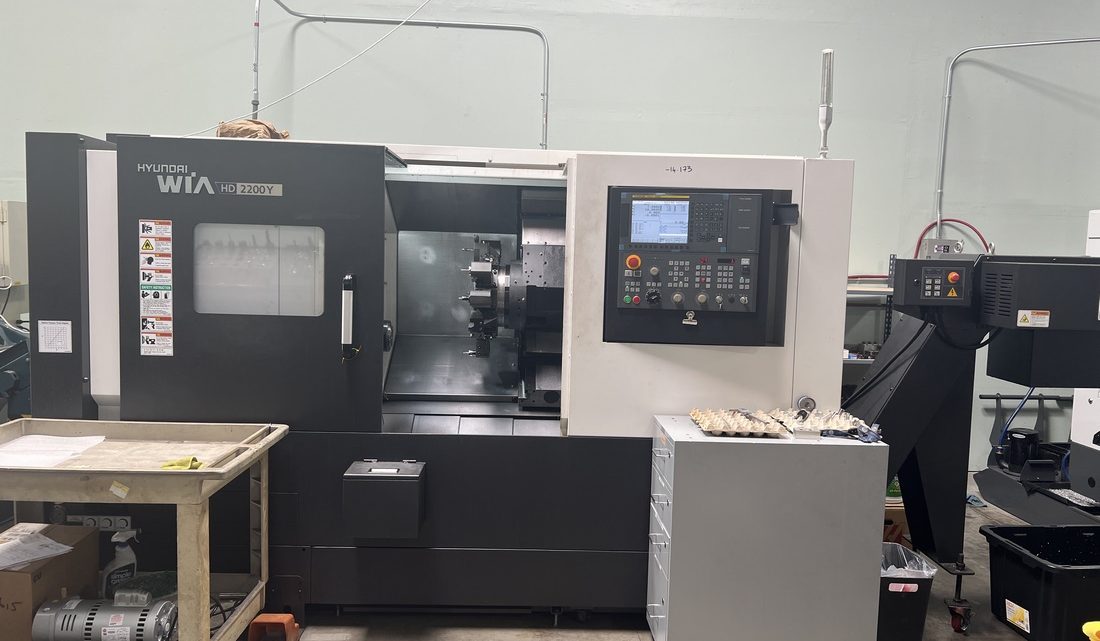
Smart Buyer’s Guide: How to Choose the Right Pre-Owned, Used, Secondhand, Surplus CNC Equipment Before Purchasing Hyundai Wia HD2200Y CNC Turning Center made in South Korea
Below is a “Smart Buyer’s Guide” tailored to procuring a pre-owned / secondhand / surplus Hyundai Wia HD2200Y CNC turning center (or equivalent high-performance Y-axis lathe). This guide combines machine-specific tips (based on the HD2200Y’s features) with general good practice for purchasing used CNC equipment. Use it as a checklist when inspecting machines, negotiating, and estimating risk & cost.
1. Know the Key Specs & Capabilities of the HD2200Y
Before evaluating candidates, you should become intimately familiar with the original/spec design intent and performance envelope of the HD2200Y. That gives you reference points for what is acceptable wear, what is out-of-spec, and what limitations you should expect.
Here are some published specs / features:
| Parameter | Typical / Published Value | Notes / Source |
|---|---|---|
| Max Turning Diameter | ~ 11.8 in (≈ 300 mm) | This is over the bed or over carriage depending on the geometry |
| Max Turning Length | ~ 24 in (≈ 610–650 mm) | The work envelope length capacity |
| Chuck Size | 8″ (≈ 203 mm) standard | For part holding |
| Guideway Type | Box guideways on all axes | Box ways provide better rigidity but may show wear more obviously |
| Spindle Speed | 4,000 RPM (main) | For general turning |
| Spindle Motor / Power / Torque | 24.8 HP (≈ 18.5 kW) output (nominal) | Indicates the power envelope available under ideal conditions |
| Y-Axis / Live Tooling | The HD2200Y is a “Y-axis” variant — allows off-center milling / live tooling on Y offset | Adds flexibility but also complexity and wear points |
| Rapid Traverse / Feed Rates | X / Y / Z rapid traverse ~ 24 / 10 / 30 (units in m/min) | Helps you compare to actual travel speeds |
| Tool Turret / Driven Tools | 12-station turret; live / driven tools support; BMT55P turret (with driven spindle) | Indicates what tooling flexibility was built in |
Why this matters:
When you test a used machine, you’ll want to see whether its actual performance is approaching or has drifted away from these baseline values. If the used machine cannot practically reach e.g. 4,000 RPM or its drive motors struggle under load, that is a red flag. Also, features like the Y-axis and live tooling introduce extra subsystems (drives, motors, feedback) that may have extra wear or require maintenance.
2. Pre-Inspection & Information Gathering
Before even physically visiting the machine, request the following from the seller or broker:
- Serial number, build year, revision / version of control and mechanical subsystems
- Complete maintenance logs / service history (lubrication, repairs, part replacement, breakdowns)
- List of upgrades, retrofits, modifications
- Spare parts included in the sale (bearings, ballscrews, control boards, drives, tool holders)
- Copies of mechanical, electrical, hydraulic, pneumatic, wiring schematics and control manuals
- Copies of CNC programs, parameter backups, control software / firmware
- “Burn-in” hours or total hours of operation (if tracked)
- A video or remote demo (jogging axes, spindle run, coolant, program run)
Having this information helps you prepare what to look for on-site, reduces surprises, and gives you negotiation leverage if discrepancies appear.
3. On-Site Inspection & Testing Checklist
When you get to the site (or contract a local expert), use the following checklist. I separate it into mechanical, electrical, control, and performance testing.
A. Mechanical / Structural & Wear Inspection
- Bed, guideways, ways & slides
- Check for signs of wear, scratches, chatter marks, discoloration, corrosion, or pitting.
- Use a straightedge / test bar to check flatness or deviation across slides.
- Check the box guideway faces for uniform contact, not just partial load.
- Inspect way covers, bellows, scrapers — missing or damaged ones may let debris in.
- Ballscrews, nuts & coupling
- Check backlash in each axis using a dial indicator (move forward/back).
- Listen for unusual noise during movement.
- Check for end play, binding, or rough spots.
- Inspect coupling and flexible joints between motor and ball screw.
- Spindle system
- Run spindle at various speeds (low, mid, high) without load: check for abnormal vibration, noise, heat, or runout.
- Use a dial indicator or test bar to check spindle radial and axial runout.
- Check spindle bearings for smoothness.
- Inspect the chuck mounting interface for wear, keyways, taper condition, and alignment.
- Turret / Tooling / Live Tools / Y-Axis
- Index turret through all stations—check for slop, mis-indexing, noise.
- Test live tooling (if installed): spin up, run, listen, check runout.
- Move Y-axis offset: check smoothness, backlash, binding.
- Inspect tool holders, collets, interfaces, centers for wear.
- Hydraulic / Pneumatic systems, coolant, lubrication
- Check for leaks (oil, coolant, air).
- Inspect hydraulic hoses, fittings, seals.
- Review lubrication pumps, levels, reservoirs.
- Inspect coolant tank cleanliness, pumps, filters, lines, flow rate.
- Frame, foundations, alignment, straightness
- Examine frame or bed for cracks, distortions, weld repairs.
- Inspect base leveling pads, shims, mounting screws for signs of adjustment.
- Use a granite plate or test indicator to verify alignment of spindle axis to bed over length.
B. Electrical / Cabinet / Wiring / Drives / Safety Inspection
- Control cabinet & wiring
- Open cabinets and inspect for dust, coolant ingress, rust, corrosion, burn marks, discoloration.
- Check that components are well secured, proper strain reliefs used, wiring is clean and labeled.
- Inspect terminal blocks, relays, fuses, contactors, circuit breakers for signs of age or stress.
- Drive units, servo motors & feedback
- Check drive temperature, fans, cooling, dust filters.
- Inspect cables (power and feedback) for damage, shielding integrity, strain relief.
- Confirm that motors and feedback encoders are present and appear intact.
- Verify cleanliness and absence of burning smell or heat damage.
- Control electronics / PLC / I/O modules
- Power up controller and check for fault LEDs, error codes, alarms.
- Confirm software version, parameter memory integrity, firmware (if accessible).
- Test communication buses (e.g. fieldbus, Ethernet, serial ports).
- Check battery for memory backup (if applicable).
- Safety Systems
- Test e-stop buttons, door interlocks, safety gates.
- Inspect cable for safety circuits and wiring.
- Confirm proper implementation of protective devices (guards, light curtains, shielding).
- Trigger faults or simulate door opening to see whether machine goes into safe mode as expected.
C. Functional / Performance Testing
- Jog / manual axis motion test
- Move axes incrementally through full stroke.
- Vary speed, check for smoothness, vibrations, chatter, lag.
- Test extreme positions, check for binding.
- Cycle test with representative part
- Run a complete part program (or a close surrogate) under load.
- Observe tool changes, spindle on/off, feeding, chip removal, coolant.
- Monitor for misfires, crashes, chatter, deviations.
- Run multiple cycles (say 10–20) to see drift or consistency.
- Dimensional accuracy / repeatability test
- Use a reference part or gauge (e.g. turned test bar or ring) to measure actual dimensions vs programmed values.
- Run repeated cycles to check repeatability (e.g. measure the same feature across multiple runs).
- Check thermal drift: measure at start and after sustained running.
- Error recovery, interruption tests
- Stop mid-cycle, resume, see how the machine recovers.
- Open doors, simulate fault, test homing, re-zeroing.
- Check how gracefully or robustly the control handles errors (e.g. tool break, overtravel).
D. Documentation & Spare Parts Verification
- Confirm presence of mechanical, electrical, control, hydraulic, pneumatic, wiring, and block diagrams.
- Verify parts list / BOM (bill of materials) and check whether parts are still available (for Hyundai Wia or aftermarket).
- Inspect tool holders, collets, fixtures, soft jaws included in sale.
- Check for any tooling, calibration equipment, test bar, indicator sets, backup discs.
- Try to verify that firmware, control license, CNC parameter backups, and configuration backups are included.
4. Risk & Cost Assessment
To decide whether a used machine is a good buy, you must factor in the hidden risks and costs. Here are key considerations:
| Risk / Cost Factor | What to Estimate | Mitigation / Red Flags |
|---|---|---|
| Refurbishment & Repair Costs | Cost to replace worn spindles, bearings, ballscrews, control boards, drives, way surfaces, hydraulics | Get quotes from service shops for likely repairs; if seller can pre-refurbish major items, that’s beneficial |
| Spare Parts Availability & Lead Time | Are parts (for older revisions) still in production? How long for major drives / boards? | Check with Hyundai Wia or third-party vendors; high lead times are a red flag |
| Calibration / Alignment Costs | After shipping / installation, you must realign axes, calibrate, test | Include costs of precision tooling, metrology, external service if needed |
| Transportation, Rigging & Installation | Heavy machine moving, packaging, protection, cellar/foundation work, anchoring | Get quotes from rigging firms; plan for special packaging and care during transport |
| Downtime / Integration Delays | The machine may take weeks/months to commission, require control tweaking, operator training | Include buffer time and cost for startup, debugging, and lost production during integration |
| Support / Warranty / Service Contracts | Used machines often come with little or no warranty; OEM support may no longer cover older models | Negotiate limited warranty or acceptance test; check local support capability |
| Obsolescence (Control / Electronics) | Control boards, drives, PLCs may be obsolete or not upgradeable; software may be locked or unsupported | If the machine uses proprietary, rare control hardware, risk is higher |
| Accuracy Drift Over Time | Older machines often lose precision over years of wear — eventually accuracy may fall outside your tolerance | Evaluate whether the machine can be reworked (e.g. way grinding, new ballscrews, scraping) |
In many used-CNC machine-buyer guides, it is often recommended to budget 20–30 % of the purchase price for transportation, setup, repair and calibration.
Also, a used-lathe guide emphasizes that cutting hours and maintenance history strongly affect value and risk.
5. Negotiation & Contract Strategy
- Acceptance / Performance Test Clause
Include in contract a clause that final payment is contingent on passing your acceptance test (e.g. running your part program, dimensional accuracy, repeatability). - Hold-back or Escrow
Retain a portion of payment until after successful commissioning. - Warranties / Guarantees
Try to obtain a limited warranty (e.g. 30–90 days) for major subsystems (spindle, drives, control). - Parts / Spares Inclusion
Ask the seller to include a spare parts package (critical boards, sensors, seals) or discount accordingly. - Transport & Installation Responsibility
Clarify who is responsible for damage during transport, alignment, reinstallation. - Documentation & IP Transfer
Ensure full transfer of manuals, schematics, software licenses, parameter backups. - Liability for Pre-existing Defects
Define how latent defects (e.g. internal damage not immediately visible) are addressed, whether seller covers repair or refund.
6. Red Flags & Deal-Breakers for the HD2200Y / Similar Lathes
Here are issues that should raise serious concern or might justify walking away:
- Spindle noise, vibration, or inability to run at rated speeds.
- Excessive backlash, slop, or wear on ballscrews, turrets, guideways.
- Missing or heavily damaged covers, way scrapers, bellows (leading to contaminant ingress).
- Burn marks, corrosion, damage in electrical cabinet, or missing critical components.
- Turret misindexing, toolholder runout, live tooling errors.
- Y-axis drive or feedback system failure (if included).
- Control hardware or boards missing, heavily modified, or unrepairable.
- Incomplete documentation or license/software absence.
- Long lead times or unavailability of major spare parts.
- Poor or no service history, unknown hours/cycle count.
- Changes or repairs done by non-qualified technicians (makes troubleshooting harder).
- The quoted “used” price is very close to cost of a newer refurbished machine — the margin for risk becomes small.
7. Example Scenario: Using This Guide in Practice
Let’s say you identify a used HD2200Y in a neighboring country. The seller provides the serial number, build year, and maintenance logs. You arrange an on-site inspection. Using the checklist:
- You measure spindle runout: it’s slightly higher than spec (0.005 mm vs acceptable 0.002 mm)—this triggers negotiation or replacement cost.
- You run your own part program: the machine struggles during certain tool paths (likely drive or backlash issue).
- You inspect the cabinet: some drive modules show discoloration, and wiring markings are faint (indicates age).
- The seller agrees to include a set of spare boards and a warranty on spindle for 60 days.
- You negotiate an “acceptance test” clause: final payment after 2 weeks of running under load in your shop.
When comparing multiple machines, choose the one with the best balance of mechanical condition, documentation, included spares, and price cushion.