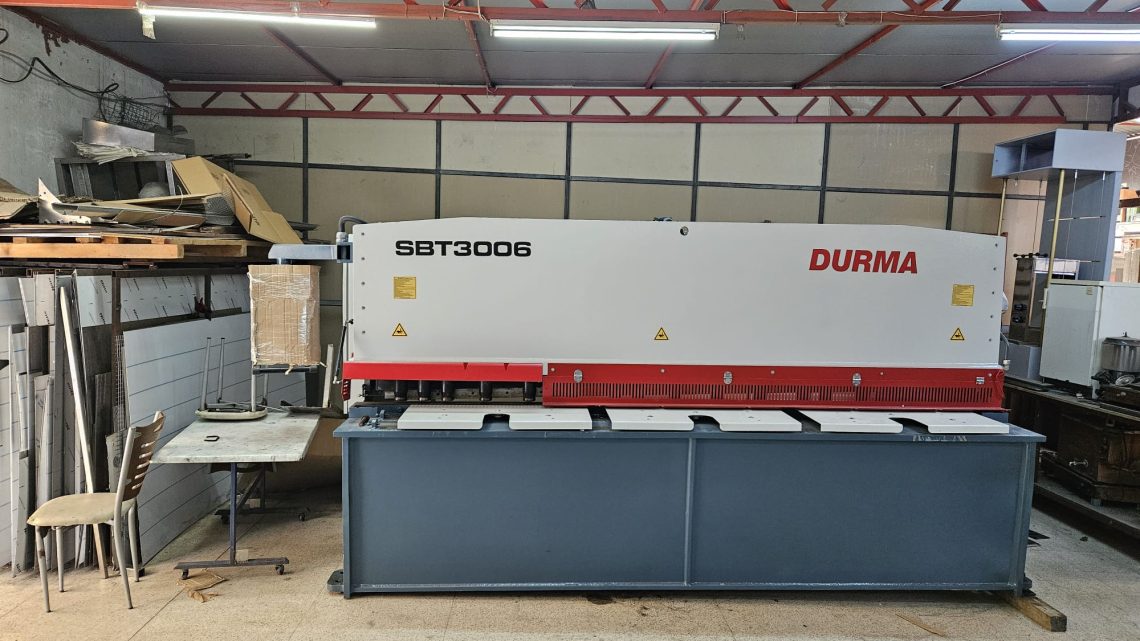
Performance Matters: How to Choose a Reliable Pre-Owned, Used, Surplus, Secondhand Durma SBT 3006 CNC Guillotine Shear made in Türkiye without Regret
When you’re evaluating a pre-owned / surplus / secondhand Durma SBT 3006 CNC swing-beam guillotine shear (made by Durmazlar in Türkiye), you face real risks — hidden wear, repair costs, compatibility issues, and interruptions. But with a systematic inspection and due diligence, you can substantially reduce “buyer’s remorse.” Below is a structured guide (with checklists and red flags) to help you choose wisely.
1. Know the machine & its specifications
Before even visiting the machine, brush up on the standard technical specs and options of the Durma SBT series (especially the 3006 model) so you can spot deviations or modifications.
What you should know / verify:
- The SBT series is a swing-beam CNC guillotine shear line from Durmazlar.
- Typical durability features: hardened & ground blades, CNC-controlled gap adjustment and cutting angle, robust frame, back gauge, safety systems.
- The “3006” designation typically means ~ 3000 mm cutting length and ~ 6 mm maximum thickness (or close thereto) in mild steel. Indeed, a listing shows SBT 3006 with 3000 mm length × 6 mm thickness.
- Other known parameters: stroke, strokes/min, back gauge travel, control type, motor power, hydraulic pressure, number & force of hold-downs, etc.
- Understand which options or upgrades might be in place (e.g. motorized blade-gap adjustment, enhanced CNC, extra arms or conveyors).
Why this matters: If the machine you inspect deviates significantly from expected spec (e.g. reduced capacity, worn parts, atypical modifications), that could indicate prior abuse or sub-optimal maintenance.
2. Ask for documentation & history (paper trail)
Before you commit time visiting, request as many of these as possible. A machine with good history is much lower risk.
Key documents to obtain:
- Maintenance & repair logs — dates, what was serviced or replaced, how often, parts suppliers, who did the work.
- Usage log / hours (or equivalent “cutting hours”) — how intensively the machine has been used (this helps assess remaining life).
- Original manuals, schematics, electrical & hydraulic diagrams.
- Parts replacement records — blades, hydraulic components, pumps, seals, sheets, etc.
- Upgrades or modifications — any changes to the original design (e.g. retrofitted control, extra load-bearing parts).
- Reason for sale — sometimes the seller knows of an impending failure or weakness, or upgraded to newer machine.
- Warranty status (if any) or residuals — though used machines often have none, but it’s worth checking if any transferable support remains.
If the seller cannot or will not provide these, that’s a strong red flag.
3. Visual inspection: Structure & integrity
Walk around the machine carefully. Use a flashlight. Note everything, photograph problem areas.
What to check:
| Area | What to look for | Why it matters / red flags |
|---|---|---|
| Frame & body | Cracks, welds, distortion, corrosion, repaired areas | A deformed frame causes cutting inaccuracy, misalignment |
| Table, side walls, supports | Signs of bending, dents, sagging | This may affect parallelism or flatness |
| Blade holder / blade carrier | Warpage, misalignment, cracks, signs of previous repair | Blade errors translate directly to cutting defects |
| Back gauge assembly | Wear, bent elements, missing parts, loose guides | The back gauge’s precision is critical to repeatability |
| Hydraulic tank & pipes | Rust, leaks, pitting, degraded seals, corrosion | Leaks or internal contamination lead to performance issues |
| Covers, guards, safety shields | Missing covers, broken guards, loose panels | Safety risk and may hint at sloppy maintenance |
| Electrical panels, wiring, junction boxes | Burn marks, loose wires, non-OEM cabling, corrosion | Electrical faults are costly and dangerous |
Focus on symmetry (both sides matching), parallelism, and lack of distortion. Also note if there appear to have been hacks, weld repairs, or modifications.
4. Mechanical & hydraulic components
These are the heart of the system. Problems here can be expensive and difficult to remediate.
a) Blades & cutting elements
- Inspect both upper and lower blades: edges should be relatively straight, without large nicks, chips, excessive wear or deformation.
- Check blade clearance: see how well the gap adjustment works across full width.
- Confirm that the blade holders and mounts are not damaged or loose.
- Ask when blades were last sharpened / replaced.
Blade condition has huge influence on cut quality; severely worn blades may require full replacement soon.
b) Hold-downs / pressure feet & presser system
- Check all hold-down (clamping) devices: air/hydraulic actuation, strokes, alignment, wear.
- Are all hold-downs present, functional and synchronized?
- Look at their rails and guides: wear, binding, misalignment.
If hold-down pressure is uneven or some feet are malfunctioning, sheet clamping won’t be uniform, causing edge defects.
c) Hydraulic pump, valves, cylinders, hoses
- Inspect cylinders for scoring, leakage, pitting.
- Check seals, rod surfaces, hydraulic fluid condition (smell, color, sediment).
- Operate the machine slowly and watch for leaks, slow drift, unintended movements.
- Check all hoses, fittings, pressure gauges, relief valves.
- Confirm hydraulic fluid type, whether filters are maintained, and replacement schedule.
Hydraulic issues are one of the primary failure sources in used machines.
d) Drive & mechanical motion (gears, bearings, linkages)
- Check for play, slop, backlash, worn bearings or bushings.
- Listen for grinding, rough movement, binding.
- Check all linkages, pins, pivot points for wear.
- Verify that the swing-beam mechanism moves smoothly and without excessive backlash.
5. CNC, control electronics, and software
Since this is a CNC guillotine (not purely manual), the control system and electronics are crucial.
Things to verify:
- Identify the CNC controller (brand, model). Is it original or aftermarket?
- Power-up and test all screens, buttons, switches, emergency-stop, indicators.
- Load and run a simple program; check responsiveness, smoothness, error messages.
- Check memory integrity, backups, program storage, connectivity (USB/serial/ethernet).
- Ask whether the original software license, modules, updates are available.
- Verify encoder feedback devices, sensors, limit switches, wiring integrity.
- Check that the CNC control is compatible with your existing job programming systems.
- Ask if there have been control replacements or retrofits (sometimes previously failing boards are swapped).
If control electronics are faulty or proprietary and obsolete, repairing them may be extremely expensive.
6. Functional / operational test
A critical step is seeing the machine in operation. If possible, test under load (i.e. sheet metal of a typical thickness you intend to use).
What to do / observe:
- Warm-up & idle behavior
- Watch for smooth start-up, abnormal noises or vibrations, hydraulic “drift” or creeping.
- Check whether any alarms, hydraulic pressure fluctuations, or system warnings appear.
- Test cut with sample plate(s)
- Use materials and thicknesses similar to your intended use.
- Measure and inspect cuts at multiple positions (left, mid, right).
- Look for parallelism, cut burrs, deviation in size, angle errors, diagonal skew.
- Check for consistency over repeated cuts (i.e. does performance degrade mid-run?).
- Back gauge accuracy & repeatability
- Command the back gauge to move to various positions. Measure the actual vs commanded.
- Repeat cycles to test repeatability (e.g. 10 moves to same position) and see if the error accumulates.
- Speed & balance
- Evaluate cycle time and compare with expected spec.
- Note whether both sides move symmetrically.
- Look for vibration, lateral movement, or drift.
- Safety & interlocks
- Test safety devices: guards, emergency stops, limit switches.
- See how the machine reacts to aborted cycles.
If possible, videotape the operation (especially cutting) so you can review later (or get a remote expert’s opinion).
7. Precision, accuracy, and tolerances
The real litmus test is whether the machine can deliver the tolerances you need over its full width and over repeated cycles.
- Measure cuts across the width: is the difference within your allowable tolerance?
- Check for angular deviation (i.e. side edges may not be perfectly perpendicular).
- If possible, use a precision measuring instrument (caliper, micrometer, gauge blocks) or even a coordinate measuring machine (CMM).
- Over sustained operation, see whether the machine “walks” off tolerance or shifts.
Some inaccurate parts may be adjustable; others may be irreversible damage.
8. Assess cost of parts, spares, future service
A used machine is only as good as your ability to support and maintain it for years.
Key considerations:
- Are Original Equipment Manufacturer (OEM) parts for the SBT series still available?
- How expensive or how long lead time for blades, hydraulic seals, valves, CNC parts, electronics, control boards?
- Is Durma / Durmazlar still supporting this model?
- Is there a local (in Türkiye or in your region) service provider who can support repairs/retrofits?
- Are there aftermarket or third-party component suppliers (hydraulics, electronics) that match?
- Will the seller or previous owner include a “spare parts package” (blades, seals, filters)?
- Estimate future maintenance costs (e.g. blade regrinding, hydraulic oil replacement, electronics maintenance, parts replacement).
If spares are scarce or aftermarket support is weak, you could be locked into costly downtimes.
9. Price negotiation & risk buffer
Once you’ve done your technical and hands-on checks, you should be in a position to rationally negotiate.
- Document your observed deficiencies and required remedial work (blade replacement, hydraulic seal jobs, electrical refurbishment).
- Ask for a price adjustment or allowance for those repairs.
- Factor in transport, installation, re-leveling, alignment, commissioning costs.
- Consider including a conditional short-term guarantee or get the seller to commit (in writing) that the machine functions as demonstrated.
- Build in a safety buffer (say 10–20 % of purchase price) for unexpected repairs you didn’t catch.
10. Red flags / “deal-breakers” to watch out for
These are issues that might make the purchase too risky unless heavily discounted or addressed:
- No or very patchy maintenance records
- Major structural damage or welded repairs in frame or beam
- Severe wear or damage to blades / blade holders
- Hydraulic leakage (internal or external), especially in cylinders
- Snapped or missing hold-downs, or nonfunctional clamping system
- CNC control is non-original, unsupported, or irreparably damaged
- Excessive vibration or noise under operation
- Back gauge not working or heavy play / lost calibration
- Electronics or wiring that look “cobbled up” or improperly modified
- Lack of spare parts availability for critical components
- Seller unwilling to allow test cuts or functional demonstration
- Unreasonable or opaque reasons for sale
If you encounter any of these, proceed with caution — or walk away unless the price is compelling and repair costs are understood.
11. After purchase: installation & commissioning checklist
Even after purchase, doing the following properly is critical to avoid damaging the machine or undercutting performance:
- Proper foundation / leveling — ensure machine is installed on a flat, rigid base with correct anchoring.
- Alignment & calibration — adjust beam, back gauge, blade alignment, parallelism.
- Hydraulic oil flushing and filter replacement — remove any contaminants.
- Full functional tests under no-load and light load — before full use.
- Break-in schedule — run slower cycles initially, measure drift, re-check tolerances.
- Spare parts stocking — have a starter set of seals, filters, blades, etc.
- Operator training — ensure staff know safe operation and maintenance procedures.
- Document everything anew — from day 0 start a maintenance log under your ownership.
Summary: How to Buy Without Regret
Buying a used Durma SBT 3006 CNC shear can be a savvy investment — if you systematically vet condition, document history, test fully, and plan for support. Here’s a compact checklist you can use as you walk through the inspection:
- Know expected specs & options.
- Insist on maintenance & usage history.
- Visually inspect all structure, welds, and integrity.
- Check blades, clamps, hold-downs.
- Dive into hydraulics — pumps, cylinders, filters.
- Test mechanical motion, linkages, bearings.
- Evaluate CNC control, software, electronics.
- Operate the machine and test cuts thoroughly.
- Measure tolerance, repeatability, deviation.
- Assess spare parts, support, cost of ownership.
- Negotiate with evidence (defects, repairs).
- After purchase, install carefully and commission.
If at any point you see a combination of serious defects, missing documentation, limited support, and inflexible seller, that’s a strong cue to walk away or demand a steep discount.