Performance Matters: How to Choose a Reliable Pre-Owned, Used, Surplus, Secondhand Deckel Maho FP4-60T made in Germany without Regret
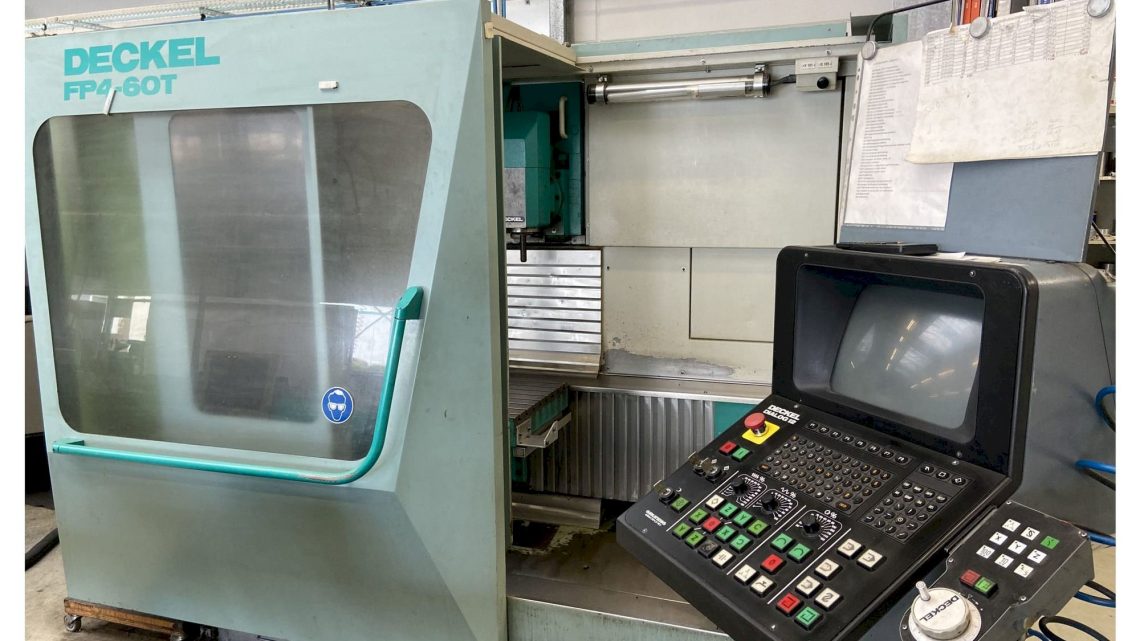
If you’re considering buying a pre-owned / surplus / secondhand Deckel Maho FP4-60T vertical machining center, here’s a detailed guide to help you choose carefully and avoid regret. The FP4-60T is a precision German machine, and many of its components (mechanical, control, spindle) must still be in strong condition for it to be a good long-term buy.
1. Understand the baseline / typical specs & features
Before you inspect a specific machine, know what “normal” is for this model so that deviations or anomalies stand out.
Here are typical specs for the Deckel Maho FP4-60T (from used-machine listings):
- Travels: X = 600 mm, Y = 500 mm, Z = 450 mm
- Table size: ~ 900 × 530 mm
- Spindle speed: up to ~ 5,000 rpm
- Tool magazine / changer capacity: ~ 24 positions
- Spindle taper: SK40 (DIN standard)
- Machine weight: ~ 4,200 kg
- Footprint / overall dimensions: ~ 3,100 × 3,400 × 2,200 mm
- Control: many are sold with Deckel’s own Dialog / Dialog 11 / Dialog 12 control systems in used ads
Knowing these nominal values helps you spot machines that have been modified, overworked, or altered, or where some components are nonstandard.
2. Checklist for inspecting a used FP4-60T
Here’s a multi-stage inspection and evaluation framework you can use (perhaps printed) when visiting the machine. Bring a machinist’s toolset (dial indicators, feeler gauges, a test bar, calipers) and someone experienced, if possible.
| Stage | What to Inspect / Test | What to Watch For / Red Flags | Why It Is Critical |
|---|---|---|---|
| (a) Documentation & history | Ask seller for maintenance logs, repair or rebuild history, spindle rebuilds, control upgrades, hours (power-on, axis motion), tool changer replacements, past breakdown records | No records, vague “ran fine,” missing key documents (electrical schematics, original documentation), conflicting claims | A machine with good documented care is much safer |
| (b) Visual & structural condition | Walk the machine foundation, base, column, spindle housing, covers, guards, way wipers, coolant pans. Look for cracks, corrosion, welding repairs, bent parts, misaligned or deformed covers | Welded patches, cracks in castings, bent guard panels, heavy rust, missing covers, alignment marks or “patch jobs” | Structural integrity underlies geometric stability |
| (c) Way surfaces, guideways & wipers | Pull aside way wipers (if possible) and inspect the guide surfaces of the X, Y, Z axes. Look for scratches, grooves, rust, inconsistent wear. Jog the axes slowly and feel for stick/slip. Use feeler gauges to gauge deviation in different positions. | Deep wear grooves, pitting, uneven wear, places where metal-to-metal contact is visible, binding, inconsistent friction | Excessive wear on ways causes loss of precision and increases backlash |
| (d) Ball screws / drives / backlash | With axes in motion (ideally slow test movement), check for backlash, repeatability, and “dead spots.” If you have a dial indicator, test how repeatable returning to a position is. Check end bearings of ball screws for play. | Significant backlash, non-repeatability, loose end bearings, binding in some sections | Ball screw and drive integrity is central to precision |
| (e) Spindle & bearings | Have the seller run the spindle if possible. Use a test bar or indicator to measure runout. Listen for bearing noise, vibration, or warmth. Ask about past spindle rebuilds or bearing replacement. | Excessive runout, whine or grinding noise, heat, vibration, spindles with signs of past damage, oil leaks near spindle seals | A damaged spindle or worn bearings dramatically degrade part quality |
| (f) Tool changer / magazine | Inspect the carousel or magazine, the tool change mechanism, grippers, sensors, motors, switching, alignment. Cycle a few tool changes. Look for worn jaws or misalignment over time. | Jamming, finger wear, sensors that mis-trigger, grippers that mis-position, magazine mis-index errors | The tool changer is often a source of failure or downtime |
| (g) Control, electronics & wiring | Open the electrical cabinet (if allowed) and visually inspect wiring, relays, drives, circuit boards. Check for signs of overheating (burn marks, discoloration), modification, wire splices, loose terminals. Power up control and check diagnostic screens, axis status, encoder signals, error logs (if accessible). | Burnt or discolored components, haphazard wiring, missing panels, many aftermarket modifications or bypassed safety circuits, broken connectors | The “brain” and control electronics are essential; a bad control system is expensive or impossible to replace |
| (h) Power, coolant & auxiliary systems | Inspect coolant tank, pumps, filters, hoses, plumbing. Run coolant & check for leaks, pressure, flow. Check lubrication (way lube, spindle lubrication) systems for function. | Leaks, clogged filters, low flow, pump issues, rust or corrosion inside tank, poor lubrication, contamination | These systems support long life and good operation; failure or neglect here shortens life |
| (i) Test cutting / trial run | If the seller allows, run a sample program. Cut a test block, do contour milling, pocketing, drills, finish passes, etc. Then measure dimensions, tolerances, surface finish. Also test at different positions and traverse extremes. | Inconsistent accuracy, taper, chatter, poor surface finish, deviation across stroke lengths, stalling axes, error messages | This is the real “proof” that the machine is in working condition |
| (j) Geometric & alignment checks | Use a dial indicator or test indicators to check squareness, alignment over travel, table flatness, perpendicularity of axes. Check if motion is linear, no sag or tilt when moving long distances. | Out-of-square motion, cumulative error, sag in Z axis, tilt in gantry/frame, drift over travel | Poor geometry kills repeatable accuracy even if axes “move” |
| (k) Parts availability & support | Ask about spare parts for the FP4-60T: spindle bearings, ball screw nuts, electronics boards, control modules, servo drives, sensors, tool changer parts, etc. Check whether third-party or OEM parts are still made or reconditioned. | Parts obsolete, long lead times, unavailable controls or modules, custom or rare components | If you can’t repair it, the machine becomes worthless |
| (l) Transport, rigging & re‐installation risk | Because these are heavy machines (~4 tonnes), transport and reinstallation can introduce misalignment or damage. Ask seller about how it was moved, if alignment marks exist, whether they’ll assist disassembly or placement. | Evidence of rough transport, misalignment marks, previously damaged base, no support in moving | A good machine can be ruined by a bad move |
| (m) Third‐party inspection & acceptance terms | If possible, commission a machine tool inspector (local to seller) to inspect critical areas. Negotiate an acceptance period (e.g. 7 days after installation) in which you can reject if you find hidden flaws | Seller refuses detailed inspection, “as is” sales with no recourse | The inspection cost is small compared to buying a bad machine |
3. What distinguishes a “safe buy” or less-risky candidate
When comparing multiple machines, some machines will stand out as better bets. Here’s what to prioritize:
- Clean maintenance history with detailed notes (e.g. spindle rebuilds, lubrication schedule, repairs)
- Low to moderate usage, ideally machines that have not been pushed relentlessly
- Upgraded or healthy control / electronics (if the machine has been retrofitted to newer drives or controls, that may be a plus if done properly)
- Well-matched tool changer and magazine with consistent, reliable operation
- Minimal wear on way surfaces (especially on the most heavily used axes)
- Spindle in good condition (low runout, smooth, no bearing noise)
- Accurate test cuts across the full travel range
- Strong parts support / spares availability
- Transport history that suggests the machine hasn’t been mishandled
- Price margin that allows for small refurbishing (blades, seals, bearings, alignment)
- Seller flexibility (allow test runs, inspection, limited return window)
4. Some special “gotchas” and caveats for Deckel Maho FP series machines
- Control obsolescence: Many FP4 machines came with Deckel’s older “Dialog / Dialog 11 / Dialog 12” controls. Some parts or modules may be obsolete or expensive. If the machine has a newer retrofit, verify that it was done properly.
- Spindle / bearing reuse: If the spindle has undergone multiple rebuilds, there may be non-standard rebuilds or modifications (e.g. non-OEM bearings) that compromise performance.
- Tool changer misalignment: Over years, the gripper jaws or magazine alignment can drift, leading to tool mis-seating or crashes. Check the taper clearance, repeatability of tool changes.
- Way lubrication / neglect: Some older machines suffer from neglected lubrication (grease/oil starvation), leading to localized wear or scoring. Check oilways, piping, and grease lines.
- Rigidity vs usage: The FP4 line is known for precision, but not for “super heavy” cutting (unlike bigger VMCs). If the previous owner used it for heavier-than-intended jobs, the structure or drive system may have been stressed.
- Hidden modifications or shortcuts: Some machines may have nonstandard modifications, like “hacks” to bypass certain protections, aftermarket wiring, or makeshift repairs. Inspect carefully for welds, extra bracing, mismatched components.
- Wear symmetry: Often one side of travel is worn more than the other (if operator bias or fixture usage skewed). Check both ends of travel.
- Thermal / environmental effects: If the machine was in a humid or extreme environment, corrosion inside covers, coolant tanks, or even in drive cabinets might have occurred.
5. Pricing & negotiation strategy
- Approach your offer assuming you will need to spend something on refurbishment (blades, alignment, wiring fixes, bearing replacement). Start with a lower bid accounting for these.
- Use observed defects (wear, alignment error, bearing play, tool changer issues) as negotiation leverage.
- Ask the seller to rectify certain issues before final payment (e.g. alignment, tool change faults, wiring fixes) or provide a credit.
- Request a short acceptance period after installation so you can test under real production loads and return if serious hidden faults appear.
- Don’t pay full asking price unless everything checks out cleanly.