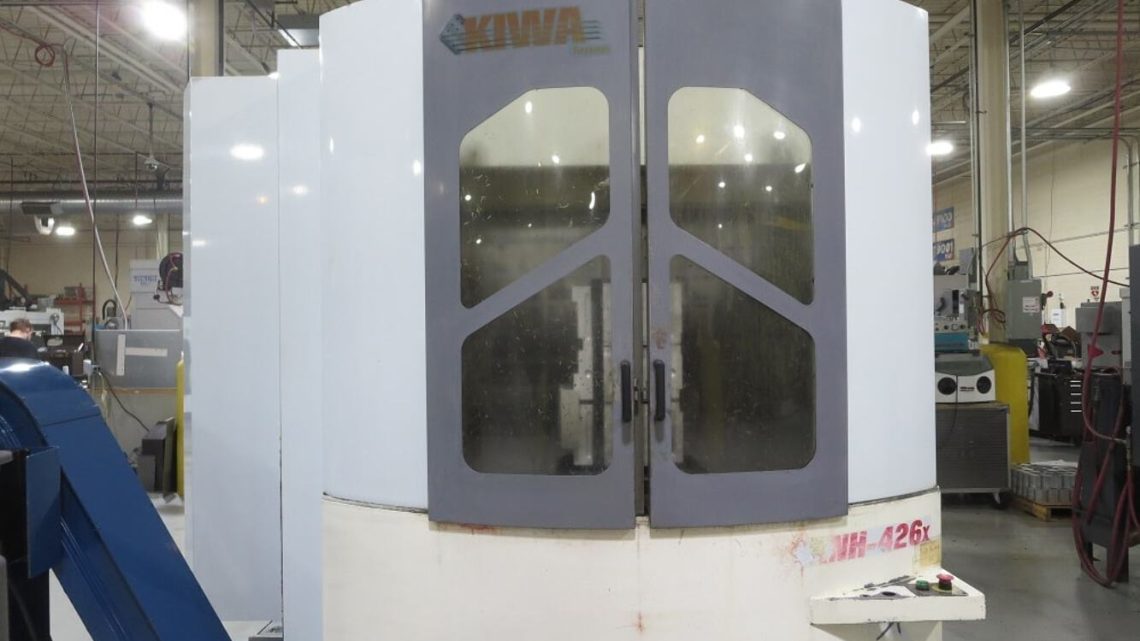
Maximize ROI: Professional Tips for Purchasing a Pre-Owned, Used, Secondhand, Pre-Owned KIWA KNH-426X CNC Horizontal Machining Center made in Japan
When investing in a used KIWA KNH-426X, the objective is not simply to secure a lower purchase price — it is to maximize production output, reliability, and long-term asset value. Below is a structured professional evaluation framework combining technical specifications and practical buying strategy.
1. Machine Overview – KIWA KNH-426X Technical Specifications
Manufacturer: KIWA (Japan)
Model: KNH-426X
Machine Type: Horizontal Machining Center (HMC)
Configuration: 4-Axis (X/Y/Z + B-axis pallet rotation)
Axis Travels
- X-Axis Travel: approx. 600 mm (23.62″)
- Y-Axis Travel: approx. 500 mm (19.69″)
- Z-Axis Travel: approx. 500 mm (19.69″)
- B-Axis Indexing: 1° standard (0.001° optional depending on version)
Pallet System
- Pallet Size: 400 × 400 mm (15.75″ × 15.75″)
- Number of Pallets: 2 (Automatic Pallet Changer)
- Maximum Pallet Load: approx. 400 kg (880 lbs)
Spindle
- Spindle Taper: BT40 / CAT40
- Spindle Speed: 8,000 – 12,000 RPM (varies by configuration)
- Spindle Motor Power: approx. 11–15 kW (15–20 HP)
- Spindle Type: Direct drive or belt driven (model dependent)
Tool System
- Tool Magazine Capacity: 30–60 tools (depending on configuration)
- Tool Change Time (T-T): approx. 1.5–2.5 sec
- Maximum Tool Length: approx. 300 mm (11.8″)
- Maximum Tool Diameter: approx. 80–125 mm (3.15″–4.92″)
- Maximum Tool Weight: approx. 7 kg (15.4 lbs)
Feed & Motion
- Rapid Traverse (X/Y/Z): up to 30–40 m/min (1,181–1,575 IPM)
- Cutting Feed: programmable via CNC
Control System
- Fanuc 0M / 16M / 18M (depending on year)
- Rigid tapping capable (if encoder equipped)
2. Why KIWA KNH-426X Is a Strong ROI Machine
A. Japanese Build Quality
Kiwa machines are known for:
- Heavy cast iron bed
- Box ways or robust linear guide systems
- Thermal stability
- High spindle longevity
This reduces maintenance cost over time.
B. Pallet Changer Advantage
The 2-pallet APC allows:
- Setup during machining
- Reduced idle time
- Higher spindle utilization
- Faster payback in production environments
C. Ideal Application Range
This model is particularly profitable for:
- Automotive components
- Hydraulic blocks
- Aerospace small housings
- Medium batch production
- Precision mechanical subcontracting
3. Professional Pre-Purchase Inspection Checklist
Mechanical Inspection
- Spindle condition
- Check vibration at 8,000+ RPM
- Listen for bearing noise
- Run warm-up cycle
- Measure taper runout (target under 0.01 mm)
- Axis backlash
- Ball screw play measurement
- Servo following error values
- Check repeatability using dial indicator
- B-axis indexing accuracy
- Verify repeatability within 5–10 arc seconds
- Confirm no excessive backlash in pallet drive
- Tool changer condition
- Inspect arm movement
- Check gripper wear
- Confirm tool change repeatability
Electrical & Control System
- Check CNC alarms history
- Verify parameter backup availability
- Confirm rigid tapping function
- Inspect cabinet cooling and fan operation
- Check servo drive hours (if available)
4. Cost vs Value Calculation Strategy
When calculating ROI, evaluate:
Purchase Cost
Example:
Used price range (depending on condition):
25,000 – 55,000 EUR
Refurbishment Budget
Possible items:
- Spindle rebuild: 3,000 – 8,000 EUR
- Ball screw replacement: 2,000 – 4,000 EUR
- Way cover replacement: 1,000 – 2,000 EUR
- Control retrofit (if needed): 8,000 – 15,000 EUR
Production Revenue Example
If machine produces:
- 60 parts/hour
- 8 hours/day
- Net profit per part: 4 EUR
Daily profit:
60 × 8 × 4 = 1,920 EUR
Payback period could be under 2–4 months in high-utilization environments.
5. Risk Factors to Avoid
Avoid machines with:
- Spindle noise at high RPM
- Poor pallet change timing
- Excessive backlash in X/Y/Z
- Poor lubrication history
- Missing parameter backups
- Major crash damage on tool magazine or spindle head
6. Logistics & Installation Considerations
- Approximate Machine Weight: 7,000–9,000 kg (15,400–19,800 lbs)
- Floor space required: approx. 3 × 3.5 meters (9.8′ × 11.5′)
- Power Requirement: 380–400V, 3 Phase
- Air supply required for tool change & pallet clamp
Ensure foundation stability due to horizontal machining torque loads.
7. Long-Term Value Strategy
To maximize ROI after purchase:
- Install spindle chiller if not equipped
- Implement preventive maintenance schedule
- Keep complete tool management system
- Maintain calibration log
- Retrofit probe system (Renishaw / Blum) if absent
- Upgrade memory if using older Fanuc control
8. Final Professional Evaluation
The KIWA KNH-426X represents:
- Strong structural rigidity
- Reliable Japanese engineering
- Excellent palletized productivity
- Moderate maintenance cost
- High suitability for subcontract machining businesses
When purchased correctly and inspected properly, this machine can deliver exceptional return on investment compared to similarly priced European or Taiwanese alternatives.