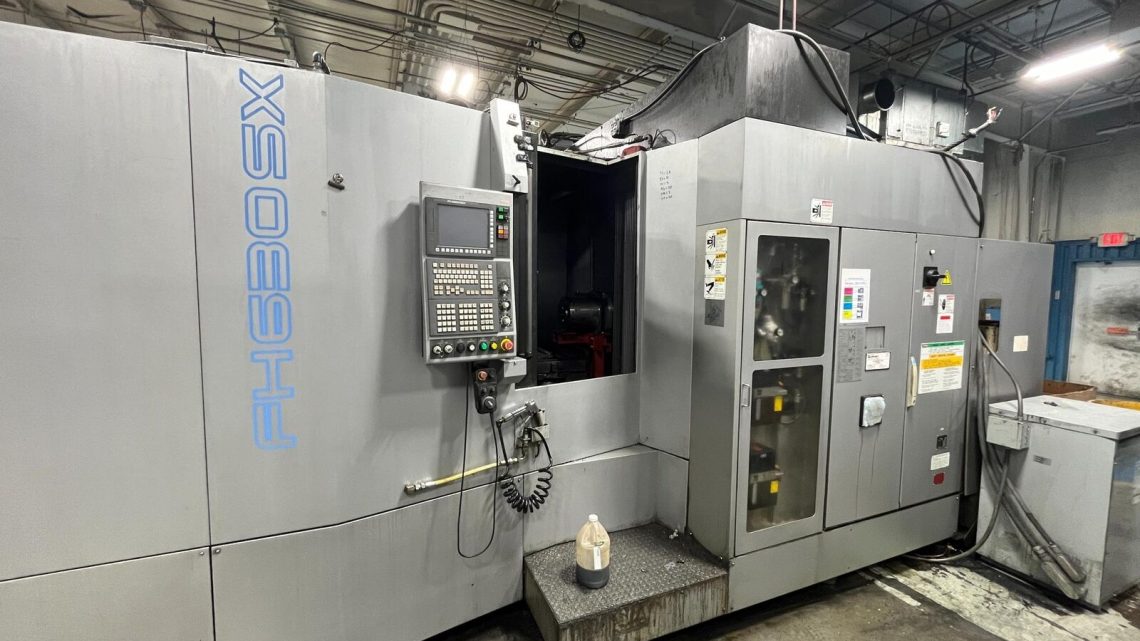
Make the Right Move: Proven Steps to Evaluate a Used, Second-Hand, Surplus, Pre-Owned Toyoda FH 630SX CNC HMC Horizontal Machining Center made in Japan
Buying a pre-owned Toyoda FH 630SX is a strategic investment, especially for shops that demand reliability, accuracy, and long spindle-in-cut performance. However, ensuring you choose the right machine requires a structured and disciplined evaluation process. The following steps are based on industry-proven inspection procedures used by successful manufacturers and machine-tool procurement experts.
1. Start With Machine Identity Verification
Before any inspection, confirm the machine’s true identity and history:
✔ OEM Build Details
- Model: Toyoda FH 630SX
- Origin: Made in Japan
- Typical spindle: 50-taper, high-torque configuration
- Pallet size: 630 × 630 mm
- Standard spindle speed: 6,000–10,000 rpm (depending on variant)
✔ Check the Data Plate & Control
- Verify serial number, manufacturing year, and CE compliance.
- Confirm the control model (Fanuc or Toyoda MiPlus).
- Ensure the details match OEM records — request a factory build sheet if available.
2. Inspect the Machine’s Structural Integrity
The FH-series is known for rigid cast iron construction, so any damage is a red flag.
Check for:
- Cracks or repairs on column, bed, saddle, and table.
- Alignment of pallet changer, including rotation and shuttle smoothness.
- Evidence of collisions—marks on:
- ATC cam box
- Tool pot arms
- Spindle face
- Rotary table top
Run an Indicator Test
- Inspect X/Y/Z straightness over full travel.
- Measure B-axis backlash and repeatability.
3. Evaluate Spindle Health Precisely
Toyoda spindles are robust but costly to rebuild. Use a structured approach:
What to measure:
- Spindle vibration (mm/s RMS).
- Run-out at 300 mm from the nose.
- Thermal growth stability after 1-hour warm-up.
- Tool holders should pull smoothly — test drawbar force with a gauge.
Warning Signs
- Metallic noise above 4,500 rpm
- Excessive warm-up time
- Spindle load spikes at low rpm
4. Examine the Axis Drives, Ball Screws & Guides
Checklist for Each Axis (X/Y/Z):
- Backlash measurement (check under load).
- Wear in linear roller guide blocks.
- Ball screw noise or pitch variation.
- Condition of way covers, telescopic shields, and lubrication ducts.
B-Axis Rotary Table
- Hydraulic clamping force test.
- Repeatability of index positions.
- Smooth rotation without oscillations.
5. Review the ATC, Pallet Changer & Hydraulic Systems
The FH 630SX relies heavily on automation; downtime here can be expensive.
ATC (Automatic Tool Changer)
- Check pot alignment and gripper claw wear.
- Test complete ATC sequence at least 20 consecutive cycles.
- Inspect tool magazine chain links for deformation.
APC (Automatic Pallet Changer)
- Verify pallet orientation accuracy.
- Inspect lifting pins, chains, and hydraulic shuttle.
6. Confirm Control, Electronics & Software Condition
Run Full Diagnostics
- Servo load graphs over long-travel moves.
- Alarm history — look for repeated servo, spindle, or ATC faults.
- Check condition of:
- Fanuc servo amplifiers
- Power supply modules
- Fiber-optic cables
- I/O boards
Optional Upgrades to Confirm
- 1GB memory expansion
- High-pressure coolant through spindle
- Tool life management software
- 4th-axis B-axis fine calibration options
7. Monitor the Cooling, Lubrication & Filtration Systems
Check:
- Condition of coolant tank (sludge = poor maintenance).
- Operation of chiller for spindle and electronics.
- Lubrication pump pressure and cycle consistency.
- Chip conveyor and augers for wear or excessive noise.
8. Evaluate Overall Accuracy Through Test Cuts
A Toyoda FH-series machine must demonstrate accuracy beyond basic movement tests.
Recommended Tests
- Circular interpolation test (ISO 230 standard).
- 5-hour continuous machining cycle for thermal drift assessment.
- Roughing + finishing test on 4140 steel or similar alloy.
Targets to Aim For
- Circularity: ≤ 0.010 mm
- Linear deviation: ≤ 0.005 mm per 300 mm
- Thermal drift: ≤ 0.020 mm
9. Review the Machine’s Usage History
Important Questions
- Was it used for heavy hogging, aerospace precision, or high-volume production?
- Number of cutting hours vs power-on hours.
- Any spindle rebuild or axis rebuild?
- Service history from Toyoda distributor.
Machines from automotive production may have high hours but excellent maintenance.
10. Calculate the True Cost of Ownership
Include:
- Freight and rigging
- Rotary table calibration
- Alignment and leveling
- ATC gripper set replacements
- New tool holders, pull studs, and chip conveyor servicing
A perfectly maintained FH 630SX pays back quickly; a neglected one can be extremely costly.
Final Advice Before You Buy
- Demand a live running video showing ATC, APC, spindle ramp-up, and B-axis operations.
- Request mechanical accuracy reports from the seller.
- Prefer machines still under Toyoda service contract.
- Never commit without on-site inspection or third-party verification.