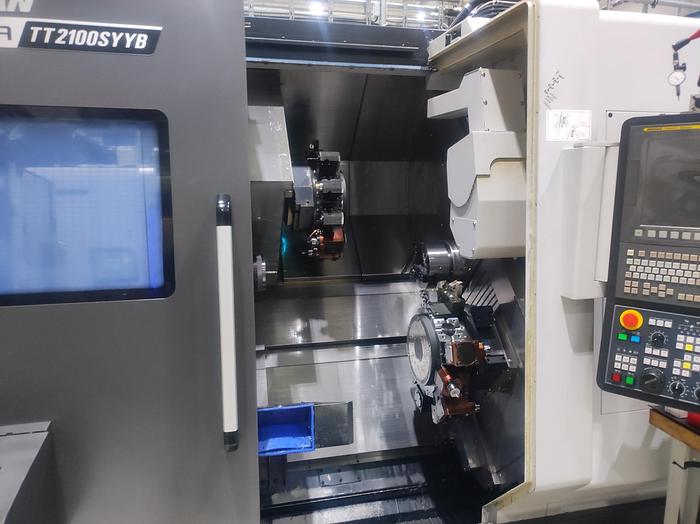
Insider Advice: What Successful Manufacturers Consider Before Buying a Used, Second-Hand, Pre-Owned, Surplus Doosan PUMA TT2100SYYB CNC Turning Center made in South Korea?
Successful manufacturers do not buy used CNC turning centers based on brand reputation alone. They evaluate technical capability, mechanical condition, long-term serviceability, and real production ROI. The Doosan PUMA TT2100SYYB is a high-end multitasking turning center, but its value in the used market depends entirely on how well it aligns with your production reality.
1. Understanding the Machine’s Core Technical Architecture
Before any commercial discussion, experienced buyers fully understand what the TT2100SYYB is designed to do.
Key Technical Configuration (Typical)
- Twin Spindle (Main + Sub-Spindle) for complete front/back machining
- Dual Turrets (Upper & Lower) enabling simultaneous machining
- Y-Axis capability on at least one turret for true milling and off-center work
- B-Axis (on Y-axis variant) for angular milling operations
- Live Tooling for drilling, tapping, and milling
- High-rigidity box guide or linear guide structure depending on build year
- Fanuc CNC control (most commonly Fanuc 31i or 32i series)
Successful buyers verify the exact configuration, not just the model name, because TT2100 variants can differ significantly.
2. Matching Technical Capability to Real Production Needs
Part Geometry & Complexity
Manufacturers ask:
- Do we truly need twin turrets + twin spindles, or will one sit idle?
- Will Y-axis and B-axis reduce setups enough to justify maintenance cost?
- Are we machining complex parts that require simultaneous machining, or mostly standard turned parts?
Overbuying capability can increase downtime and maintenance without ROI.
Work Envelope & Capacity
Check actual limits:
- Maximum turning diameter and length
- Bar capacity (if bar-fed)
- Sub-spindle capacity relative to part weight
- Tool station count per turret and live-tool positions
A machine that is technically impressive but mismatched to part size leads to inefficiency.
3. Mechanical Condition: Where Value Is Won or Lost
Experienced manufacturers inspect wear-prone systems first, not cosmetics.
Spindles (Main & Sub)
- Bearing noise at high RPM
- Thermal stability during long cycles
- Runout measurements under load
- History of spindle rebuilds
Twin-spindle machines double the risk and replacement cost if neglected.
Turrets & Live Tooling
- Indexing accuracy and repeatability
- Live-tool backlash and noise
- Clamping force and coupling wear
- Alignment between turrets and spindles
On a TT2100SYYB, turret condition directly affects simultaneous machining accuracy.
Axes & Guideways
- X, Z, Y, and B-axis backlash
- Servo load history
- Ball screw condition
- Way lubrication performance
Y-axis and B-axis repairs are significantly more expensive than standard X/Z.
4. CNC Control, Software, and Integration
Control Version Matters
- Fanuc 31i / 32i controls are preferred for:
- Long-term support
- Spare parts availability
- CAM compatibility
- Verify:
- Software options installed (Y-axis, B-axis, synchronous control)
- Number of controlled axes licensed
- Look-ahead and high-speed machining options
CAM & Post-Processor Compatibility
Manufacturers confirm:
- Existing CAM system supports dual-turret synchronization
- Proven post-processors are available
- Operators have experience with multitasking logic
A powerful machine without proper programming expertise becomes a bottleneck.
5. Total Cost of Ownership (TCO): The Real Decision Metric
Successful buyers calculate installed cost, not purchase price.
Typical Hidden Costs
- Heavy rigging and transport
- Precision leveling and alignment
- Electrical and air upgrades
- Tooling and driven tools
- Probing and setup systems
- Commissioning and test cuts
A low-priced TT2100SYYB can quickly exceed budget if these are ignored.
6. Serviceability and Long-Term Support
OEM and Independent Support
- Availability of Doosan/DN Solutions service in your region
- Cost difference between OEM and third-party service
- Lead times for:
- Spindle parts
- Servo drives
- Turret components
- Hydraulic units
Manufacturers favor machines with predictable support paths, not rare configurations.
7. Reliability History and Documentation
Professionals demand:
- Maintenance logs
- Alarm and fault history
- Records of spindle, servo, or turret replacement
- Electrical diagrams and manuals
A missing service history increases risk and lowers real value.
8. ROI, Productivity, and Payback Logic
Key questions:
- How many setups will this machine eliminate?
- Will cycle time reduction justify multitasking complexity?
- What is the expected remaining service life?
- How quickly can the machine reach stable production?
Successful manufacturers buy machines that pay for themselves through throughput, not just capacity.
9. Strategic Fit Within the Factory
Experienced shops consider:
- Operator skill level
- Standardization with existing Doosan machines
- Tooling and spare part commonality
- Automation readiness (bar feeder, gantry, robot interface)
The TT2100SYYB performs best in well-organized, process-driven environments.
10. Red Flags That Stop Experienced Buyers Immediately
- No permission for test cuts
- Excessive spindle vibration
- Turret indexing errors
- Incomplete CNC options (Y/B-axis not licensed)
- Missing manuals or electrical diagrams
- Seller unable to explain machine configuration clearly
Final Insight
The Doosan PUMA TT2100SYYB is a highly capable, production-grade multitasking turning center. When properly maintained, it offers exceptional productivity and flexibility. However, successful manufacturers buy it only after validating technical configuration, mechanical integrity, control options, serviceability, and true ROI.
In the used market, knowledge and inspection discipline determine whether this machine becomes a profit center or a liability.
here are three deep, practical deliverables you can use when evaluating a used Doosan PUMA TT2100SYYB:
- Model-Specific Inspection Checklist
- Technical Comparison vs Other Multitasking Turning Centers
- Cost-to-Rebuild vs Buy-Used Analysis Framework
All are written from a manufacturer’s perspective with real shop-floor criteria.
1. Model-Specific Inspection Checklist — Doosan PUMA TT2100SYYB
A. Documentation & Records
- Verify machine nameplate, serial number, year of build.
- Confirm control type/version (e.g., Fanuc 31i/32i) and licensed axes/options.
- Request full maintenance history (service logs, part replacements, rebuilds).
- Ask for alarm/fault history and cycle count reports.
- Manual set: Mechanical, Electrical, CNC program manuals, parts diagrams.
B. Mechanical Condition
Spindles
- Main and sub-spindle run at rated RPM without noise/vibration.
- Take runout readings with calibrated indicators under light cut.
- Check temperature rise during warm-up and extended run.
- Inspect spindle taper condition and wear at contact points.
- Verify spindle bearing replacement history.
Turrets
- Indexing accuracy under power and under cut load.
- Consistent indexing time and minimal backlash.
- Confirm rigid live-tooling clamp condition.
- Check turret gear teeth, quill runout, and tool block integrity.
Axes & Motion Systems
- X, Z, Y, B axes backlash and repeatability tests.
- Ball screw end play and lubrication condition.
- Servo current and encoder feedback consistency.
- Test high-speed rapids for smooth motion and noise.
Guideways & Ways
- Inspect box or linear guide wear patterns.
- Check lubrication system operation and oil condition.
- Side-to-side level variance across bed length.
C. CNC Control & Software
- Confirm control model and installed software options.
- Check for Y-axis and B-axis license activation.
- Review macro libraries and custom parameters.
- Test axis hand jog, incremental moves, and MPG response.
- Verify I/O and peripheral communication ports.
D. Hydraulic / Pneumatic Systems
- Test hydraulic pressure stability (turret clamping, chuck clamping).
- Leak checks around manifolds, hoses, seals.
- Coolant pump flow and degree of coolant contamination.
- Air filter and dryer condition.
E. Electric Cabinet & Wiring
- Clean, dry electric cabinet (no rust or conductive dust).
- Secure cable harnesses; no ad-hoc splices or mismatched cables.
- Check servo drive heatsinks and fan operation.
- Inspect contactors, relays, fuses for age and wear.
F. Functional Tests
- Load basic part program and run dry cycle.
- Perform short test cuts on representative material.
- Check tool change, spindle direction change, turret indexing under power.
- Verify sub-spindle synchronization and part transfer.
- Test optional features: probing, canned cycles, macro calls.
G. Accessories & Tooling
- Check condition of chucks, jaws, steady/rest, fixtures.
- Verify tooling list and live tool holders.
- Inspect bar feeder (if included) for alignment and feed reliability.
- Look for missing guards, doors, handles.
2. Technical Comparison — TT2100SYYB vs Similar Machines
When comparing the TT2100SYYB to other multitasking turning centers, use these criteria:
A. Axis Configuration
- Many competitors offer 5-axis turrets or additional C-axis turrets.
- Evaluate whether the TT2100SYYB’s Y/B axis combination delivers the flexibility your parts need vs other axis mixes.
B. Spindle & Power
Compare:
- Rated spindle speed / torque / power
- Bearing size and cooling system
- Ramp rates vs competitor models
A machine with lower torque but same RPM can suffer under heavy cuts.
C. Tooling Capacity
- Tool pool size
- Live tool power & speed
- Indexable vs solid tooling capacity
Competitors with larger tool magazines may reduce changeovers.
D. Control Capability
- Fanuc 31i/32i vs Siemens 828D/840D
- Look-ahead, block processing speed
- Ease of complex synchronization
Fanuc typically has broader aftermarket support.
E. Structure & Dynamics
- Look for box-guide vs conventional guides
- Evaluate dynamic response with test cuts at high feedrates
- Compare rapid traverse rates and damping characteristics
F. Supportability
- Ease of finding drives, encoders
- Availability of retrofit kits
- Local service network
Older proprietary controls may limit longevity.
G. Typical Use Case Fit
- High-mix, low-volume shops benefit from turret flexibility.
- High-volume, long parts benefit from robust spindles and stable guideways.
3. Cost-to-Rebuild vs Buy-Used Analysis Framework
Successful manufacturers quantify all costs before purchase.
A. Purchase Price
- Negotiated asset price
- Include rigging, transport to your site
B. Inspection & Validation Costs
- Third-party technician inspection fee
- Calibration and run-in costs
C. Rebuild/Refresh Costs (if needed)
Estimate separately:
- Spindle rebuilds (main & sub)
- Ball screws and nut replacements
- Guideway scraping or recertification
- Turret indexing gear replacement
- Control upgrade or retrofit
- Electrical harness repairs
Total rebuild = sum of individual component costs plus shop labor.
D. Installation Costs
- Floor prep and anchoring
- Power supply and transformer upgrades
- Air and coolant system setup
- Leveling and laser alignment
E. Tooling & Consumables
- New tooling packages
- Live tool holders
- Probes and tool setters
- Coolants and filters
F. Training & Ramp-Up
- Operator training
- CAM/post processor updates
- Process optimization cycles
G. Ongoing Maintenance Costs
- Spare parts pool
- Annual service contracts
- Wear part replacement schedules
Simple Decision Formula
Total Cost of Ownership (TCO) =
Purchase Price
- Inspection & Transport
- Rebuild & Retrofit
- Installation & Tooling
- Training
- Yearly Service Costs (projected)
Value Index =
(Expected Productive Life * Annual Production Value) / TCO
If Value Index exceeds your internal threshold (shop minimum profitable margin), proceed.
Practical Example (Hypothetical)
Assume:
- Purchase Price = 50,000
- Transport & Rigging = 8,000
- Rebuild Costs = 15,000
- Installation & Tooling = 12,000
- Training & Software = 5,000
TCO = 90,000
If annual production gain (net of operating cost) = 90,000 per year
Expected life = 5 years
Value Index = (5 * 90,000) / 90,000 = 5
A Value Index above 3 is typically strong in precision manufacturing.