Insider Advice: What Successful Manufacturers Consider Before Buying a Used, Second-Hand, Pre-Owned, Surplus BYSTRONIC BYSTAR 4020 CNC Laser made in Switzerland?
Below is a professional, practical, industry-oriented guide written for real manufacturing decision-makers evaluating a used, second-hand, pre-owned, surplus BYSTRONIC BYSTAR 4020 CNC Laser (made in Switzerland).
Purchasing a pre-owned BYSTRONIC BYSTAR 4020 can be a strategic investment—if you evaluate it correctly. High-performance Swiss laser systems can serve reliably for decades, but only when their mechanical, optical, and electronic subsystems are in stable condition.
Below is what experienced manufacturers and plant managers always check before signing the deal.
1. Hours, Duty Cycles, and Real Wear Indicators
Successful buyers do not rely only on the “machine hours” listed on a sheet. They verify:
- Laser ON hours vs. machine ON hours (huge difference).
- The number of piercings, cutting cycles, and assist gas consumption logs.
- Whether the machine was operated in high-duty production or low-volume prototyping.
Why it matters: Lasers deteriorate faster when frequently run near maximum power or operated on thick plate materials.
2. Condition of the Resonator (CO₂ Laser)
BYSTRONIC BYSTAR 4020 traditionally uses high-precision Swiss CO₂ resonators. The key checks include:
- Resonator tube condition (wear, leaks, contamination).
- When the last full overhaul was performed.
- Beam stability at low, mid, and high power.
- Mirrors and optics alignment performance.
- Quality of RF power supplies and their temperature history.
Tip: If the resonator hasn’t been serviced in the last 8,000–12,000 laser hours, budget for refurbishment.
3. Cutting Head & Optics Condition
Advanced buyers always inspect:
- The condition of the cutting head, including lens module, ceramic parts, nozzle holder, and autofocus unit.
- Status of collimating lenses, focusing lenses, and protective windows.
- Z-axis smoothness and calibration.
Warning: Many issues show up only when cutting stainless at high power—request a real cutting test.
4. Tables, Shuttle System, and Drive Mechanics
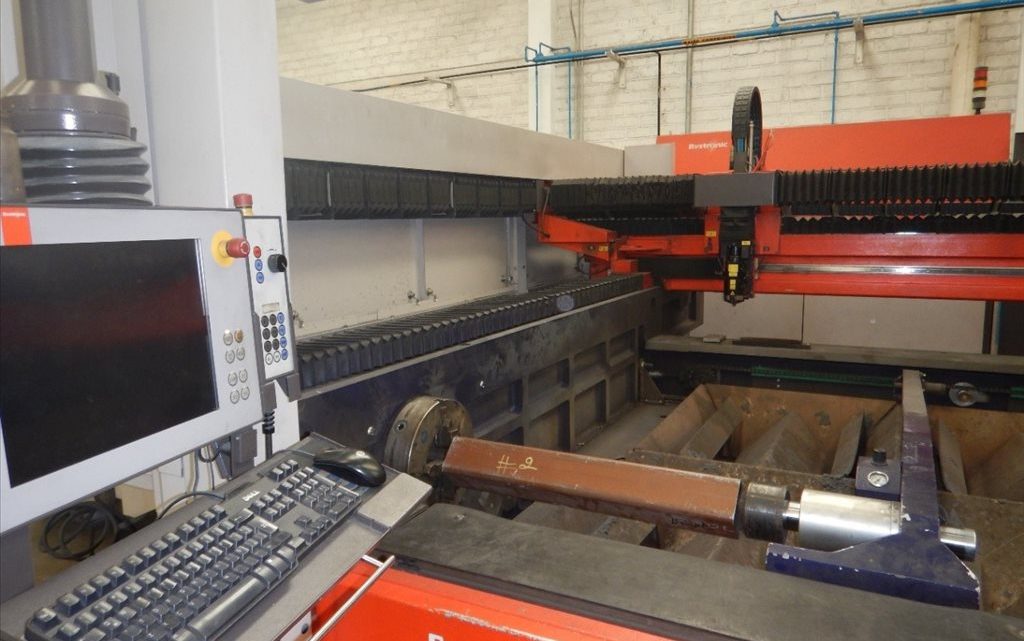
The BYSTAR 4020 includes a large 4 × 2 m bed, so mechanical inspection is crucial:
- Ball screw and linear guide wear on X/Y axes.
- Shuttle table synchronization and vibration level.
- Backlash test results (Y-axis typically shows wear first).
- Gearboxes and servo motors for smooth torque output.
Key rule: A mechanically worn table costs far more to rehabilitate than optics.
5. CNC Control System Condition
BYSTRONIC machines use robust controls, but experienced buyers verify:
- Controller version (older versions may lack critical updates).
- Status of the laser diagnostics package.
- Firmware errors, stored faults, and historical logs.
- Functionality of USB/Ethernet I/O for programming.
6. Assist Gas System Integrity
Check the full supply chain for:
- Leaks in oxygen, nitrogen, and air lines.
- Correct pressure regulation in cutting tests.
- Condition of valves, solenoids, sensors, flowmeters.
Tip: Poor assist gas delivery produces bad cuts—often misdiagnosed as laser power loss.
7. Chiller Unit & Cooling Circuit
The chiller is the hidden heart of the machine. Check:
- Compressor health and cooling efficiency.
- Proper coolant flow to the laser tube and optics.
- Maintenance history of filters and pumps.
- Evidence of overheating incidents.
8. Electrical Cabinet and Power Electronics
What experienced technicians inspect:
- Temperature discoloration on PCBs.
- Dust contamination near high-voltage modules.
- Quality of grounding and main power contactors.
- Age and condition of capacitors in power supplies.
If the electrical cabinet smells burnt—walk away.
9. Cutting Accuracy and Real Performance Test
A serious seller should allow:
- Cutting of mild steel, stainless, and aluminum at various thicknesses.
- Measurement of dimensional accuracy, kerf width, and repeatability (±0.1 mm expected).
- Verification of pierce times and edge quality.
No test cutting = major risk.
10. Software Licensing and Upgradability
Smart buyers confirm:
- Availability of BySoft, ByVision, or compatible software licenses.
- The presence of original dongles and upgrade rights.
- Whether the machine can integrate with nesting software.
Lack of licensing can cost more than mechanical repairs.
11. Consumables, Spare Parts, and Operating Costs
Before buying, calculate:
- Lens, nozzle, mirror replacement costs.
- Expected annual maintenance of CO₂ resonator.
- Availability of second-hand spare parts in the seller’s region.
- Condition of filters, bellows, protective covers, hoses.
12. Transportation, Installation & Calibration
Large laser machines are expensive to move. Consider:
- Whether the machine was properly powered down and de-energized before dismantling.
- Resonator alignment after relocation (mandatory).
- Whether crane access and vibration-free floor space are available at your facility.
Final Insider Advice
The BYSTRONIC BYSTAR 4020 is one of the most respected Swiss-built laser cutters in the world. A well-maintained unit can outperform many newer lower-cost systems.
However, never buy without:
- Full maintenance & service history
- Live cutting demonstration
- Optics + resonator evaluation report
- Mechanical backlash test results
- Verification of software licenses
Following these steps ensures you secure a powerful, long-lasting machine—and avoid the costly mistakes less experienced buyers often make.