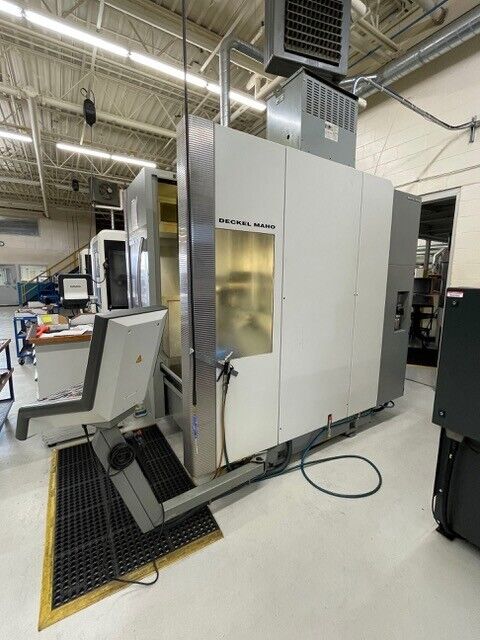
Industrial Insights: How to Spot Quality in Pre-Owned, Used, Secondhand, Surplus CNC Equipment Before Purchase DECKEL MAHO DMU 50 eVolution linear CNC 5-axis Vertical Machining Center made in Germany
Below is a detailed, industrial-grade “due diligence” checklist and methodology for evaluating a pre-owned / surplus / secondhand 5-axis CNC vertical machining center like a DECKEL MAHO DMU 50 eVolution / eVo Linear (or equivalent) before committing to purchase. I also interweave specific considerations for that model based on its known specs and typical wear modes.
1. Know the Reference / Benchmark Specification
Before you go to inspect the machine, arm yourself with the original (or high-spec) baseline data for the DMU 50 eVolution series — you will compare the measured condition against these.
Key baseline parameters for DMU 50 eVolution
From multiple sources, the common spec envelope is:
| Parameter | Typical / published value |
|---|---|
| X / Y / Z travel | 500 mm / 420 mm / 380 mm |
| Spindle speed | up to 18,000 rpm (some variants) |
| Spindle motor / power | ~ 25 kW (33.5 hp) at 100% duty, ~35 kW (46.9 hp) at 40% duty |
| Spindle taper | CAT 40 / ISO 40 / SK40 (DIN) depending on variant |
| Table size / load | ~ 500 × 380 mm; table load often around 200 kg (some sellers list 350 kg) |
| B / C axis ranges | B ~ 0° to 180° (or variant) / C full 360° rotation |
| Rapid traverse and feed rates | linear axes up to ~ 50 m/min in rapid (varies) |
Use such values to set expectations and detect “down-rated” or degraded units.
2. Visual & Structural Inspection
Start with a methodical walk-around. Many fatal issues are evident by eye if one is systematic.
What to look for:
- Frame, castings, and body
- Cracks, “cold joints,” weld repairs
- Twisting, distortions, or sagging in the base
- Surface rust, pitting (especially in coolant splash zones)
- Evidence of deliberate repainting in localized spots (may hide damage)
- Missing covers, panels, or shrouds
- Way covers, bellows, and guards
- Are they intact, free of tears, corrosion, or weld repairs?
- Do they move freely (open/close) without binding?
- Check that guards don’t rub or hit the machine frame under movement
- If rubber bellows, check for cracking, delamination, or brittleness
- Leveling, base, and foundation
- Are there residual mounting marks or shims under the machine?
- Has the machine been moved off its original foundation?
- Are leveling screws intact, not deformed, with proper lock nuts?
- Signs of coolant/oil leakage
- Around axis seals, ball screws, spindle area
- Underneath — hydraulic, lubrication, coolant piping
- Rust stains or corrosion near union points, flanges, and junctions
- Wear patterns
- Look for “polished” areas on slideways that might indicate excessive friction or dry sliding
- Spots where operators’ hands or parts may rub over long life
- Localized wear in direction of movement (e.g. in a specific segment of axis travel)
If the structural integrity is compromised, many repairs are extremely costly (welding, stress relief, realignment) — be cautious.
3. Mechanical Motion & Kinematics
Here you test how the machine moves under command (preferably under light load), and check for looseness, backlash, noise, or binding.
Tests and checks:
- Axis motion (X, Y, Z, B, C)
- Jog each axis slowly over full travel, listen/feel for binding, change in sound or friction
- Check for “dead zones” or sticky spots
- Measure backlash in each axis (by dial indicator or probe)
- Check for pitch error, straightness, and squareness deviations (if possible)
- On rotary/swivel (B/C) axes: check backlash, bearing play, smooth rotation
- Ball screws, nuts, and linear guides
- Visually inspect ball screw surfaces for scoring, scratches, wear marks
- Check nut pre-load condition if accessible
- Check that linear guideways (e.g. box ways, linear rails) are lubricated, clean, and not chipped
- Gearing, gearboxes, and transmission (if applicable)
- Some axes (especially B/C) may have gearboxes — check backlash, gear noise, smoothness
- Inspect for oil leaks or gear oil contamination
- Spindle runout and wobble
- Using test bars or reference probes, measure radial and axial runout at different spindle speeds
- Spin the spindle unloaded and loaded; listen for bearing hum, growl, or vibration
- Monitor temperature of spindle housing after running for a few minutes
- Inspect the bearing housing and lubrication system for cleanliness
- Tool changer, spindle coupling, and retention system
- Test tool change sequences (pick/place cycles) — all stages (approach, clamp, release)
- Inspect carousel, tool arms, grippers, magazine rails for wear
- Test retention force or drawbar function
- Check for alignment and concentricity between spindle and tool holder interface
If any axis shows excessive backlash, binding, noise, or erratic motion, it may imply significant internal wear that can be expensive to repair or worse, non-restorable.
4. Electrical, Control & Software Systems
Mechanical soundness is necessary but not sufficient — the “brain” must be functional and maintainable.
Key items to verify:
- CNC controller & interface
- Power on the control, confirm boot, check for error messages or alarms
- Verify that soft limits, homing routines, offsets, and axis referencing function
- Check memory integrity (EEPROM, backups)
- Test program loading (USB, Ethernet, serial)
- Verify version of CNC firmware, and whether updates are possible
- Servo drives, amplifiers, and motor cables
- Inspect cables for wear, shielding, joints, strain reliefs
- Turn on motors, jog axes, feel for irregular motor heating or noise
- Check for amplifier errors, overcurrent alarms
- Ensure proper grounding and cable routing
- PLC, I/O, sensors, limit switches
- Trigger limit switches, emergency stops, interlocks, safety doors — check response
- Test sensors (probes, tool detection, coolant detection)
- Inspect wiring harnesses, connectors, ID tags
- Check whether the original wiring schematic / ladder diagram / I/O documentation is included
- Power & environmental systems
- Verify the incoming power supply (voltage, phases) matches what the machine expects
- Check transformer, power conditioners, UPS, distribution
- Cooling fans, chiller / spindle cooling, chip conveyor drives
- Verify that the coolant pumps, filtration, lubrication systems, hydraulics work
- Homing, offsets, calibration routines
- Execute full homing cycle and check repeatability
- Test tool length compensation, spindle orientation, axis offset settings
- If the control supports advanced compensation (error maps, linearization), confirm whether they are in place or whether they have been wiped or degraded
Lack of proper documentation or proprietary control modules no longer supported can be a hidden “deal breaker.” As one forum user advised:
“If it does not come with the electrical schematics and hardcopy of the ladder diagram, I’d move on.”
5. Accuracy, Repeatability & Test Cuts
This is the “prove it works under load” stage — not only should the machine move, but should make parts within spec.
Recommended checks:
- Calibration / test piece
- Run a calibration part or test coupon with known geometric features
- Measure straightness, flatness, circular features, angularity
- Compare to tolerances you require in your work
- Long travel / full-length motion test
- Move an axis full length repeatedly (zigzag), measure cumulative error, drift
- See if error accumulates (slippage, thermal drift)
- Thermal drift and warm-up stability
- Run spindle at speed for a period (e.g. 10–30 minutes) and measure drift/thermal growth
- Monitor temperature of axes, ball screws, and spindle
- Dynamic tests
- Run at moderately aggressive feed / speed, check vibration, chatter, consistency
- Listen for noise or signs of contact in ways or bearings
If the machine can’t produce reference test parts at acceptable tolerances, any repairs or compensation may cost more than the savings of buying used.
6. Service / Maintenance History & Documentation
A machine with good documentation and a history is far more trustworthy than one sold “as is.”
What to request / verify:
- Complete maintenance logs (lubrication, repairs, replacements, bearing changes)
- Original manuals (operator, maintenance, electrical schematics)
- Spindle log (hours at speed)
- Control and software version history, backup copies
- Spare parts list / exploded views
- Upgrades performed (e.g. new drives, retrofits, linear scales, control upgrades)
- Evidence of major repairs (e.g. motor replacement, control board swap)
Often the seller will present only partial data; cross-check with observed condition.
7. Spares, Support, and Upgradeability
Even if a used machine is mechanically perfect, its long-term viability depends on whether you can maintain it.
Consider these:
- Parts availability
- Are key parts still manufactured (spindle bearings, drive modules, control boards)
- Are there known “end-of-life” components in that control generation
- Are aftermarket or remanufactured equivalents available
- Service / technical support
- Does the manufacturer or third-party service provider still support this model / control
- Will someone be able to assist you for parts or diagnostics
- Upgrade or retrofit potential
- Can the control be upgraded or modernized (for example, to iTNC or a higher version)
- Can you add additional features (e.g. high-speed spindle, linear encoders, advanced compensation)
- Obsolescence risk
- If the machine uses niche or proprietary modules no longer manufactured, it’s a risk
- Verify that backup support (like software keys, controllers) can still be sourced
8. Economics, Risk & Negotiation Points
Once you have condition data, you must fold that into a commercial decision.
- Factor in repair / refurbishment costs (e.g. replacing bearings, guides, control modules)
- Contingency for unknowns (budget margin)
- Negotiate on “as-is” but with test / acceptance clause — e.g. final payment contingent on test parts
- Warranty or guarantee (if possible) even for a short-term period
- Transportation, installation, leveling, alignment costs
- Downtime risk / ramp-up cost (if the machine needs months to be viable)
- Residual value / resale potential
9. DMU 50-Specific Weak Points & Observations
For the DMU 50 eVolution series (and its variants), here are some known or likely wear modes / caution areas to emphasize:
- High-speed spindle wear
Because the spindle runs up to 18,000 rpm (or close) in many units, bearing life is critical. Any signs of runout or bearing deterioration are red flags. - Rotary / swivel axis (B/C) wear
These axes are mechanically complex and are high-value failure points. Check their backlash and smoothness carefully. - Tool magazine & tool arm wear
Because it often uses 30–60 tool capacity, the magazine mechanism is subject to wear; misalignment or tool pickup issues are common. - Control generation / obsolescence
Many DMU 50 eVolutions are shipped with older Heidenhain controls (e.g. TNC 430, MillPlus, or early iTNC). Some functions may be dated or lacking modern connectivity.
Ensure that software, keys, and spare control electronics are available. - Cooling, thermal stability and lubrication systems
Over time, coolant and lubrication systems—pumps, seals, tubes—may degrade. These auxiliary systems are vital for precision, and failures are often the sources of costly downtime. - Previously overloaded / heavy-duty use
Some sellers list table load of 350 kg, whereas others stick to more modest 200 kg. If the machine has been routinely overloaded or used for heavy cuts, internal wear is more likely. - Backlash / drift in long axis travel
Because travel in X = 500 mm is long, cumulative error can accumulate due to wear or misalignment.
Given that used machines on offer often date to early 2000s or late 1990s, expect significant “normal wear” — the question is whether it’s still serviceable within your precision / uptime targets.
10. Execution Strategy & On-Site Protocol
When you go to inspect:
- Bring your own instrumentation: test bar, dial indicators, temperature gun, torque wrench, voltmeter, etc.
- Request a live “under power” inspection (not just visual)
- Insist on a sample program / part run
- Walk through all alarm logs, error histories (if accessible)
- Engage or bring along a trusted service technician / machinist with experience
- Photograph and document everything for later comparison
- If possible, negotiate a trial period or acceptance clause