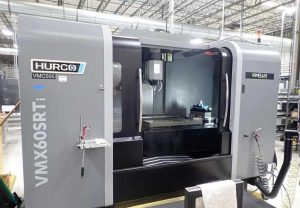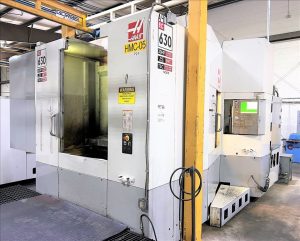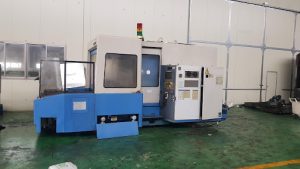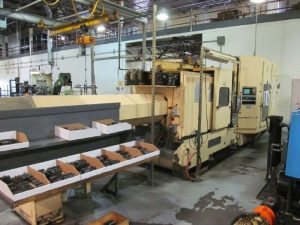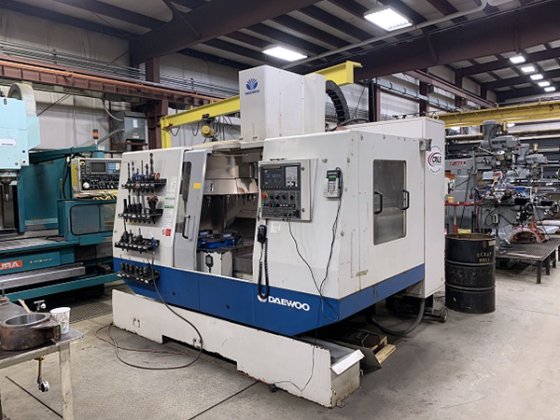
Industrial Insights: How to Spot Quality in Pre-Owned, Used, Secondhand, Surplus CNC Equipment Before Purchase Daewoo Mynx 530 CNC Vertical Machining Center made in South Korea
Here is a technical, industrial-grade guide you can use to spot quality (and hidden risks) when evaluating a pre-owned / surplus Daewoo / Doosan MNX-530 (Mynx 530) vertical machining center (VMC). Use this as a due-diligence checklist during site inspections and contract negotiations.
1. Know the Baseline / Nominal Specs
Before inspection, equip yourself with the “as new” or typical published spec values for the MNX-530. These become your reference thresholds to detect wear or misrepresentation. From listings:
| Parameter | Typical / Published Value* |
|---|---|
| X travel | ~ 32 in (~ 813 mm) |
| Y travel | ~ 20.1 in (~ 511 mm) |
| Z travel | ~ 20.1 in (~ 511 mm) |
| Table size | ~ 39.4 in × 19.7 in (~ 1,000 × 500 mm) |
| Table load / capacity | ~ 1,760 lbs (~ 800 kg) |
| Spindle taper | CT-40 (or equivalent ISO/BT-40 style) |
| Spindle speed (max) | ~ 8,000 rpm |
| Spindle motor power | ~ 15 HP (≈ 11 kW) |
| Rapid traverse (X / Y) | ~ 945 IPM (≈ 24 m/min) |
| Rapid traverse (Z) | ~ 708 IPM (≈ 18 m/min) |
| Tool changer | 24-station ATC (in typical config) |
* These are drawn from published used-machine listings. The actual machine may differ slightly depending on options, retrofits, or regional variants.
Use these values as “upper bounds” — if the machine under inspection cannot approach many of these values, that’s an early red flag.
2. Pre-Inspection / Documentation Checklist
Before going on site, request or demand these documents (if the seller can provide them). Good documentation is a strong quality indicator.
- Operation & maintenance logs
- Spindle rebuilds or bearing replacements
- Guideway / linear slide regrinding or refurbishment
- ATC maintenance (jaw replacements, magazine servicing)
- Coolant / lubrication system servicing
- Total machine hours and cutting-on hours vs idle hours
- Many machines accumulate many idle hours; pure “on time” is less harmful than “cutting time under load”
- Repair / parts replacement history
- Any major repairs (spindle, ballscrews, motor replacements)
- Documented modifications or retrofits
- Original / as-built drawings, schematics, parts lists, wiring diagrams
- Especially helpful for wiring, pneumatics, hydraulics, and control circuits
- Control / CNC version, software license, backup files
- Know the control brand (Fanuc, etc.) and version and whether spare modules or software support are available
- Alignment / calibration / test reports
- Any measurements of geometry, flatness, taper, accuracy after prior maintenance
- List of included tooling / fixtures / parts / spares
- Sometimes sellers include spare guide blocks, ATC jaw sets, or tool holders
- Photos (historical & current)
- Images from various angles to spot previous damage or repairs
If the seller refuses or lacks many of these, that raises risk.
3. On-Site Visual & Mechanical Inspection
When you are physically at the machine, do a systematic walkthrough. Use your eyes, hands, feel, simple measurement tools (feeler gauges, straightedges, dial indicators) to surface obvious issues.
3.1 Structure, Base & Casting
- Check the machine base, column, frame for cracks, weld repairs, distortion, or signs of settling
- Inspect for corrosion, rust, pitting, especially in coolant-wet zones or base sump
- Evaluate how the machine is installed — is the foundation solid, leveled, anchored properly?
- Are guards, access covers, splash shields intact and well-fitting? Missing panels suggest neglect or abuse
3.2 Linear Motion / Guideways / Slides
- Examine linear guide rails, ways, slides for wear: scoring, pitting, scratches, discoloration
- If possible manually (with power off) slide each axis and feel for binding, stiction, rough patches, stick-slip
- Check wipers, seals, scrapers that protect the ways — if these are badly damaged, debris ingress likely harmed the rails
- Inspect any ballscrews or lead screws (if used) for thread wear, backlash, axial play
- Inspect the encoder or linear scale system: look for damage, dirt, misalignment
3.3 Spindle Assembly, Nose & Bearings
- Inspect the spindle nose / taper for wear, burrs, scratches, or chipped surfaces
- Use a test bar or cylindrical reference to measure radial runout and axial play (end float)
- Rotate the spindle manually (if possible) at slow speeds and listen/feel for bearing noise, roughness, irregular vibration
- Check lubrication / coolant lines, seals, and spindle coolant (if present) for leaks or blockages
- Inspect the spindle drive motor, coupling, belts/gears (if any) for looseness or misalignment
3.4 Tool Changer / Magazine / Tool Interface
- Cycle the ATC tool changer (if seller allows) and watch for hesitation, mis-alignment, collisions, or slow indexing
- Inspect magazines, rails or carousels, tool pockets and jaws for wear or damage
- Check the tool clamp / release mechanism (hydraulic / pneumatic / mechanical) for tightness, play, and consistency
- Inspect tool holding interfaces (hold-down, taper fit, retention knobs) for wear or damage
3.5 Table, Workholding & Load Interface
- Examine the table surface and T-slots for dents, gouges, repairs, surface irregularities
- If the table moves (in some VMCs), check for play or looseness in its mounting or sliding mechanism
- Verify whether the table structure shows signs of being overloaded historically (bending, distortion)
- Check edges, mounting holes, fixtures for alignment and straightness
3.6 Coolant & Chip Handling Systems
- Inspect the coolant system, pumps, piping, filters, hoses for leaks, damage, contaminants
- Check chip conveyor, chip removal paths, sumps for clogging, rust, debris, misalignment
- Evaluate whether coolant is clean, whether tramp oils are removed, filtering is functioning
- Check auxiliary systems: chiller units, coolant temperature regulators, filtration units
3.7 Electrical, Control & Wiring
- Open the control cabinet: inspect interior cleanliness, wiring harness condition, signs of overheating or burnt components
- Look for loose or spliced wires, poor insulation, corrosion, moisture damage
- Check ventilation / cooling fans, filters, and their functioning
- Check grounding and shielding of control, motors, feedback systems
- Inspect the control panel / HMI / operator interface: buttons, switches, emergency stop, display integrity
4. Functional & Performance Testing
Even a visually pristine machine can hide problems. Use these tests (with the seller’s permission) to probe the machine’s condition under motion and load.
4.1 No-Load / Dry Motion Tests
- Jog each axis through its full travel at various speeds: slow, moderate, fast — look and feel for jerks, binding, inconsistent friction
- Reverse direction, stop–start tests, rapid direction changes to see how responsive the control is
- Do combined axes motion (e.g. diagonal XY) to test synchronization and lookahead
4.2 Tool Change / ATC Tests
- Run repeated tool change cycles, observe for mis-picks, hesitation, collisions or slow movements
- Command the magazine to index multiple times, verifying repeatability
- Monitor tool clamp/unclamp times and consistency
4.3 Simulated Machining / G-Code Path Runs
- Load a non-aggressive test program (e.g. simple pocket, contour) and run it to test axis tracking, interpolation, coordination
- Pause, reverse, command small incremental moves, and verify axis behavior
- Observe acceleration / deceleration dynamics and jerk control
4.4 Real Test Cuts under Load
- Use typical material (steel, aluminum, etc.) that you’ll use in production
- Cut test shapes: pockets, holes, slots, contour
- Measure finished parts: dimensional accuracy, straightness, taper, roundness, and surface finish
- Check for chatter, vibration, deflection or tool wear anomalies
- Test cut performance in various zones of the machine envelope (center, corners, extremes)
4.5 Long-Run / Thermal Stability
- Run the machine continuously under moderate load for several hours
- Monitor for drift in coordinates, changes in accuracy as components heat, variation in backlash or alignment
- Listen for increased noise, vibration, or signs of overheating in motors, spindles
4.6 Repeatability / Backlash & Settling Tests
- Command back-and-forth moves (e.g. +10 mm, –10 mm, +10 mm) in each axis and use a dial indicator or displacement sensor to verify how closely it returns
- Repeat in multiple axes and directions
- Test how stable the machine is after dwell / load (settling error)
5. Red Flags & Warning Signs (Deal Breakers)
If you encounter several of these, the risk is high — either demand deep discounting or walk away.
| Red Flag | What It Suggests / Why It’s Critical |
|---|---|
| Deep scoring, pitting, or wear on guideways or slides | Accuracy and precision lost; expensive rework needed |
| Excessive spindle runout or axial play | Tooling and finishing will suffer; bearings likely degraded |
| Spindle bearing noise, vibration, or rough feel | Major repair or replacement needed |
| ATC mis-picks, hesitation, collisions, slow / erratic indexing | Reliability problem; could halt production frequently |
| Worn or loose tool pockets, jaws, or magazine parts | Tool clamping or change reliability is compromised |
| Coolant / chip handling leaks, damage, or clogged systems | Poor maintenance; possible contamination or corrosion inside systems |
| Electrical cabinet signs of overheating, burnt wiring, haphazard wiring | Reliability & safety risk |
| Control modules, drives, or boards missing or replaced loosely | Spare parts or repair in future may be hard or costly |
| Absence of maintenance history or blank logs | Unknown condition; seller can’t guarantee claims |
| Test cuts yield unacceptable tolerances, chatter or drift | Machine may not meet your quality requirements |
| Obsolete or unsupported control / software | Repair or upgrade possibilities may be limited |
Any machine showing multiple of these is high risk. Always quantify how many and how severe before committing.
6. Lifecycle & Economic Risk Assessment
- Estimate remaining life of wear components: ball screws, guides, spindle bearings, ATC parts
- Check availability, cost, and lead time of spare parts (especially for Daewoo / Doosan brands)
- Budget for refurbishment: realignment, calibration, replacing worn modules
- Compare asking price + expected rebuild cost vs price of a similarly spec’d newer/refurbished machine
- Consider transportation, leveling, reinstallation and commissioning costs
- Include a contingency buffer (often 10–20 % of purchase cost) for unexpected issues
7. Contractual Safeguards & Negotiation Levers
- Performance / Acceptance Clause: (e.g. “this sale is contingent on passing test cuts and accuracy specs on site before final payment”)
- Holdback / Escrow: Keep a portion of the purchase price until you’ve verified performance post-delivery
- Spare Parts / Consumables Package: Request the seller provide spare tool holders, guide blocks, coolant pump parts, etc.
- Documentation & Ownership Rights: Ensure you receive all manuals, schematics, wiring diagrams, software licenses, and any calibration records
- Refurbishment Before Shipping: Negotiate that the seller perform basic mechanical cleanup, lubrication, and pre-alignment checks before the machine is moved
- Short-Term Limited Warranty: Even a 30–60 day guarantee on key systems (spindle, drives, ATC) can mitigate risk
- Right-to-Return Clause: If machine fails critical acceptance tests after delivery, you have recourse