In Stock & Available For Sale : used NARRAN ROD 500 Bright+ Laser Cleaning System – Year 2025 made in Czech Republic / REQUEST MACHINE INSPECTION
NARRAN ROD 500 Bright+ Laser Cleaning System – Year 2025
Specification
Metric
Imperial
Laser Specifications
Average Output Power
500 W
Peak Power
1.7 MW
Maximum Pulse Energy
100 mJ
Pulse Energy
33 / 50 / 71 / 100 / 100 mJ
Pulse Duration
20–100 ns
Wavelength
1064 nm
Laser Mode
Pulsed, ns
Scanning
1D / 2D
Optics & Working Range
Optical Fiber Length
10 m
Approx. 32.81 ft
Focus / Working Distance
300–600 mm
Approx. 11.81–23.62 in
Laser Head Weight
2.5 kg
Approx. 5.51 lb
Electrical Specifications
Power Supply
230 / 110 V, 50 / 60 Hz
Power Consumption
3,800 W
Power Connector
CEE 16 A 5P 400 V
Cooling & Operating Conditions
Cooling
Water
Operating Temperature
15–30 °C
59–86 °F
Diode Lifetime
Over 100,000 Hours
Safety
Laser Safety Class
Class 4
Dimensions & Weight
Dimensions
1,400 × 640 × 1,120 mm
Approx. 55.12 × 25.20 × 44.09 in
Weight
240 kg
Approx. 529 lb
NARRAN ROD 500 Bright+
Pulsed Fiber Laser Cleaning SystemMade in the Czech Republic
500 W Average Power
Up to 1.7 MW Peak Power
Pulses up to 100 mJ
Industrial Cleaning Without Abrasives or Chemicals
Designed for metals, molds, components, weld areas and critical surfaces.
Average Output Power
500 W
Peak Power
1.7 MW
Maximum Pulse Energy
100 mJ
Diode Lifetime
Over 100,000 Hours
Overview
Industrial Precision Cleaning System
Mobile architecture. Pulsed operation. Controlled energy delivery to the surface.
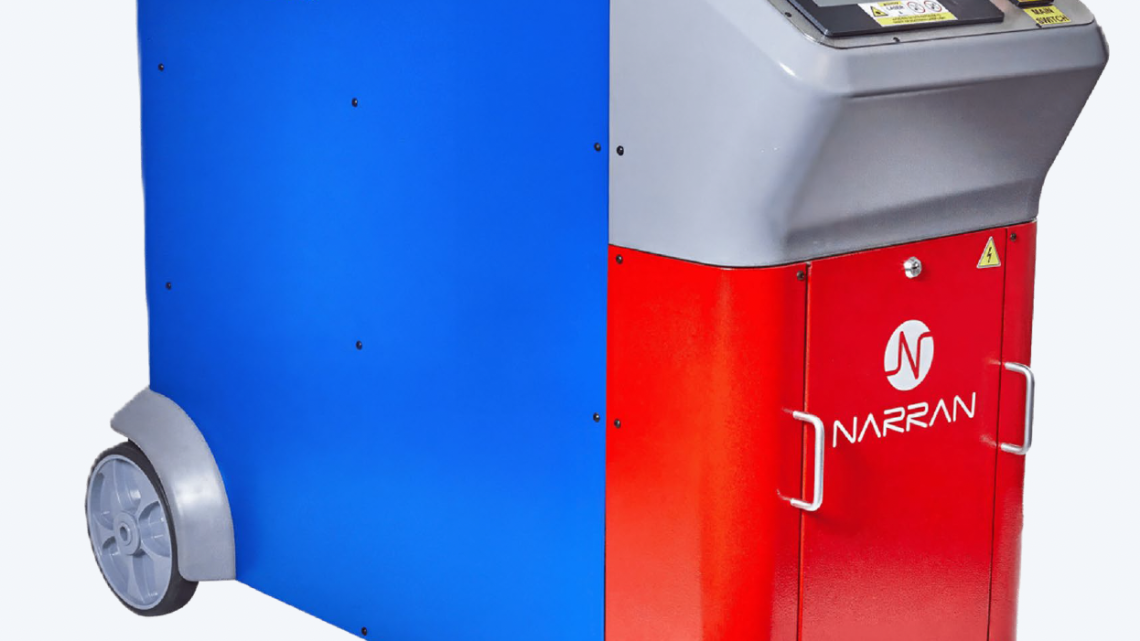
ROD 500 Bright+ is a next-generation mobile industrial laser cleaning system developed and manufactured by NARRAN in the Czech Republic.
The system is designed for cleaning metals as well as a range of other materials, including stone and wood.
The key principle of the technology is that contaminants are removed using light energy, without sand, blasting media or chemical reagents.
With correctly selected parameters, the surface can be cleaned with minimal impact on the base material.
Optical Fiber
10 m
Special Optical Fiber Version
Up to 100 m
Process Head Weight
2.5 kg
Process Head Operation
Manual / Robotic
System Weight
240 kg
Platform
Mobile Platform
Power Supply
230 / 110 V
Frequency
50 / 60 Hz
What the Company Gains
Controlled Cleaning: Power, scan shape and scan width are adjusted to the application.
Mobility: The long fiber and wheeled platform allow work directly at the equipment.
Repeatability: Industrial controls and saved process settings reduce dependence on operator skill.
Automation-Ready: The process head can be used manually or integrated into a production line or robotic cell.
Operating Principle
How Laser Cleaning Works
Short nanosecond pulses provide high peak power and precise energy dosing.
1. Focusing
The 1064 nm beam is delivered through the optical fiber to the process head.
2. Pulse
A nanosecond pulse creates a high power density in the contamination layer.
3. Removal
Rust, oxide, paint, carbon deposits or another layer is heated/ablated and removed.
4. Clean Surface
With the correct process settings, the base material retains its geometry and is ready for the next operation.
Advantage of Pulsed Operation
High peak power with limited average thermal load makes the system especially suitable for applications where precision, repeatability and preservation of part geometry are important.
Design
Purpose-Built Mobile Architecture
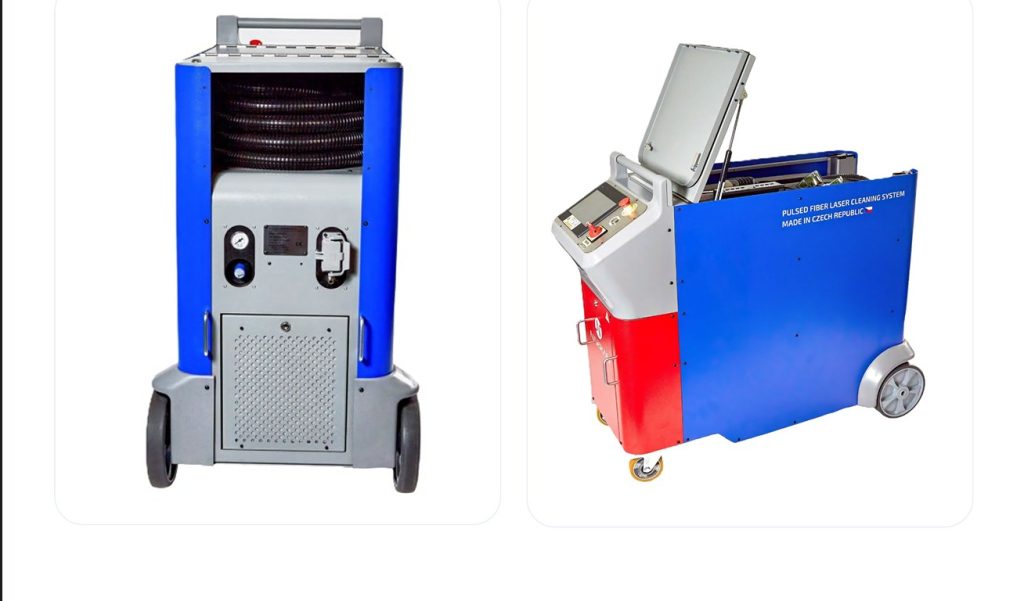
All key components are integrated into a single industrial enclosure.
1. Industrial PLC
According to NARRAN, the system uses industrial controls with saved operating profiles.
2. Integrated Cooling
A closed-loop water circuit cools the system and process head without a separate external chiller.
3. Manual or Automated Operation
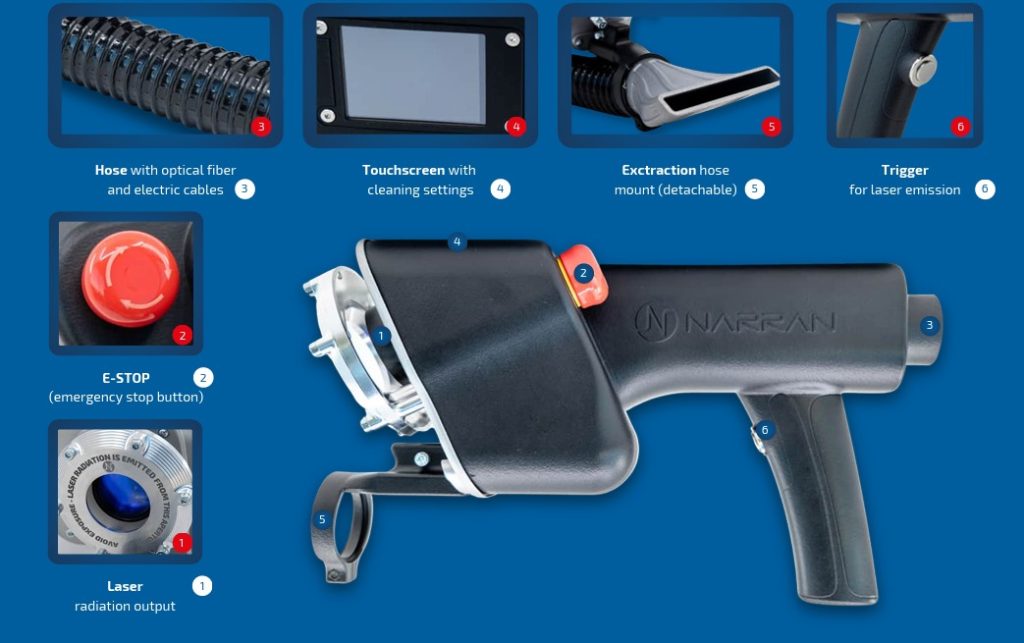
The head is suitable for manual cleaning and integration into an industrial line.
4. Mobility
Industrial wheels, a robust enclosure and a long optical fiber allow operation directly at the target equipment.
Technical Specifications
Average Output Power
500 W
Peak Power
1.7 MW
Maximum Pulse Energy
100 mJ
Pulse Duration
20–100 ns
Power Supply
230 / 110 V, 50 / 60 Hz
Power Consumption
3,800 W
Diode Lifetime
Over 100,000 Hours
Optical Fiber
10 m
Dimensions
140 × 64 × 112 cm
Weight
240 kg
Head Weight
2.5 kg
Wavelength
1064 nm
Mode
Pulsed, ns
Pulse Energy
33 / 50 / 71 / 100 / 100 mJ
Scanning
1D / 2D
Focus / Working Distance
300–600 mm
Cooling
Water
Laser Safety Class
Class 4
Operating Temperature
15–30 °C
Power Connector
CEE 16 A 5P 400 V*
Laser Source
IPG Photonics – A Platform for Reliability
The presented configuration uses an IPG Photonics fiber laser source.
IPG Photonics is a global leader and one of the key industry benchmarks in fiber lasers. The company develops and manufactures key components within its own vertically integrated platform.
ROD 500 Diode Lifetime
100,000+ Hours
Pulsed ns Laser Source
500 W
Coupling Efficiency
90–95%
Pump Technology
IPG Single-Emitter Pump
Why This Matters in Industrial Operation
Service Life: The long lifetime of the diode section reduces the risk of costly replacement of a key component.
Stability: The fiber architecture minimizes the amount of free-space optics inside the source.
Low Maintenance: IPG emphasizes high reliability and minimal service requirements.
Industrial Track Record: IPG technologies are used in numerous manufacturing processes worldwide.
Reliability statements are based on official IPG Photonics materials; the ROD 500 Bright+ diode lifetime is based on NARRAN data.
Applications
What the ROD 500 Bright+ Is Designed to Handle
The system is particularly suited to applications where the cost of surface damage is higher than the cost of cleaning itself.
1. Rust and Corrosion
Localized removal of corrosion products from metal; preparation for inspection, painting or repair.
2. Oxides and Scale
Removal of oxide layers; especially useful before welding, brazing and coating.
3. Paint and Coatings
Selective removal of paint/varnish in the work area without abrasive blasting contamination.
4. Oil and Contamination
Removal of process contamination and surface preparation for bonding/coating.
5. Molds and Press Tooling
Removal of rubber, polymer residues and deposits while preserving surface geometry.
6. Weld Areas
Cleaning before and after welding; localized removal of contamination and oxides.
Where the System Delivers the Greatest Value
On complex-shaped parts, molds, mating surfaces, weld areas and high-value components where repeatability, abrasive-free processing, localized treatment and geometry preservation are critical.
Industries
Metalworking, Power Generation and Service
The ROD 500 Bright+ is particularly effective for localized, precise and repeatable cleaning.
1. Metalworking
Preparation for welding and painting, oxide removal, and cleaning of parts and production tooling.
2. Oil & Gas Service
Localized corrosion, flange areas, pump/valve components, threaded and mating surfaces, subject to testing on the specific part.
3. Power Generation and Repair
Cleaning of critical parts, assemblies, rotors/stators and NDT inspection areas without abrasive contamination.
4. Transport and Rail
Repair areas, localized coating removal, and cleaning of welded joints and components.
5. Aviation and Precision Manufacturing
Surfaces where controlled energy input, geometry preservation and process repeatability are important.
6. Restoration and Stone
According to NARRAN, the technology is also used on stone/masonry to remove soot, contamination and certain coatings.
Practical Selection Principle
The more valuable the part, the more complex its geometry, and the higher the cost of damage/disassembly, the stronger the economic case for pulsed laser cleaning. For thick layers over large areas, productivity should always be confirmed by testing.
Integration
From Manual Operation to a Robotic Cell
One laser source can serve as a maintenance tool or as part of an automated process.
Manual Operation
The operator uses the process head directly on the part. The 10-meter fiber provides a wide working radius without constantly moving the main unit.
Automation
According to NARRAN, the head can be integrated into an industrial line; the current platform supports interaction with industrial systems and robots.
Process Economics
Process economics are determined by more than cleaning speed.
No Abrasives
No need to purchase or dispose of sand/blasting media.
No Chemicals
No solvent required.
Less Disassembly
Cleaning can be performed directly at the equipment.
Repeatability
Saved settings reduce variation in results.
Business Value
Why the ROD 500 Bright+ Is More Than Just a Cleaner
It is a tool for reducing the risk of part damage and standardizing the cleaning process.
1. Surface Preservation
There is no mechanical contact with the surface. This is an important advantage for molds, mating areas and precision parts.
2. Process Control
Adjustable power, scan width and scan shape allow the process to be tuned to a specific layer.
3. Mobility
A wheeled enclosure plus long optical fiber allow one system to be used in different work areas.
4. Service Life
The stated diode lifetime of more than 100,000 hours reduces long-term total cost of ownership.
5. Flexibility
From manual cleaning to line integration – one technology platform.
6. Image and Standardization
A Czech industrial system based on fiber technology, with clear documentation and industrial controls.
The ROD 500 Bright+ Advantage
For regular abrasive-free cleaning of high-value surfaces, fast changeovers and repeatable results, the 500 W pulsed system becomes a production tool rather than a service device.
Key Figures
Average Power
500 W
Peak Power
1.7 MW
Pulse Energy
100 mJ
Diode Lifetime
100,000+ Hours
For an accurate assessment of cleaning speed and quality, evaluation of the actual surface, contamination type and required result is recommended. Testing is what turns a versatile laser into a predictable production process.
Application Areas and Technological Capabilities
The laser cleaning system is intended for industrial use at manufacturing, power generation, engineering and repair facilities where regular equipment maintenance, restoration of high-value assemblies and components, localized surface preparation or cleaning before subsequent process operations is required.
The technology is particularly effective where controlled removal of light to moderate corrosion, oxide layers, carbon deposits, oils, process contamination, paint and other coatings is required without abrasive materials and with minimal impact on the base material.
Pulsed laser cleaning is especially valuable for applications where precision, repeatability, preservation of part geometry, localized treatment and the absence of secondary abrasive contamination are important.
Main Industries and Applications
Oil and Gas Industry: Maintenance of equipment used for oil and gas production, transportation and processing; repair of pipeline valves, pumps, compressors, heat exchangers and other process equipment.
Petrochemical and Chemical Industry: Cleaning and preparation of reactor components, heat exchangers, pipelines, tanks, flange connections and production equipment.
Power Generation: CHP plants, thermal power plants, hydroelectric plants and other power facilities; repair and maintenance of turbines, generators, rotors, stators, heat-exchange and auxiliary equipment.
Metallurgy: Ferrous and non-ferrous metallurgical plants, including aluminum, copper, nickel, steelmaking and ferroalloy production.
Mining Industry: Maintenance of quarry, crushing, beneficiation, transport and process equipment.
Heavy Engineering: Cleaning parts before repair, welding, non-destructive testing, coating, cladding and restoration operations.
Railway Industry: Repair of locomotives, railcars, wheelsets, bogies, traction motors, gearboxes and other assemblies.
Shipbuilding and Ship Repair: Treatment of welded joints, engine parts, mechanisms, hulls and marine equipment components.
Aerospace Industry: Precision cleaning of metal parts and high-accuracy components, subject to prior confirmation of the material, coating and permissible process parameters.
Automotive Industry: Cleaning of welded joints, molds, dies, foundry tooling and production tooling.
Tire and Rubber-Product Manufacturing: Cleaning molds of rubber, carbon deposits and process residues while preserving complex working-surface geometry.
Plastics and Composite Manufacturing: Cleaning molds, dies and production tooling.
Glass Industry: Maintenance and cleaning of molds and production tooling.
Repair, Mechanical and Engineering Facilities: Restoration of shafts, housings, gearboxes, mating surfaces and other high-value components.
Pump and Compressor Manufacturing: Preparation of parts for inspection, repair and restoration.
Electrical Engineering Industry: Cleaning components of electric motors, generators, rotors, stators and other equipment.
Metal Fabrication and Welding: Surface preparation before and after welding, removal of contamination and oxides, and localized cleaning of welded joints.
Non-Destructive Testing: Localized surface preparation before magnetic-particle, liquid-penetrant, ultrasonic, eddy-current and other inspection methods.
Toolmaking and Foundry Production: Cleaning dies, molds, casting molds, production tooling and precision tools.
Maintenance and Overhaul Facilities: Cleaning parts and assemblies of industrial equipment directly within the repair cycle.
Construction and Infrastructure: Localized treatment of metal structures, bridge components and engineering structures.
Utility Infrastructure: Repair of pumps, pipeline valves, heat-exchange equipment and power equipment.
Food and Pharmaceutical Industries: Cleaning selected metal components and tooling, provided the requirements of the specific process and any necessary validation are met.
Restoration and Conservation of Cultural Heritage: Controlled removal of contamination and corrosion products from metal and certain mineral surfaces after preliminary parameter selection.
Industrial Service and Repair Companies: Service and repair companies supporting industrial facilities across various sectors.
Technological Advantages
Depending on the specific application, laser cleaning can provide:
Non-contact surface treatment.
No sand, shot or other abrasive consumables.
Minimal secondary waste.
Localized treatment of only the required area.
Automation and integration into production lines.
High process repeatability.
Cleaning of complex-geometry parts.
Surface preparation immediately before welding, inspection, coating or restoration.
In many cases, an assembly can be treated without complete equipment disassembly, provided there is safe optical access to the surface being cleaned and laser-safety requirements are observed.
Industrial Tool Applications
The laser system should be considered not as a specialized device solely for rust removal, but as an industrial tool for:
Maintenance and repair.
Surface preparation.
Non-destructive testing.
Restoration of high-value components.
Cleaning precision tooling.
Cleaning molds.
Preparation before welding and coating.
Localized cleaning of critical metal surfaces.
The technology delivers the greatest economic benefit where the value of the part, tooling or equipment is significantly higher than the cost of the cleaning operation and where preserving the geometry and condition of the base surface is critically important.
Technology Limitations
Pulsed laser cleaning is not a complete replacement for abrasive blasting.
For large areas, structures with severe deep corrosion, thick rust layers or heavy coatings, abrasive blasting, shot blasting or another high-productivity technology is often more appropriate and cost-effective.
Laser Technology Is Most Effective For:
Light to moderate corrosion.
Localized cleaning.
Work on high-value and precision components.
Surface preparation before non-destructive testing.
Cleaning molds and tooling.
Removing coatings and contamination where abrasives are undesirable or unacceptable.
For parts made of heat-resistant alloys, components with functional coatings, claddings, thermal-barrier coatings, hardened layers or other special surfaces, process parameters must be selected individually.
Before industrial implementation, the base material, type of contamination or coating, and acceptable surface condition after treatment must be defined.
Thus, the primary value of pulsed laser cleaning lies not in maximum material-removal speed, but in process control, selectivity, repeatability and the ability to perform high-precision cleaning where traditional abrasive methods may be undesirable or technologically unacceptable.