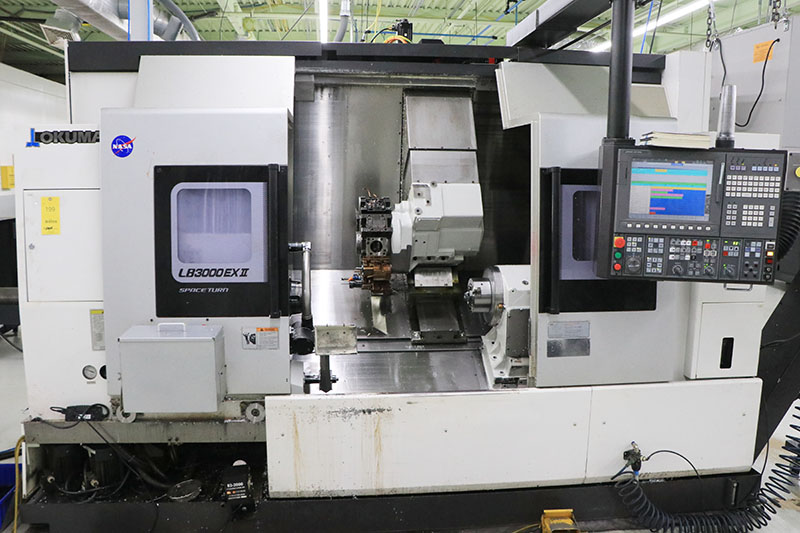
How to Avoid Common Pitfalls When Buying a Pre-Owned, Second-Hand, Surplus, Used Okuma Space Turn LB3000EX II MYW 800 CNC Turning Center made in Japan?
Below is a professional, technical, and sector-accurate guide on how to avoid common pitfalls when purchasing a pre-owned, second-hand, surplus, used Okuma Space Turn LB3000EX II MYW 800 CNC Turning Center.
How to Avoid Common Pitfalls When Buying a Pre-Owned Okuma Space Turn LB3000EX II MYW 800
The Okuma Space Turn LB3000EX II MYW 800 is a highly capable Japanese-made CNC turning center equipped with C-axis, Y-axis, sub spindle (W-axis), and milling capabilities. While it is one of the most reliable multi-tasking lathes in the industry, buying it second-hand requires careful technical evaluation. Below are the key pitfalls to avoid and how to inspect the machine properly.
1. Not Checking the Actual Spindle Running Hours
Many buyers only check the power-on hours, which are meaningless for evaluating wear.
For LB3000EX II:
- Check Spindle Cutting Hours (SP-CUT)
- Check Spindle Running Hours (SP-RUN)
- Compare them with typical expected values (heavy-use shops often exceed 15,000–25,000 hours).
Pitfall: Machines with low power-on hours but extremely high spindle hours are often heavily used and worn.
2. Ignoring the Turret and Y-Axis Alignment Condition
The LB3000EX II MYW uses a robust Y-axis box-type construction, but misalignment can still occur due to crashes.
Perform these checks:
- Y-axis centerline alignment relative to main spindle
- Angular misalignment in driven tools
- Turret indexing repeatability (< ±3 microns typical for Okuma)
- Excessive vibration during milling cuts
Pitfall: Y-axis misalignment is expensive to correct and typically indicates a crash.
3. Not Inspecting Sub-Spindle (W-axis) Accuracy
The W-axis is critical for part handover and synchro-cutting.
Check:
- Runout at the sub-spindle nose (< 5–10 microns is expected)
- Clamp and unclamp force
- W-axis linear guide backlash
- Synchronous spindle-to-spindle transfer accuracy
Pitfall: W-axis wear leads to misalignment during part transfer, causing rejects and instability in multi-process operations.
4. Overlooking Milling Spindle Load and Gearbox Noise
This model’s M- and Y-axis milling system must operate smoothly.
During inspection:
- Monitor spindle load during a circular interpolation test
- Listen for noise in live tooling gearbox
- Check temperature rise during 20–30 minutes of milling
- Verify max rpm under load without abnormal vibration
Pitfall: Noisy or overheating live tools often require expensive repairs.
5. Not Verifying B-Axis or C-Axis Positioning Accuracy
Although the LB3000EX II does not have a continuous B-axis, it has precise C-axis indexing used for milling operations.
Check:
- C-axis clamping force
- C-axis positioning accuracy and repeatability
- Brake condition
- Any chatter during milling operations
Pitfall: A worn C-axis brake creates chatter marks during contour milling.
6. Assuming Thermal Compensation Still Works Correctly
Okuma machines use Thermo-Friendly Concept, but if sensors or calibration are faulty, accuracy drops.
Test:
- Dimensional stability on cold start vs after warm-up
- Thermal drift over 2–3 hours
- Okuma diagnostic page for sensor errors
Pitfall: Machines with disabled or defective thermal compensation show inconsistent dimensional accuracy.
7. Not Checking OSP Control Health and System Logs
The OSP-P300L control is extremely reliable, but buyers should still review:
- Alarm history
- Overtravel or servo collision logs
- PLC or ladder modifications
- Memory and storage integrity
- Condition of embedded PC boards
Pitfall: Repeated servo alarms and collision alarms indicate deeper mechanical issues.
8. Underestimating the Cost of Okuma Original Parts
Okuma parts are high quality but not cheap.
Common replacements include:
- Turret curvic couplings
- X/Z-axis ball screws
- Servo drives and amplifiers
- Live tool spindle cartridges
- Hydraulic cylinders for chuck/sub-chuck
Request:
- Maintenance records
- Any replaced components
- Confirmation of genuine Okuma parts
Pitfall: Grey-market or non-OEM repairs reduce accuracy and reliability dramatically.
9. Not Checking Full Machine Alignment and Geometry
You should perform:
- Ballbar test
- Laser interferometer test
- Spindle runout test
- Backlash and circularity tests
Most precision problems can be detected with these.
Pitfall: Relying only on “visual inspection” without geometric tests.
10. Overlooking Chip Management and Coolant System Condition
LB3000EX II MYW models often run high-volume production, so coolant and chip systems wear quickly.
Inspect:
- Chip conveyor chain wear
- Coolant flow rate and filtration system
- Coolant tank contamination
- High-pressure pump condition (if equipped)
Pitfall: Weak coolant pressure causes poor surface finish in milling.
Final Recommendation
Always request:
✔ Full inspection report
✔ Video of machine cutting a part
✔ C-axis milling test
✔ Spindle warm-up + thermal stability data
✔ Alarms and maintenance records
✔ Backlash measurements
A well-maintained Okuma Space Turn LB3000EX II MYW 800 is one of the best multitasking lathes in its class, but poor inspection can lead to expensive surprises.