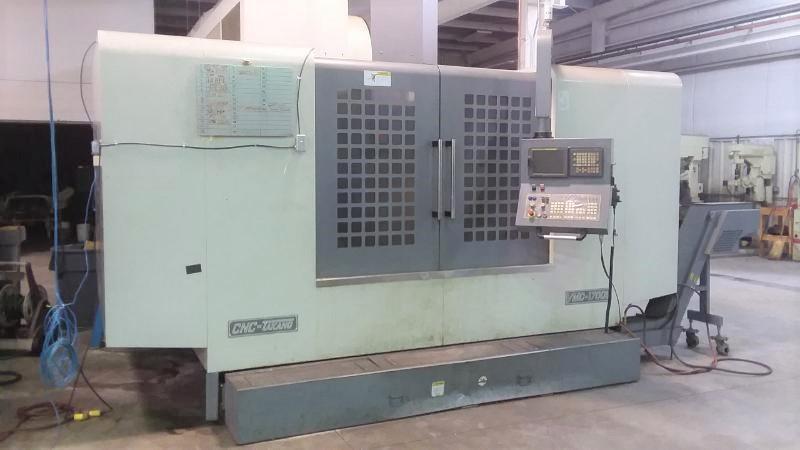
How Smart Engineers Assess a Pre-Owned, Used, Second-Hand, Surplus CNC-Takang VMC 1700S – Year 2011 made in Taiwan Before Purchase
Below is a professional, detailed guide for engineers and buyers on how to evaluate a pre-owned, used, second-hand, surplus CNC-Takang VMC 1700S (Year 2011, Made in Taiwan) before purchase. This covers inspection steps, technical checkpoints, and readiness for installation and operation.
How Smart Engineers Assess a Pre-Owned CNC Takang VMC 1700S Before Purchase
Model: Takang VMC 1700S
Type: Vertical Machining Center (VMC)
Year: 2011
Origin: Taiwan
This guide helps you evaluate mechanical condition, control systems, precision components, safety, documentation, and post-installation readiness.
1. KNOW YOUR MACHINE – BASELINE TECHNICAL PROFILE
Before you inspect the machine physically, make sure you obtain:
A. Factory Specifications (from seller or manual)
- Travel (X × Y × Z) – Typically 1700 × 700–900 × 700–800 mm (confirm exact model spec)
- Table Size
- Spindle Taper / Speed
- Tool Magazine Type & Capacity
- Control System Brand & Version
- Drive Type (Servo / Ballscrew)
- Machine Weight & Footprint
- Power Requirements
Request an official spec sheet from the seller.
2. WORKSPACE & SITE READINESS CHECKLIST
Before buying, evaluate whether the machine will fit your workshop:
- Machine Footprint
- Confirm the floor space required (L × W × H)
- Check access doors and crane access
- Power Requirements
- Voltage / phase specification
- Breaker capacity
- Floor & Foundation
- Flat, level concrete floor
- No cracks or uneven surfaces
- Cooling & Extraction
- Coolant supply system
- Chip conveyor or removal arrangement
3. MECHANICAL & STRUCTURAL CONDITION
A. FRAME & COLUMN
- Check for cracks, rust, or weld repairs
- Look at base rigidity and alignment
- No obvious signs of distortion
B. BALLSCREWS & GUIDEWAYS
- Move axes manually; check for:
- Backlash
- Vibration
- Noise
- Smooth travel
- Inspect lubrication lines and greasing quality
C. SPINDLE AND HEADSTOCK
- Run spindle manually
- Listen for unusual bearings noise
- Check runout with dial indicator
- If possible, measure spindle taper runout
4. CONTROL & ELECTRICAL SYSTEMS
A. CNC Control Panel
- Check model and version (Fanuc/Siemens/Mitsubishi/etc.)
- Ensure display works without glitches
- Test button responsiveness
B. Drive & Servo Modules
- Look for heat damage, burn marks, or rust
- Run basic motion tests
- Verify parameter settings are intact
C. Wiring & Terminals
- Tight and clean
- No broken or frayed wires
D. Emergency Stop & Safety Locks
- All E-Stops work
- Guards and interlocks functional
5. RUNNING TEST & FUNCTIONALITY
With the seller’s permission:
A. POWER-UP TEST
- Turn machine on
- No error codes
- All fans and cooling systems start
B. HOMING
- Axis homing should complete smoothly
C. MOTION TEST
- Move each axis full travel
- Check speed and acceleration
D. TOOL CHANGE
- If automatic tool changer is present:
- Check for correct tool handling
- No binding or failures
E. SPINDLE TEST
- Verify spindle rotation at various RPM
- Listen for noise
- Confirm air/oil mist unit if equipped
6. CUTTING TEST & PRECISION CHECK
A. TEST PART CUTTING
Run a simple G-code part like:
- Square or circle
- Pocket or slot
Inspect:
- Surface finish
- Accuracy
- Burrs
B. MEASUREMENT
Use precision tools:
- Dial indicator (runout check)
- Micrometer (accuracy)
- Test cut dimensions vs nominal
7. COOLANT & HYDRAULIC SYSTEMS
A. COOLANT
- Does the tank hold liquid without leaks?
- Is coolant clean?
- Pump runs well
B. HYDRAULICS (if equipped)
- Fluid pressure
- No leaks
- Cylinder smooth motion
8. DOCUMENTATION TO REQUEST
Always obtain:
- Original user manual
- Electrical diagram
- Wiring diagram
- Service & maintenance records
- Calibration reports
- Laser/system test records (if any)
- Past repair invoices
No documentation = increased risk
9. SAFETY & COMPLIANCE CHECK
Evaluate:
- Machine guards
- Interlocks
- Emergency stops
- Lockout/Tagout capability
- OSHA compliance (if required)
10. WEAR & LIFE COMPONENT CHECK
Common wear parts include:
- Ball screws
- Linear guides
- Encoders
- Spindle bearings
- Tool changer elements
Ask for:
- Ball screw backlash data
- Spindle runout measurements
11. SPARE PARTS & SUPPORT AVAILABILITY
Before purchasing:
- Check spare parts availability
- For a 2011 Taiwanese machine, parts may be available locally or via reseller
- Control System Support
- Verify if control (Fanuc, Siemens, etc.) has available backup
- Service Network
- Local technicians familiar with Takang
12. PRICING & VALUE DETERMINATION
Value depends on:
- Age of machine
- Hours of operation
- Condition of mechanical components
- Spindle condition
- Control system health
- Warranty (if offered)
- Location and transport cost
13. LAST-MINUTE VERIFICATION LIST
Before paying:
☑ Confirm polarity and color codes on wiring
☑ Back up CNC parameters
☑ Capture control software version
☑ Inspect controller memory and backups
☑ Legal title and ownership documents
☑ Transport logistics planned
14. FINAL PURCHASE CHECKOUT
✔ Pre-inspection report
✔ Photographs of key areas (spindle, guideways, control panel)
✔ Machine serial number verification
✔ Written agreement on condition
✔ Pickup and delivery plan