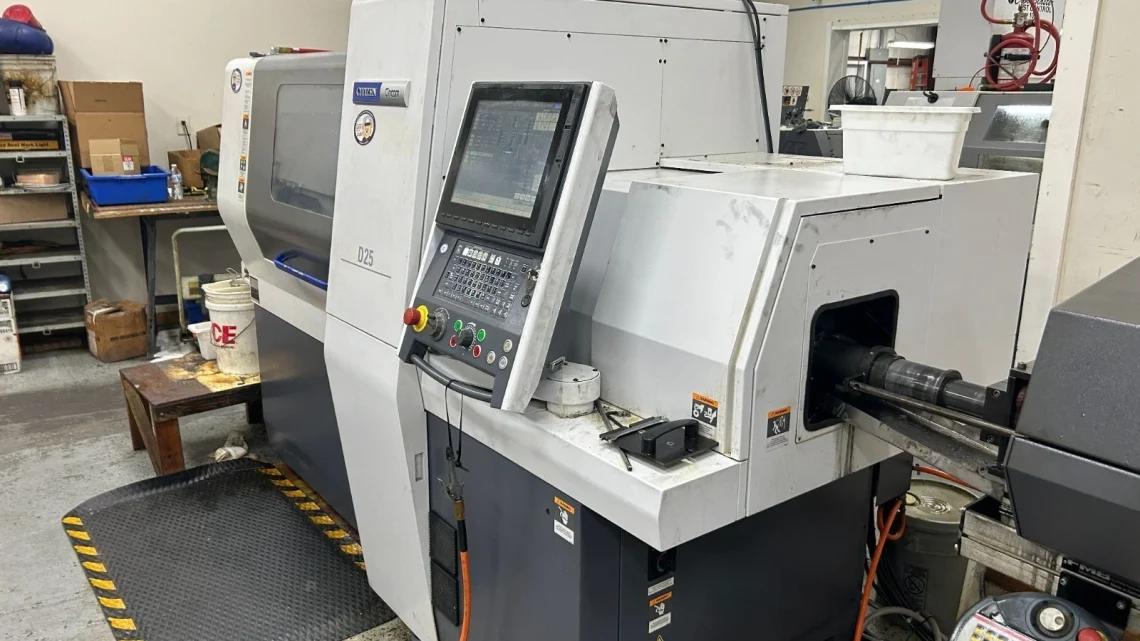
How Smart Engineers Assess a Pre-Owned, Used, Second-Hand, Surplus Citizen D25-1M8 (32mm) CNC Swiss Lathe made in Japan with FMB TURBO 3-38 Bar Loader Before Purchase
If you’re considering buying a pre-owned or surplus Citizen D25‑1M8 (32mm) CNC Swiss lathe made in Japan (often paired with a FMB TURBO 3-38 bar loader) then smart engineers will evaluate it thoroughly. Here’s a detailed checklist covering what to inspect, ask, and verify before purchase, tailored to this machine model and its typical configuration.
Why this particular machine deserves careful review
- The D25-1M8 is a high-performance sliding-headstock Swiss-type lathe (bar capacity ~ 32 mm) from Citizen / Cincom.
- It features a double gang tool post layout, B‐axis control, rapid spindle speeds (10,000 rpm) and is designed for high productivity.
- The addition of a FMB TURBO 3-38 bar loader (for example) significantly boosts automation/throughput — making the machine capable of near‐unattended operation.
- Because of its complexity (sliding headstock, gang tooling, live tooling options, bar loader), a used machine brings more risk (wear, hidden issues, automation integration) than a simpler lathe.
Pre-Purchase Assessment Checklist
Below are the major areas and specific items to inspect. You can tailor this into your on-site inspection worksheet.
1. Specification and suitability check
- Confirm machine model and variant: D25-1M8 (Type VIII) as opposed to earlier Type VII (D25-1M7) – the “VIII” variant supports B-axis and more tooling.
- Verify bar capacity: many listings show 32 mm (≈1.25″) bar capacity for the 32mm version.
- Check maximum machining diameter and lengths: according to spec sheet, max diameter ~ 1″ (25 mm) for default D25-1M8, but some listings state 32mm upgrade.
- Check spindle speeds: main and sub spindles up to 10,000 rpm.
- Tooling configuration: double gang tool posts, Y/Z axes, B-axis (for Type VIII) – verify what tooling stations are installed.
- Automation / bar-loader: Confirm the FMB TURBO 3-38 (or similar) bar loader is present and functioning — this affects loading, cycle time, unattended shifts.
- Control system: Ensure it’s the correct CNC (e.g., Mitsubishi M850W) and appropriate for your tooling/automation integration.
- Suitability for your parts: Check if the bar diameter, part length, live tooling, sub spindle, gang tooling meet your production requirements (material, complexity, cycle time).
2. Condition & usage history
- Request usage history: number of operating hours, shifts per day, maintenance logs. Was the machine used for high‐volume production of simple parts, or for complex/low-volume work?
- Review wear and tear on sliding headstock mechanism: sliding head machines present unique wear points (guide bushing, linear ways, sliding columns).
- Inspect spindle condition: Both main and sub spindles should be checked for bearing noise, run-out, thermal growth, vibration.
- Gang tool posts and live-tooling: These are expensive components – check for wear, especially on live tool spindles, rotary tools, tool posts.
- Bar loader & automation: The FMB loader must be functioning correctly (bar feed reliability, loader mechanics, sensors). In automation, loader issues often cause downtime.
- Coolant system and chip handling: Swiss‐type lathes generate a lot of chips and require good coolant/filtration. Check condition of coolant, sump, chip conveyor, cleanliness.
- Electrical/controls: Check the electrical cabinet (age of drives, condition of wiring, replacement parts availability), see if any major retrofits done.
- Maintenance records: Ask for rebuilds or major replacements (guide bush, headstock bearings, live tooling spindles). If missing, you may factor cost for upcoming refurbishment.
- Documentation: Ensure manuals, wiring diagrams, tooling lists, automation interfacing documentation available.
- Safety/compliance: Especially if importing into Türkiye/EU, check that machine meets required safety standards, interlocks, CE compliance (if required) or can be retrofitted.
3. On-site functional inspection & testing
When you visit the machine location, bring measurement tools (dial indicator, run‐out gauge, drawbar check tool, etc). Perform the following tests:
- Bar feed / sliding head test: Load a bar, start up bar loader (if present), run the sliding headstock mechanism, check for smooth movement, absence of chatter, correct guide bushing operation if used.
- Spindle run-out: Mount a test gauge in main spindle, check run‐out at tool holder and collet; also check sub spindle if present.
- Tool post movement: Move gang tool posts through X/Z axes, check for backlash, chatter, smoothness. Check live tool spindles rotate cleanly without noise/vibration.
- Tool change / gang tool post assembly: If machine has automatic tool post or turret, test selection, tool change reliability.
- Cycle test: If possible, run a short production cycle or test the machine under load (with a representative part) to verify cycle time, surface finish, dimensional accuracy, sub‐spindle transfer (if used).
- Bar loader test: Running the FMB TURBO loader: load bars, test bar feed, ensure sensors, clamps, bar ejector/chute operate correctly.
- Control/facet tests: Verify CNC control operation, axes respond correctly, servo motor currents normal, no alarms/historics showing major faults.
- Chip & coolant management: Observe chip disposal, check for excessive chip accumulation, inspect coolant sump cleanliness, check filters, check if coolant smells burnt or contaminated.
- Alignment/leveling check: Visually inspect machine base, check if it appears level, if there are signs of past relocation, if foundation or floors have sag/unevenness.
- Documentation check: Match serial number, year of manufacture, check firmware/software versions, check what retrofits have been done.
4. Infrastructure & integration requirements
- Floor loading: Swiss‐type machines can be heavy and may need reinforced floor or vibration isolation — check weight/footprint from spec and your facility’s floor load capacity.
- Utilities: Check electrical supply (voltage, phases, amps) — older machines may use 200V or 220V systems. Bar feeder may require compressed air, drive power, sensors.
- Chip/air/hydraulics: Check whether your facility has adequate chip disposal, coolant filtration, mist extraction, and bar loader air supply.
- Automation interface: If the machine is to be integrated into a cell (bar feeder, parts conveyor, robot), check existing wiring/interfaces, bar loader compatibility, safety interlocks.
- Tooling and consumables: Consider cost and availability of tooling (Swiss collets, guide bushings, live tool spindles, gang tool holders). If you invest in this machine you may need to invest in tooling.
- Spare parts and support: Check availability of service/support for Citizen machines in Turkey/EU, check if key spares (servos, control boards, live tool spindles, bearings) are still available for the D25-1M8 generation.
5. Total cost of ownership & risk factors
- Price vs expected remaining life: Given usage history and wear, estimate refurbishment cost and remaining life before major rebuild.
- Hidden upgrade cost: Older machines might need control retrofits, loader updates, software updates — factor these in.
- Obsolescence risk: Live tooling/spindles may be discontinued or expensive; bar feeder models may not be future‐proof if parts limited.
- Downtime risk: A used machine with complex automation has more risk of downtime, which must be factored into ROI calculation.
- Tooling cost: Swiss machining often incurs high tooling cost (collets, guide bushes, live tooling) — align this with your cost structure.
- ROI timeline: Ensure machine’s productivity (cycle times, unattended hours) will allow payback within acceptable time — otherwise you may better invest in newer model.
- Resale value: Consider how the machine will resale in future. A Swiss lathe with bar feeder and high automation tends to hold better value, but if wear is high its value drops faster.
Inspection Worksheet (Sample)
You may wish to use or adapt the following:
| Item | Pass / Fail | Comments |
|---|---|---|
| Model & serial number match | ||
| Bar capacity confirmed | 32 mm version | |
| Spindle speed & condition | Run-out within tolerance | |
| Sub spindle function | ||
| Gang tool post condition | No chatter/backlash | |
| Live tooling spindles | Noise, balance, vibration check | |
| Bar loader (FMB 3-38) | Feed, sensors, clamps functioning | |
| Coolant & chip management | Clean sump, functioning filters | |
| Control panel & CNC | No fault history, interface good | |
| Electrical cabinet | Wiring condition, drive status | |
| Maintenance history | Service records provided | |
| Floor/load requirements | Our facility capable? | |
| Tooling/collets included? | Check included tooling | |
| Spare parts availability | Key parts catalogue still supported | |
| Installation & rigging cost | Transportation, leveling, connections | |
| Warranty or inspection clause | Provision for post‐move test run |
Final Recommendation
If after inspection the machine checks out (good condition, low wear, functioning loader, tooling included, documentation complete) then the D25-1M8 + FMB bar loader represents a very capable production asset for small diameter/high complexity parts. On the other hand, if you find major wear in the sliding mechanisms, live tooling dysfunction, inconsistent bar feed, missing service records or questionable automation condition — then either negotiate a substantial price reduction or consider a newer machine.
Before purchase, insist on a working demo under load (with representative parts) and ideally a short time guarantee (e.g., 30 days or limited warranty) especially given the complexity of this machine.