25/10/2025
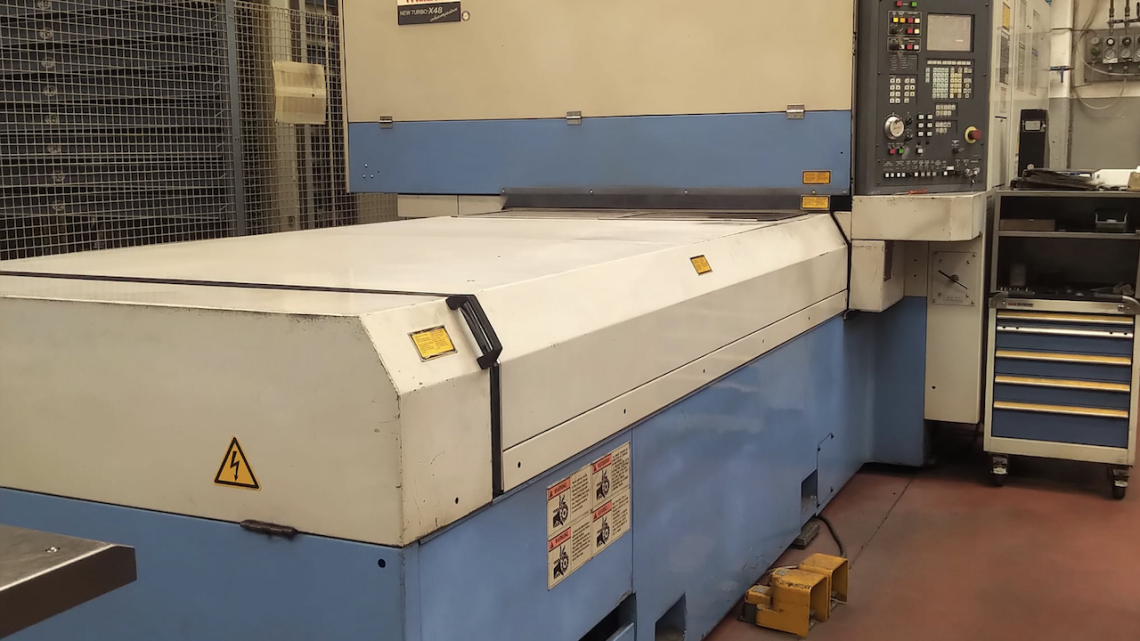
From Inspection to Installation: What to Verify Before Buying a Pre-Owned, Used, Secondhand, Surplus MAZAK NEW TURBO X48 CHAMPION CNC Laser Cutting Machine made in Japan
Here are some typical specifications & features for this model (variations exist depending on year, configuration, and power):
- Table/bed size ~ 4′ × 8′ (≈ 1250 × 2500 mm) in many units.
- Laser power around 1000 W up to ~1500 W in later versions.
- Travels reported: X ≈ 2600–2700 mm, Y ≈ 1270 mm, Z small (~100 mm) for laser head.
- CNC control: Mazatrol L-32B (older variant) in many units.
- Cutting thickness: for example one listing quotes 12 mm max for certain materials.
Because you’re dealing with a high-value machine tool, the inspection must be thorough.
1. Pre-Inspection / Technical Condition
Visual & Structural inspection
- Check the machine frame, bed, table, rails and escorting structure for cracks, corrosion, missing welds, or distortion.
- Examine the sheet support table/moving bed for smooth motion, no binding, no undue wear on rollers or guides.
- Inspect the laser head assembly, including focusing lens, mirrors, laser resonator area (if accessible), and check for signs of lens damage, burnt parts, or misalignment.
- Check the control panel (Mazatrol L-32B or others) — screen, buttons, pendant should be in good condition, no error logs, replacement parts visible.
- Check the exhaust/scrap removal system, chip/minor slag evacuation area, as laser cutting machines produce fumes/slag — any buildup may indicate poor maintenance.
Operational / Specification checks
- Verify the exact model variant (e.g., NEW TURBO X48 CHAMPION) and compare with what the manufacturer’s specs state.
- Confirm table size/travel: ensure the X/Y travel matches the specification (e.g., ~2650 mm x ~1270 mm for certain units).
- Confirm laser power: e.g., 1000 W, 1500 W in some adverts.
- Check the cutting thickness capability offered vs what you need in your business (e.g., one listing: max thickness 12 mm).
- Ask for running hours or “laser on hours” — a high number of hours can imply major maintenance soon.
- Check nozzle, lens and mirror replacement history — these are critical for laser performance.
- If possible, check servo motors/ drives for the table motion — they should be smooth without unusual noise or backlash.
Functional / Test Run
- Request or witness a live cutting test: ideally cut a part of similar thickness/material as your business will use (mild steel, stainless, etc.).
- Inspect the edge quality, presence of dross, burrs, slanted cuts — these are signs of alignment issues or worn optics.
- Check the cutting speed versus what the specification states; if it is much slower, maybe optics/lens are worn.
- Confirm the CNC control operation: ability to load programs, fast feed, move axes manually, emergency stop working.
- Check the shuttle bed or material loading/unloading system (if applicable): smooth function, no jamming.
- Inspect the cooling/chiller system (since CO2 lasers or even older fiber conversions may need chiller): ensure water temperature stability, no leaks.
- If machine has exhaust/dust collection or scrap conveyor, make sure those are working well because they affect the working environment and machine longevity.
Documentation & Disclosures
- Ask for manufacturer manual, wiring diagrams, service logs (especially for optical components replacement).
- Confirm if any retrofits or upgrades have been performed (e.g., laser resonator upgrade, fiber conversion, table retrofit).
- Ask about prior production environment: was it lightly used (one shift) or heavy 24/7 production? This affects wear.
- Check for any accidents or major repairs (floor instability, table crash, beam misalignment) – these could reduce reliability.
2. Purchase Conditions & Logistics
- Confirm machine location: This affects shipping & installation cost (especially into Türkiye).
- Verify footprint: ensure you have adequate floor space including clearance for maintenance, loading/unloading of sheets, scrap removal, operator access.
- Check foundation/floor loading: Laser machines with large beds need sufficiently strong, level floor with minimal vibration.
- Check utilities required: power supply (voltage, phase), chiller/cooling water, compressed air, extraction system for fumes. Older CO2 lasers require higher utilities.
- Check transport/disassembly: The bed, laser head, table may need disassembly for shipping; ensure seller provides guidance and accounts for rigging.
- Check installation cost & downtime: relocation, leveling, aligning, commission test cuts may take a few days—budget accordingly.
- Check spare parts availability in your region for Mazak lasers and the specific older model (since obsolete parts may cause cost or downtime issues).
- Verify any warranty or conditional return clauses: because used machines may come with “sold as-is” status—so you must accept risk.
3. Installation & Commissioning
- On arrival, ensure the bed is leveled and anchored (if required). Ensure motion axes X/Y are square, Z-axis height correct.
- Perform alignment of laser head: optical alignment, mirror/lens checks, beam centering, focus height verification.
- Confirm cutting parameters: set up sheet material, test cut, measure actual thickness capability, verify edge finish meets your production needs.
- Check control software version: older Mazatrol versions may need update; ensure software license is valid (if applicable).
- Confirm safety systems: interlocks, door guards, emergency stops, laser safety curtains/shields operational and up to local regulatory standards.
- Ensure exhaust/fume system is correctly connected: many used machines may have removed or bypassed extraction, leading to operator and machine issues.
- After commissioning, run production trial for some (e.g., 1 shift or 1 day) to verify operation under load; track quality, scrap rate, speed, cut edge quality.
- Set up baseline logs: track running hours, laser hours, cuts completed — this helps you monitor wear and schedule maintenance.
4. Final Checklist Summary
- Model & year verified, matches spec sheet for New Turbo X48 Champion.
- Usage hours / service history documented.
- Visual & mechanical inspection done (frame, bed, optics).
- Operational test achieved: demonstration cut and quality verified.
- All utilities and installation prerequisites verified (floor, power, chiller, exhaust).
- Installation & transport plan in place.
- Spare parts/support situation understood.
- Contract/purchase agreement clearly states condition and responsibilities (e.g., “as-is”, freight, installation).