25/10/2025
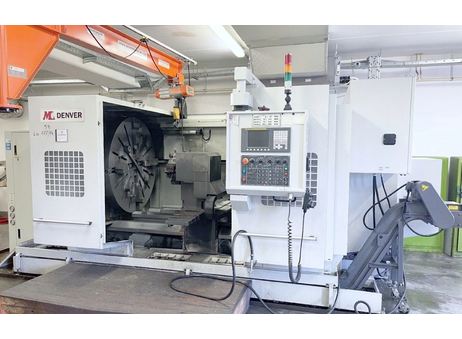
From Inspection to Installation: What to Verify Before Buying a Pre-Owned, Used, Secondhand, Surplus Denver DHL 1300 x 2000 CNC Lathe made in Taiwan
When considering purchasing a **pre-owned or surplus DENVER DHL 1300 × 2000 CNC flat-bed lathe (made in Taiwan) for your facility, you’ll want to conduct a complete inspection through to installation to minimise risk, ensure performance and avoid expensive surprises. Below is a comprehensive checklist tailored for this machine class:
Pre-Purchase & Inspection Checklist
1. Manufacturer & Documentation Verification
- Confirm the manufacturer: Denver Industrial Co., Ltd., Taiwan.
- Obtain the machine’s exact model (DHL 1300 × 2000), serial number, year of manufacture and original build specification. A listing shows “DHL-1300 with 2000 mm between centers” as available.
- Request hours or cycle count, maintenance/service history, any major rebuilds, and whether the lathe has ever been relocated (which can affect alignment).
- Confirm control system (brand, version), options and accessories included (tailstock type, chuck, turret, tool magazine, CNC control version).
2. Structural & Bed/Slide Condition
- Inspect the base, bed casting and slideways for cracks, weld repairs or visible damage. According to specs, the DHL series uses a one-piece Meehanite cast bed for stability.
- Check the width of the bed (in this series bed width is ~610 mm (24″) for many models) and ensure the bed width and travel match the model spec.
- Check wear on the ways/slide surfaces: look for scoring, pitting, excessive wear or rust—especially in the cross-slide rails and saddle.
- Inspect the cross-slide and Z-axis travel components for signs of abuse, misuse or missing covers/seals.
- Verify the spindle mounting surface, chuck mounting interface and spindle nose for damage or excessive wear.
- Confirm that the tailstock (if present) is aligned, functions properly, and its quill (if hydraulically operated) is still serviceable.
3. Spindle, Drives & Axes Movement
- Check spindle bore size and chuck compatibility—DHL series may have spindle bore sizes (e.g., 9″, 10″, 12″, 15″, 20″) depending on model.
- Run the spindle (if seller allows) and check for vibration, bearing noise, thermal behaviour and run-out (especially under load).
- Check the drive motors and gearbox (if applicable); review for oil leaks, gearbox noise, unusual heat; inspect for nameplate data and matching spec to build sheet.
- Jog each axis (X, Z, W if the model has a W axis) through full travel: observe smoothness, no binding, consistent feed, return accuracy and minimal backlash.
- Check the automatic turret (if included), tool-changer, or indexing device for proper operation, wear on tool-holding interfaces and correct indexing.
- Review lubrication system for axes: many heavy-duty lathes have automatic lubrication; verify it still functions and there is no blockage or missed maintenance.
4. Electrical, Control & Safety Systems
- Inspect the electrical cabinet: check for cleanliness, signs of overheating (discoloration, burnt smell), wiring condition and the presence of OEM components.
- Verify the CNC control (e.g., Fanuc, Siemens) is functioning, that all axes are enabled, alarm history is available and there are no persistent fault codes.
- Confirm that there are safety interlocks, emergency stop, door guards, chip-conveyor guards, coolant pumps and that all protective devices are intact.
- Check that the machine’s power supply, grounding and electrical phase match your facility’s standard or determine if conversion is required.
- Ensure that ancillary systems (coolant, chip conveyor, hydraulic tailstock or steady rest) are present and working (many used lathes are missing these).
5. Work-Holding, Accessories & Specifications Match
- Verify the actual travel specs: for the DHL-1300 × 2000 model you should expect ~1300 mm turning diameter over bed and 2000 mm between centres (or equivalent) as noted in the listing.
- Confirm actual chuck size, fixture condition, steady/rest availability and whether adapter plates or chucks are included.
- Check condition of any tooling, adapters, steady/rests; missing accessories may increase cost.
- Review the machine’s documented spec sheet against actual build: bed width, centre height, turret type, spindle bore, travel axes etc. In the catalog the DHL series shows bed width 610 mm for certain models.
6. Foundation & Site Readiness
- Confirm that the machine has been properly installed: look for anchor bolts, leveling jacks, stable foundation slab. If the machine was relocated, ask for re-level records.
- Assess the site where the machine has been running: floor level, vibration environment, dust/coolant conditions, chip disposal system.
- Confirm that your facility has adequate ventilation, power capacity, hydraulic/air supply (if tailstock or chuck uses hydraulics), and chip removal system.
- Plan for transport, rigging, relocation: heavy-duty flat-bed lathes may require special rigging and re-alignment after move which adds cost.
Installation & Commissioning Checklist
Once you’ve purchased the machine and brought it to your site, ensure the following before putting it into production:
- Level the machine precisely: use machinist’s level or laser level to check bed level, column/travel alignment and cross-slide perpendicularity.
- Perform spindle alignment: check chuck run-out, spindle taper, bearing condition.
- Verify axis travel limits, resets, home returns, and perform backlash/ball-screw checks.
- Replace consumables: hydraulic oil (if tailstock or chuck uses hydraulics), coolant change, filters, belts, seals. Even if used machine, fresh fluids reduce risk.
- Run a dry cycle: tool change, axis motion, turning movement, turret indexing (if present) without load; then with a light load to check for anomalies.
- Conduct dimensional test: turn a sample piece (or simulate) to verify accuracy, repeatability, surface finish, and no chatter or vibration.
- Confirm safety systems: emergency stop, guard interlocks, chip-conveyor operation, coolant safety, hydraulic supply fail-safe.
- Document baseline performance: record cycle times, tool-to-tool times, bed vibration, chatter, spindle temperatures. This creates a benchmark for future maintenance.
- Train operators and maintenance staff on specific machine’s quirks, PPE requirements, tool change procedure, maintenance schedule.
Key Red Flags to Watch For
- Excessive axis backlash or inconsistent motion across travel.
- Spindle bearing noise or run-out outside specification.
- Missing or non-functional turret/tool-changer, chucks or steady rests.
- Poor documentation of maintenance or machine history; unknown number of cycles or hours.
- Machine relocated several times without professional rigging—alignment may suffer.
- Foundation issues: if the machine was on inadequate support, floor vibration or deflection may cause poor results.
- Electrical cabinet appears modified/hacked: could mean OEM parts are missing or reliability reduced.
Summary Table
| Item | What to Verify |
|---|---|
| Structural & bed condition | No cracks/welds, bed flat, slides smooth |
| Spindle & drives | Bore size, run-out, bearing condition |
| Axes movement | Full travel, no binding, backlash minimal |
| Control & electrical | Clean cabinet, correct control, no recurring alarms |
| Work-holding & accessories | Chuck, steady/rests, turret included and working |
| Service & documentation | Serial number, hours/cycles, major rebuilds logged |
| Foundation & installation | Proper anchoring, leveled, site ready |
With careful attention to each of these areas, you’ll greatly reduce risk when purchasing a used Denver DHL 1300 × 2000 CNC lathe. Doing a full inspection and installation check upfront can save you from unexpected costs and downtime afterward.