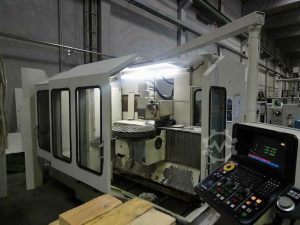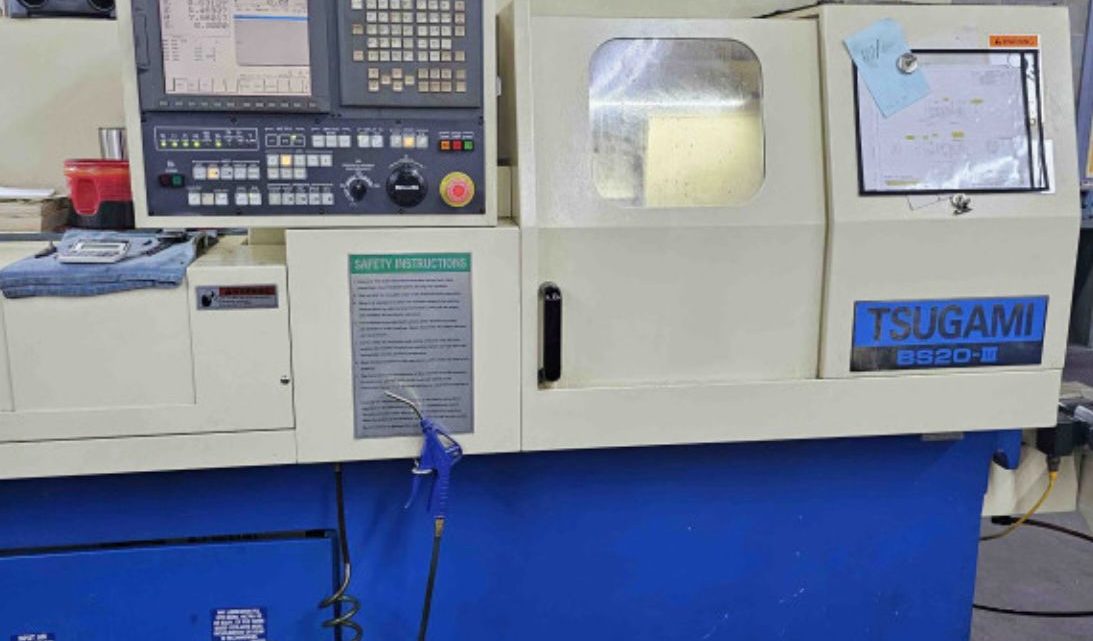
From Factory Floor to Your Workshop: Evaluating a Pre-Owned , Used , Secondhand, Surplus CNC Machines Before Purchase TSUGAMI BS20-III CNC Swiss Lathe made in Japan
Here’s a detailed, domain-specific evaluation framework you can use when assessing a pre-owned / used / surplus TSUGAMI BS20-III (or variant such as BS20(C)-III) Swiss (sliding head / gang) CNC lathe before purchase. I’ll also include what is known about that machine as a benchmark, common problem areas in Swiss lathe machines, and negotiation strategy.
1. Know the Machine — Baseline Specs & What to Use as Reference
Before visiting, gather all available documentation (spec sheets, maintenance logs, control manuals) so you have reference numbers to compare what you see. Some reference values for a TSUGAMI BS20-III (or BS20(C)-III) model:
| Spec / Feature | Typical / Published | Sources & Notes |
|---|---|---|
| Bar capacity / maximum work diameter | ~ 0.78 in (~20 mm) | On a listing: “Bar Capacity: 0.78” for BS20(C)-III. |
| Max machining length / turning length | ~ 8.26 in (≈ 210 mm) | One listing for BS20(C)-III says “Max Turning / Cutting Length: 8.26” |
| Spindle speed | Up to ~ 8,000 rpm | The spec listing indicates spindle speed up to 8,000 rpm |
| Control | Fanuc 18i-TB (for example in that listing) | |
| Tooling / turret | ~ 8-position turret, live tooling, Y / C axis capability in some variants | |
| Sub-spindle / secondary spindle | Some units include a sub-spindle; in the listing, second spindle is listed with ~7,000 rpm | |
| Rapid traverse, tool motions, feed rates, etc. | Usually fast movement capability, but wear degrades these. (Not always publicly listed) | Many Swiss lathes are designed for very fast small movements. |
These numbers give you a “performance envelope.” If the machine under inspection falls significantly short (e.g. spindle cannot attain expected rpm, sub-spindle missing or dead, turret stations fewer than expected), that’s a red flag or sign of modification.
Because Swiss / sliding-head lathes are precision machines, small deviations or wear can degrade output significantly.
2. Pre-Inspection / Offsite Inquiries & Documentation
Before traveling, try to get the following from the seller or broker. The quality of these docs is a strong indicator of machine care and transparency.
- Maintenance / service history — spindle rebuilds, tool turret repairs, cam / slide refurbishments, bearing replacements
- Usage / runtime / cutting hours — how intensively it was used (especially for Swiss-type high-speed, small-diameter turning)
- Crash / collision / misuse history — spindle crashes, part collisions, overtravel events
- Retrofits / upgrades — changes in control, added axes (Y, C, B), upgraded spindle, extra live tooling
- Parts & spares inventory — do they hold spare parts (bearings, tool turret parts, belts, motors)?
- Accessories included — collets, guide bushings, bar feeders, steady rest, tooling, spare turrets, documentation, wiring diagrams
- Control / CNC details — version, software, backups, custom programs, compatibility
- Electrical / cooling / lubrication specs — voltage, cooling water, lines, pumps, filters
- Transport / rigging plan, disassembly / reassembly — especially because Swiss lathes are compact but delicate
- Right to inspect, test, and trial use — run the machine, load tests, sample parts
- Return / acceptance clause — possibility to reject the machine after installation if major defects appear
If the seller cannot or will not provide good documentation, that raises risk — demand extra protections or a lower price.
3. Visual & Static Structural Inspection (Before Power)
Once you arrive on-site, before turning anything on, do a detailed walk-around. Many serious issues can be caught visually or through non-powered checks.
A. Exterior / Structural Components
- Check the bed / base / frame castings for cracks, weld repairs, distortions, or signs of past impact.
- Examine covers, way guards, bellows, scrapers — if torn, missing, or damaged, chips and coolant may have penetrated into critical areas.
- Look at the column / turret area / tool-post frame for damage, misalignment, or evidence of bumps.
- Inspect all panels, doors, guards, control enclosures — missing covers or poorly fitted panels are suspicious.
- Check wiring harnesses, cable carriers, conduits, connectors for abrasion, splices, tape repairs or non-OEM fixes.
- Inspect coolant and lubrication pipes, fittings, tanks, and filters for leaks, corrosion, or blockages.
- Check collet / guide bushing systems (if visible) for wear, rust, damage, or misalignment.
B. Manual / Static Mechanical Checks
- Using hand feed or manual traverse (if safe), move axes gently to feel for binding, roughness, sticking points.
- Use feeler gauges or a dial indicator to test backlash / play in each axis (X, Z, Y if present).
- Mount a dummy bar, collet or test piece and gently test for axial or radial play (“wiggle”) in the spindle or headstock.
- Manually index the turret / tool post if possible to check for smooth indexing and absence of binding.
- Rotate the sub-spindle (if present) manually to verify smooth motion.
- Inspect lubrication / oiling ports, grease fittings — check for obstruction, leakage, or dirty oil.
Any structural damage or excessive wear detected here is cause for deep discounting or refusal.
4. Power-Up & Control / Drive / Safety Tests
If the static inspection looks acceptable, proceed to powering the machine (with all safety precautions and interlocks engaged). Start with light tests.
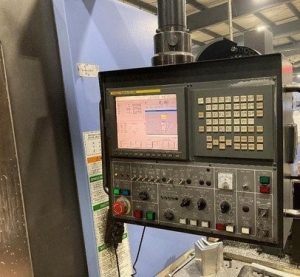
- Observe boot-up / control startup: check whether the CNC control initializes properly, lists all axes, shows errors or missing modules.
- Test all panel buttons, switches, display, alarms to verify responsiveness.
- In manual / jog mode, move axes slowly (X, Z, Y if applicable). Check for smoothness, stutter, or drive errors.
- Test safety circuits / E-stop / limit switches / guard interlocks — these must function correctly without bypassing.
- Monitor power draw (if instrumented) — any abnormal surges or instability is suspicious.
- Try feed override, manual function, spindle start / stop — see whether response is proportional and consistent.
- Engage homing / zero referencing routines, see whether axes home accurately.
If the control or servo drives cannot initialize or show repeated faults even in test mode, that suggests deeper electrical or control issues.
5. Dynamic Tests & Sample Part Machining
Assuming axes respond, proceed to more strenuous dynamic testing, and sample machining to reveal hidden issues under load.
A. Axis / Motion Tests
- Command full travel moves at multiple speeds (slow → medium → fast), listening for noise (grinding, squealing), and feeling for irregular motion.
- Reverse motions and measure backlash / reversal error via a dial indicator or equivalent test method.
- Move to a point then back, repeating multiple times, to test repeatability.
- If possible, run compound moves / simultaneous axis moves (especially if there is Y, C, or complex tool paths) and check for smooth interpolation.
B. Spindle & Tooling Performance
- Run spindle at multiple speeds, listen for bearing noise, hum, vibration.
- Mount a test bar or datum in the spindle and measure radial run-out.
- Run the spindle under no load for a time and monitor whether noise/vibration/temperature drift develop.
- If you have live tooling, run it and test for vibration, power, response under load.
C. Sample Part / Test Machining
- Request or perform a test part / sample machining using your type of workpiece or similar.
- Aim to stress the machine: small diameters, long length, fine tolerances, multiple operations (drilling, milling, turning).
- Measure the results: dimensional accuracy, surface finish, concentricity, roundness, repeatability.
- Try worst-case tool paths or high-feed operations to see if the machine holds stability.
- Observe coolant flow, chip evacuation, cleanliness during the run.
- After machining, inspect the workpiece deviation and compare to tolerance.
If machining fails or parts come out far off, that suggests wear or misalignment that might be costly to fix.
6. Geometric / Metrology / Alignment Checks
If possible (or bring a measuring tech), do precise geometry tests using straightedges, indicators, gauge blocks, or laser systems.
- Check straightness on X and Z axes across full travel (bow, sag, deflection).
- Verify parallelism of spindle axis to axes, whether tool head aligns properly over guide bushings.
- Check squareness / orthogonality of axes relative to each other (X vs Z, tool slides, turret alignment).
- Command precise distances and measure actual vs commanded — find scale errors / linearity deviations.
- Let the machine warm up, then re-check to detect thermal drift or motion shift.
- At the extremes of travel, test deflection / bending or lost accuracy.
Because Swiss lathes are high-precision, even small geometric errors degrade final parts significantly.
7. Estimate Refurbishment, Hidden Costs & Risk Buffer
Every used high-precision machine has latent repair or adjustment needs. Plan for:
- Spindle bearing rebuild / replacement
- Refurbishment or repair of guide bushings, collets, tool-holding components
- Replacement or refurbishment of servo motors / drives / feedback modules / cables
- Repair or replacement of worn axes/ballscrews / nuts / slides
- Rewiring harnesses, connector replacements, cleaning cable carriers
- Control / electronics overhaul or modernization
- Calibration, alignment, compensation, shimming and test machining
- Replacement or repair of worn covers, way wipers, guard parts
- Coolant / lubrication / filtration system repairs or cleaning
- Spare parts kit (bearings, collets, seals, belts)
- Transport / rigging / disassembly / reassembly / setup costs
- Contingency buffer (often 15–30 %) for surprises
Because Swiss-type machines operate tightly, even minor misalignments or wear can cascade into poor output — factor in that your “repair to production condition” effort might be substantial.
8. Red Flags & Deal Breakers
Watch for these serious warning signs during your inspection and testing:
- Spindle or head rotating with audible bearing noise, vibration, or heating
- Control refuses to boot or experiences repeated drive / servo errors
- Excessive backlash, stick-slip, or erratic axis motion beyond acceptable compensation
- Significant structural damage, crack repairs, or bent components in bed, frame, or tooling types
- Tool turret or live tool mechanism misbehaves, misindexes, binds, or does not function properly
- Missing or poor covers, guards, way wipers, or open guide surfaces (chips / coolant intrusion risk)
- Obsolete electronics / drives with no spare parts or support
- No opportunity to perform a real test piece or load machining test
- Large deviations from original specs (travel, spindle speed, tooling capability) that are unexplained or not documented
- Severe thermal drift, inability to hold geometry over a run
- Excessive wear or damage in collet / guide bushing / bar guiding zones
If you see multiple red flags, demand steep discounts or consider walking away — the risks escalate quickly.