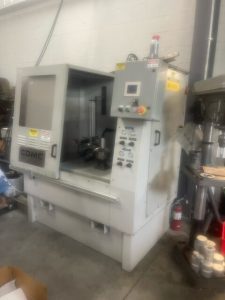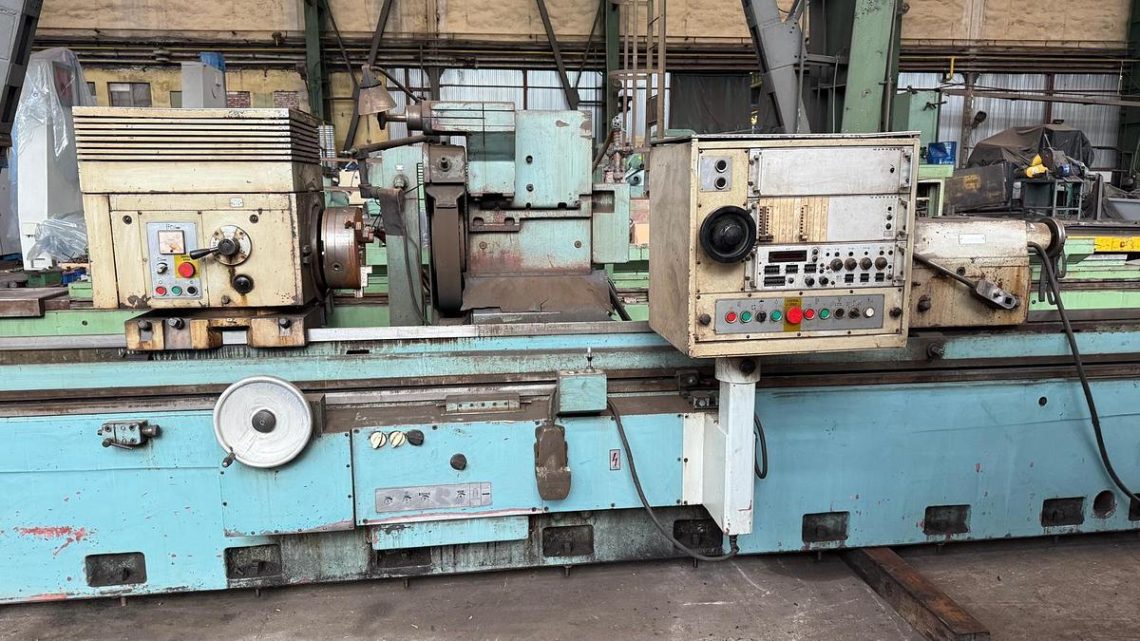
From Factory Floor to Your Workshop: Evaluating a Pre-Owned , Used , Secondhand, Surplus CNC Machines Before Purchase TOS HOSTIVAR BUC 63A/4000 Cylindrical Grinder made in Czechia
Here’s a tailored evaluation guide for the TOS Hostivař BUC 63A / 4000 universal / cylindrical grinder (made in Czechia). I’ll first summarize its known specs and typical issues, then walk you through what to check (structural, mechanical, dynamic, control, alignment, risk factors) when examining a used example.
A. Typical Specifications & Baseline Data
Before inspection, it’s essential to know what the “healthy” machine should deliver. Below are typical parameters for BUC 63A / 4000 units, based on listings and catalogs:
| Parameter | Typical Value / Range | Notes / Sources |
|---|---|---|
| Max grinding diameter (external) | 630 mm | Many listings show Ø 630 mm swing capacity. |
| Grinding length / distance between centers | 4,000 mm | As model designation implies. |
| Workpiece weight (between centers) | ~ 2,500 kg | Some ads list 2,500 kg capacity. |
| Grinding wheel (diameter × width × bore) | ~ 750 × 100 × 305 mm | From listings. |
| Grinding spindle speeds | 840 / 970 rpm | Dual speeds in many units. |
| Workpiece spindle / drive speeds (internal / external workhead) | approx. 8–315 rpm | Many ads list that range. |
| Machine weight / physical size | ~ 13,700 kg; footprint ~10,000 × 3,400 × 2,000 mm | One listing: ~ 13.7 t, ~10 × 3.4 × 2 m. |
| Power requirement / motor | ~ 15 kW for wheel spindle, main drive | One listing gives the wheel-head drive at 15 kW. |
These figures are your “target envelope.” Any used machine that deviates significantly (for example, only capable of 300 mm grinding length, or severely lower weights, or missing capability) should raise caution. Always verify “as is” specs on the actual machine.
B. Pre-Inspection / Off-Site Inquiries
Before you travel, request as many of the following as possible from the seller or broker. Good documentation increases confidence; refusal is a red flag.
- Maintenance/service history (bearing replacements, spindle overhauls, head repairs, regrinding, alignment adjustments)
- Operating hours / duty cycles (how intensively it was used)
- Past accidents, overloads, crashes, or overtravel incidents
- Modifications or retrofits (e.g. changed drive motors, added CNC retrofits, replaced control modules)
- Spare parts inventory (bearings, spindle parts, grinding wheels, drive components)
- Accessories included (steadies, internal grinding attachments, wheels, balancing arbor, dressers, work supports)
- Power / electrical requirements (voltage, phases, cooling, wiring)
- Transport / rigging plan (how the machine will be moved, disassembled, reassembled, alignment)
- Permission to power it on, test it, run sample grinding under load
- If possible, internal photos or video (especially of spindle area, bearings, ways, spindle internals)
If the seller is vague in these areas, proceed with extra caution.
C. Visual & Static Inspection (Before Power)
Once on-site, before applying power, do a careful walk-around and static inspection. Many issues are visible before turning on.
1. Structure & Castings
- Examine the bed, columns, wheelhead support structure, cross slide, and all castings for cracks, weld repairs, distortions.
- Look for surface corrosion, pitting, rust, especially on exposed surfaces and internal areas that see coolant or dust exposure.
- Check the way covers, guards, telescopic covers, scraper shields — torn, missing, or poorly fitting covers often imply chips/coolant intruded into critical surfaces.
- Inspect the wheelhead, cross-feed mechanisms, tailstock (if present), and check for alignment or structural bending.
- Check for any signs of past collisions, bump marks, dents, weld patches around the spindle housing or workhead.
- Examine electrical wiring, conduits, cable carriers for damage, chafing, splices, or non-OEM repairs.
- Check coolant / lubrication piping, reservoirs, pumps, lines, valves for corrosion, leaks, or blockages.
2. Mechanical / Static Checks
- Try to move (manually, cautiously) the table or cross-feed where possible (with power off) to sense for binding, stiff spots, rough motion.
- Use feeler gauges, dial indicators, or test probes to check for play / backlash in cross-feed or longitudinal feed mechanisms.
- Mount a dummy tool or arbor (if available) and check the spindle nose / wheel arbor taper for axial / radial play (“wiggle”).
- Inspect the steadiers or work supports, internal grinding attachments (if present) for wear, looseness, or damage.
- Inspect lubrication lines, greasing ports, and check whether fittings are clogged, broken, or missing.
If you spot structural damage, excessive wear, or missing protection components, they should demand serious discounting or abandonment.
D. Power-Up & Control / Drive Checks
If the machine clears the visual checks, power it up (with all safety precautions) and test basic controls and drives.
- Observe startup / boot sequence of the control / drive systems. Look for alarms, error codes, missing modules.
- Test control panel buttons, switches, displays, and ensure response is correct.
- In manual or jog mode, command cross-feed, longitudinal feed, wheelhead feed (if possible) at slow movements. Check for smooth motion, erratic motion, drive faults, alarms.
- Test interlocks, e-stop, limit switches, safety guards — ensure none are bypassed.
- Monitor power draw (if instrumentation available) and watch for surges, instability, or overcurrent warnings.
- If there is a control override or feed override, test whether it works as intended.
If the controls don’t boot cleanly, or drive faults occur even in no-load jogging, that’s a serious warning sign.
E. Dynamic Testing & Grinding Trials
Assuming axles and controls respond, move next to dynamic testing and real grinding trials to expose latent defects.
1. Axis / Feed Motion / Accuracy Tests
- Move the table/cross feed over its full travel at various feed rates. Listen for grinding, scratchiness, unevenness.
- Reverse direction and measure backlash / reversal error using a dial indicator or precision probe.
- Command small incremental moves back and forth and see how closely the system returns (repeatability).
- If possible, run composite movements (if the unit supports simultaneous cross + longitudinal feeds) to test coordination.
- If you have a test circular or reference ring, test the grinding motion’s consistency.
2. Spindle / Wheelhead Testing
- Spin the grinding wheel spindle at low / medium / high speeds. Listen for bearing noise, hum, vibration.
- Use a dial indicator to check radial run-out of the grinding wheel arbor or spindle nose.
- Let it run under no load for an extended period to observe any changes in noise, vibration, or temperature.
- If possible, mount a wheel and perform light grinding cuts (on scrap) to test how the spindle behaves under load.
3. Grinding / Sample Work Tests
- Do test grinding of a known workpiece. For example, grind a cylindrical section, or perform a plunge / axial grind, depending on the machine’s capabilities.
- Measure and compare the result: dimensional accuracy, surface finish consistency, repeatability.
- Try tougher cases: longer surfaces, varying diameters, transitions, internal grinding (if unit has that capability).
- Monitor chip evacuation, coolant behavior, thermal drift during the grind, and whether vibrations or chatter arise.
- After grinding, inspect the workpiece for undercut, taper, out-of-roundness and compare to tolerances.
These trials will reveal whether the machine still meets production-level tolerance or whether wear is too severe.
F. Geometric / Alignment / Metrology Checks
If you or a metrology technician can bring measurement hardware (straight edges, gauge blocks, indicators, laser tools), do the following:
- Measure straightness of the feed axes over full travel (check for sag, bow).
- Check parallelism between the grinding wheel axis and table / work axis.
- Check flatness / planarity of table or supporting surfaces.
- Measure squareness and whether axes remain orthogonal over travel.
- Command known travel distances and measure actual vs commanded (linearity / scale error).
- Allow the machine to warm up, then re-check alignment to see thermal drift effects.
- At extremes (e.g. far ends of travel), check for deflection or degradation of geometry.
Some errors can be compensated or shimmed; structural distortions or bent components are expensive or impossible to fully fix.
G. Risk Assessment & Hidden Cost Estimation
Even if a used machine seems okay at first glance, you must budget for refurbishment, hidden problems, or parts replacement:
- Spindle bearing replacement / overhaul
- Wheelhead or arbor reconditioning
- Replacement of worn ways, guides, or re-scraping surfaces
- Re-grinding or rebuilding feed screws, nuts, or leadscrews
- Control / drive electronics repairs or modernization
- Wiring loom repairs, replacement of damaged cables
- Replacement of wear items, covers, way-wipers, guards
- Coolant / lubrication system overhaul (pumps, lines, flushing)
- Alignment, calibration, shimming, test grinding setup
- Spare parts (bearings, seals, tooling, collets, etc.)
- Transport / rigging / disassembly and reassembly costs
- Contingency buffer (e.g. 15–30 %) for surprises
Because a grinder is a precision surface machine, even small misalignments, worn bearings, or thermal drift can degrade final part quality significantly.
H. Deal-Breakers & Red Flags
As you inspect and test, some issues are serious enough to demand steep discounting or walking away:
- Grinding spindle producing clear audible noise, vibration, or instability
- Controls failing to boot cleanly or showing multiple errors / faulty modules
- Excessive backlash or sloppy motion that seems unrecoverable
- Structural damage: cracks, major weld repairs, distortions in bed or support castings
- Wheelhead or arbor damage (e.g. bent arbor, arbor taper damage)
- Missing covers, way wipers, chipped guard plates or damaged bearing housings
- Poor or missing documentation, diagrams, spare parts lists
- No opportunity to test under load or run grinding trials
- Drive faults or erratic behavior under motion tests
- Severe thermal drift or inability to maintain stable operation
- Major deviation in geometry (e.g. wheel axis not parallel to work axis) beyond correction
If multiple red flags appear, your risk escalates dramatically.