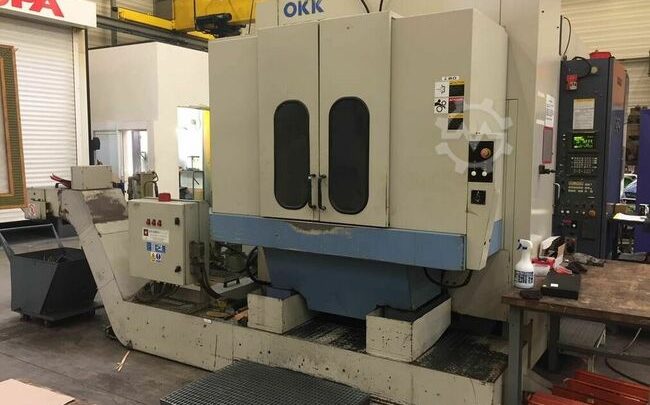
From Factory Floor to Your Workshop: Evaluating a Pre-Owned , Used , Secondhand, Surplus CNC Machines Before Purchase OKK HM 50 made in Japan
Here is a comprehensive guide you can use when auditing a pre-owned / surplus OKK HM-50 (horizontal / “HM50”) CNC machining center (Japan origin) — from initial screening through on-site tests to final decision criteria. I’ve also gathered reference specs to serve as benchmarks you can use to validate seller claims.
1. Reference Specs & Expectation Benchmarks
Before you inspect the machine, knowing what “normal” looks like for an HM-50 helps you identify exaggerations or red flags. Below are published / used-machine data for OKK HM50 units:
| Specification | Typical / Published Value | Notes / Source |
|---|---|---|
| X, Y, Z Travels | 760 mm × 730 mm × 800 mm | From a dealer listing: “X-travel 760, Y 730, Z 800 mm” |
| Pallet / Table Size | 500 × 500 mm | Multiple listings show 500 × 500 mm pallets |
| Spindle Speed | 35 – 13,000 rpm (stepless) | On the Machinestock spec sheet: “spindle turning speed 35 – 13,000 U/min” |
| Spindle Power / Motor | 25 / 30 kW | Listed in some specs: “spindle motor 25/30 kW” |
| Spindle Taper | BT-50 | The spec sheet lists BT50 taper |
| Rapid Traverse / Feed | 40,000 mm/min | Spec sheet shows “rapid traverse 40,000 mm/min” and feed programming to that range |
| Tool Magazine Capacity | ~ 120 tools | Some listings mention 120-position magazine |
| Machine Weight | ~ 23 tons | Spec listing: “weight of the machine ca. 23 t” |
| Control / Option Features | B-axis indexing, pallet transfer, high-pressure coolant, etc. | Some auction listings note “Full B axis to 0.001°,” twin-pallet, etc. |
Use these values as a “safe envelope” — if a seller claims drastically higher travel, rpm, or tool capacity, ask for proof (logs, test cuts, controller data).
Also note variant differences: some HM50 units may have different control systems (e.g. Mitsubishi, Fanuc) or optional add-ons (pallet pools, B-axis indexing). As one listing states: “Mitsubishi M500, travels 760×730×800, 500×500 table, etc.”
2. Pre-Screening & Documentation Requests (Before Visiting)
To avoid surprises, gather the following info/deliverables from the seller ahead of time:
- Nameplate / identification photos (mechanical, electrical) showing model, serial, year
- Original spec sheet / manual / parts list for that particular HM50 variant
- Controller / CNC system details: brand, version, parameter backup, tool tables
- Usage history: total hours, cutting / spindle-on hours vs idle hours
- Maintenance / repair logs: spindle rebuilds, guide reworking, major component replacements
- List of included accessories / tooling / spares: fixtures, pallets, probes, tool holders
- Operational photos / videos: axes motion, tool changes, spindle running
- Reason for sale: is the machine being replaced, decommissioned, or failing?
- Shop environment: how clean / dusty, coolant type, chip control, ambient temperature swings
- Installation / rigging data: machine weight, footprint, crane access, power requirements
If the seller is evasive or cannot supply many of these, consider that a red flag.
3. On-Site Mechanical & Structural Inspection
Bring precision instruments (dial indicators, test bars, granite block, squares) and, if possible, a technician familiar with large machining centers. Proceed in a structured order:
3.1 External & Structural Checks
- Frame, base, gantry / cross-structure: inspect for cracks, weld repairs, distortions, misalignments
- Columns, rails, guideways (X / Y / Z axes): look for pitting, surface corrosion, scoring, uneven wear
- Way covers, bellows, guards: damaged, torn, or missing covers are a liability
- Spindle head / housing: check for repairs, distortions, signs of overheating or misalignment
- Palettes / table surfaces: flatness, wear, mounting alignment
- Tool changer / ATC: mechanical condition, gripper arms, indexing faces
- Wiring, cabling, conduit, junction boxes: look for patched wiring, exposed conductors, strain on cables
- Coolant / lubrication system: leaks, dried residue, seal condition, coolant tank cleanliness
Try gently jogging axes (in safe / manual mode) to feel for any sticking, bumps, or irregular motion.
4. Kinematics, Backlash & Motion Testing
- Move each axis (X, Y, Z) slowly through full travel; feel for uniform motion or sticky spots
- Use dial indicators to measure backlash / lost motion on each axis (push-pull) at various positions
- Reverse direction near end of travel to detect hysteresis / deadband
- Check ball screws, nuts, couplings, drive linkages for looseness, wear, side play
- Use small incremental moves to detect jerkiness or steps in motion
- Cycle tool changes / pallet indexing (if applicable) many times to check for mis-index, slop, or inconsistency
5. Spindle, Tooling & ATC / Pallet System Tests
- Power-up the spindle (if permitted) and run at multiple speeds; listen for bearing noise, vibration
- Use a test bar + dial indicator to measure spindle runout at nose (and along length if possible)
- Check spindle acceleration / deceleration behavior
- Inspect taper, mounting seat, chuck / fixture mount surfaces for wear or damage
- Operate the tool changer / magazine: tool pick / placement, indexing accuracy, clamping consistency
- If B-axis or indexing table is present, test its rotation / tilt for backlash and alignment
- If pallet-changing system is installed, test pallet swap times, repeatability of indexing, alignment among pallets
6. Control / Electrical / CNC Inspection
- Open control / power cabinets, inspect wiring, fuses, relays, cable traces, terminal blocks
- Look for signs of overheating: discolored insulation, burnt connectors, melted wires
- Inspect drive / servo modules, interface boards, PCBs for damage or corrosion
- Check cable routing, shielding, strain relief integrity
- Power the control panel: test buttons, switches, emergency stop, limit switch interlocks
- Navigate the CNC interface: view parameter settings, tool tables, offsets, error logs
- Confirm safety interlocks: opening covers, guarding should disable motion
- If feedback encoders / linear scales present, test their response and consistency
7. Operational / Test Cuts & Load Running
If the seller allows, performing real cutting under load is one of the most revealing steps:
- Run a dry / air program (no cut) to verify coordinated axis motion, tool change, indexing, etc.
- Perform a test cut on known material (e.g. aluminum or mild steel) to inspect surface finish, dimensional accuracy, tool chatter
- Run a longer cycle (30–60 min) under moderate load; afterward, remeasure key axes / offsets to detect thermal drift
- After warm-up, repeat earlier motion / backlash / runout tests to check for stability
- Cycle through tool changes, pallet swaps, B-axis moves (if present) repeatedly to test fatigue and repeatability
8. Metrology, Accuracy & Drift Verification
- Use calibrated gauge blocks, test bars, square references, or certified artifacts to verify geometry: straightness, squareness, alignment
- Test repeatability / reversal error: move to a reference point, retract, return, measure the deviation
- Inspect test part tolerances: roundness, flatness, dimensional conformity
- After extended runs, re-measure offsets, backlash, alignment to detect drift
- Compare actual measured deviations with your required tolerances and against the spec envelope
9. Infrastructure & Practical Considerations
- Confirm your shop floor load-bearing capacity is adequate for the machine weight
- Ensure crane / rigging / removal path, door/height clearances, installation path are workable
- Validate your power supply (voltage, phase, capacity) matches machine needs
- Ensure coolant / lubrication / chip removal / filtration / venting are adequate
- Plan for leveling, foundation, anchor bolts, alignment work
- Confirm access for service and maintenance (back, sides, control cabinet, drive modules)
- Assess parts / support availability for OKK / HM series (spindle bearings, drives, control modules) in your region
10. Decision Criteria, Red Flags & Negotiation Leverage
Once your testing, measurements, and observations are complete, evaluate as follows:
Acceptable / Good Signs:
- Measured travels, rpm, power close to the claimed spec
- Smooth motion, low backlash, consistent axis behavior
- Quiet spindle, low vibration, minimal runout
- Tool changer / pallet indexing is reliable and repeatable
- Control electronics healthy, no burnt modules, clean wiring
- Test cuts yield acceptable surface finish, dimensional precision
- Results are stable after warm-up (minimal drift)
- Spare parts, documentation, tooling included or available
Red Flags / Deal Breakers:
- Major deviation from claimed spec (travel, rpm, spindle power)
- Severe wear on guideways, binding, inconsistent motion
- Noisy or vibrating spindle, high runout
- Tool changer mis-index, stuck tools, slop
- Visibly damaged / burnt / missing control / drive modules
- Test cuts show drift, chatter, tolerances missed
- Behavior changes significantly after warm-up
- Obsolete or extremely difficult-to-obtain spare parts
- Seller refuses operational tests, measurement, or documentation
Use any defects or mismatches you identify to negotiate: request spare modules, discount, acceptance test guarantees, or refurbishment.
Because OKK machines tend to have good parts support compared to obscure brands, leverage that in your confidence. But still ensure you get everything documented, and insist on a performance acceptance trial if possible (e.g. the machine must produce a part to your tolerance before final commitment).