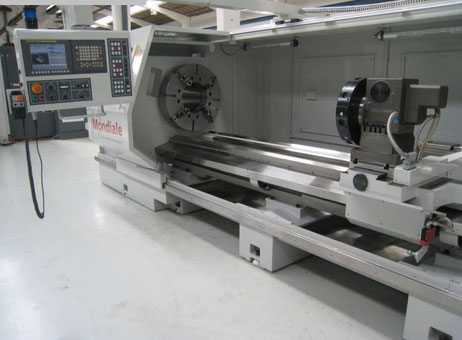
From Factory Floor to Your Workshop: Evaluating a Pre-Owned , Used , Secondhand, Surplus CNC Machines Before Purchase Mondiale BNC 3500/355 – CNC Flat Bed Lathe 4 Meters
Here’s a detailed guide for evaluating a pre-owned / used / surplus Mondiale BNC 3500/355 CNC Flat-Bed Lathe (4 m center distance) — from the factory floor to your workshop. This is a structured checklist + strategy you can use to assess condition, risk, and value.
I. Understand Baseline / Nominal Specs & Design Intent
Before you visit, collect whatever documentation or published specs you can. For Mondiale BNC 3500/355, some public specs are already available:
- Max swing over bed: ~ 890 mm
- Centre distance (between centers / bed length travel): 4,000 mm
- Spindle bore: 355 mm
- Max swing over cross slide: ~ 550 mm
- RPM range: 10 – 500 rpm (as listed in one spec sheet)
- Motor power: 22 / 33 kW (depending on configuration)
- 4-jaw chuck Ø (standard in that listing): Ø 800 mm
- Other included items: turret (Baruffaldi TB 200, 8 pos), steady rests Ø 500 / Ø 300, backstand, chip conveyor, coolant system.
These published specs are useful reference points. The actual machine you evaluate may have upgrades, wear, or deviations; but having target numbers helps you spot serious drifts.
II. Inspection & Evaluation Checklist
Use the following checklist when inspecting the candidate machine (on-site or via detailed video/photos). Mark observations and compare against your tolerance for “acceptable deviation” based on your production needs.
| Focus Area | What to Inspect / Test | Why It Matters / Red-Flag Indicators |
|---|---|---|
| Structural / Visual Condition | Examine the bed, headstock, tailstock, saddle, cross-slide, and supports. Look for cracks, weld repairs, misalignment, bending, sagging. | Structural deformation can’t be easily corrected; even slight bend or twist in a bed can ruin precision. |
| Check the condition of way covers, guards, sheet metal, protective elements. | Missing covers allow chips and coolant to damage guideways and components. | |
| Check for oil, coolant, or lubricant leaks (headstock, slides, hydraulics). | Leaks signal wear, seal failure, or neglect. | |
| Inspect wiring, conduits, electrical panels for damage, burnt marks, amateur repairs. | Poor wiring affects reliability and safety. | |
| Control / CNC / Electronics | Power up the control; watch for boot failure, alarm logs, error history. | A corrupt or failing CNC can render the machine unusable. |
| Test jogging in manual mode (axes: likely X, Z). | If axes move erratically, or stall, or bind, it shows mechanical or servo problems. | |
| Inspect control interface, display, buttons, pendant. | Damaged or unresponsive interface is a cost to repair. | |
| Check software version, parameter backups, non-volatile memory, control upgrades. | Obsolete or unsupported control software is a liability. | |
| Spindle / Headstock | Run the spindle at low, medium, and (if safe) higher speeds. Listen for abnormal bearings noise or vibration. | Spindle bearings are expensive to fix; early indicators are noise or vibration. |
| Mount a test bar or collet and measure radial run-out. | Excessive run-out is a serious sign of spindle wear. | |
| Check spindle taper / bore for wear, nicks, scoring. | Damage in the taper area affects tool holding and accuracy. | |
| Ask for any maintenance or rebuild history for the spindle. | A recently rebuilt spindle is a strong plus. | |
| Axes, Guideways, Slides, Leads / Ballscrews | Move axes (saddle, cross-slide, tailstock) across full travel. Check for binding, roughness, dead zones. | Smooth travel across full stroke is essential for usable range. |
| Measure backlash in X and Z axes (and possibly others). | Excessive backlash degrades repeatability and accuracy. | |
| Inspect guideway surfaces for wear, scoring, rust, pitting. | Severe wear may require regrinding or reconditioning. | |
| Check lubrication / oiling system (automatic lube lines, reservoirs, filters). | Poor lubrication accelerates wear significantly. | |
| Verify way covers, scrapers, bellows, chip shielding. | Missing or ineffective covers expose slides to damage. | |
| Tailstock, Steadies, and Workholding | Check alignment of tailstock to headstock centerline. | Misalignment causes taper or run-out in long parts. |
| Inspect the tailstock quill, its movement, wear, and locking system. | A weak or sloppy tailstock is a limitation for long turning. | |
| Check the condition of steady rests, backstand, and their alignment. | These components are often heavily used; poor ones degrade work accuracy. | |
| Turret / Tooling / Accessories | If there is a turret or tool change system (or a tool bar), test indexing smoothness, accuracy, jitter. | Tool change or position errors show mechanical wear or play. |
| Inspect tool holders, slides, alignment of turret / tool bar relative to spindle axis. | Any misalignment causes errors in turning operations. | |
| Coolant / Chip Removal / Support Systems | Test coolant pump, flow, nozzles, cleanliness of coolant, condition of filters. | A clogged or failing coolant system damages tools and parts. |
| Inspect chip conveyor or removal mechanism. | Poor chip handling leads to chip re-circulation or jamming. | |
| Check hydraulic / pneumatic circuits (if used for clamps, tool systems). | Leaks or weak actuation hurt reliability. | |
| Inspect electrical cabinets, clean of chips/dust, proper ventilation. | Overheating or dirt in cabinets causes failures. | |
| Metrology / Test Part / Geometric Checks | Perform a test turning or finishing pass on a sample part. Measure roundness, diameter tolerance, surface finish. | The real measure: can this machine meet your tolerances? |
| Conduct repeatability tests: command same positions repeatedly and measure deviation. | Good CNC machines keep tight repeatability. | |
| Measure linear accuracy with gauge blocks or precision instruments. | Detect drift or wear in axes. | |
| If machine runs for a while, check for thermal drift (dimensions change after warm-up). | Thermal stability is critical for precision across long runs. | |
| Documentation / Maintenance History | Request past maintenance logs, parts replaced, alignment records, rebuild records. | A well-documented machine is lower risk. |
| Ask for operation / maintenance manuals, electrical schematics, control wiring diagrams, parts lists. | These are needed for servicing, repairs, and spare parts. | |
| Inquire about any modifications / retrofits, and whether they are documented. | Unofficial modifications may complicate future maintenance. | |
| Installation / Logistics / Environment | Check how the machine was mounted: leveling, anchoring, base condition. | Poor foundation means misalignment or vibration issues. |
| Review environmental conditions: cleanliness, temperature control, humidity, dust levels. | Poor environments accelerate wear. | |
| Determine footprint, weight, crane / rigging needs, power requirements. | These affect your installation cost and viability. |
III. Red Flags / Warning Signs
When evaluating, watch out especially for:
- Spindle with audible noise, vibration, or overheating
- Run-out beyond acceptable microns on test bar
- Excessive backlash or play in X / Z or cross-slide axes
- Binding or jerkiness in slide travel
- Severely worn guideway surfaces (scoring, deep scratches, pitting)
- Missing or damaged protective covers, way scrapers
- Control failures, boot issues, parameter corruption
- Poor wiring, burnt boards, compromised electrical cabinets
- Leaks in hydraulics, coolant, lubrication systems
- Corroded internal coolant sumps or pump systems
- Tooling / turret misalignment or jitter
- No test part allowed, or poor output when tested
- Missing manuals, maintenance records, parts lists
- Any undocumented or sloppy modifications
- Difficulty obtaining replacement parts for this model
Any of these could substantially lower machine utility or require expensive refurbishment.
IV. Estimating Remaining Life & Valuation Strategy
Once your inspection is done, you’ll need to decide whether the machine is worth acquiring and for what price. Here’s how to approach that:
- Compare measured vs nominal specs
– How far has performance drifted (run-out, backlash, linear error) from design spec?
– If deviations are within your acceptable tolerance (or can be compensated / repaired), that’s good. - Identify required repairs / refurbishments
– Spindle rebuild, guideway re-grind, re-lapping slides, replace bearings, recondition lubrication systems, control upgrade, etc.
– Get quotes (or ballpark estimates) for these restorations. - Factor in spare parts availability / obsolescence risk
– For Mondiale BNC models, how easy is it to source parts (bearings, spindles, control boards)?
– If parts are rare or obsolete, that’s extra risk. - Compare with market listings / comps
– Search for used Mondiale BNC 3500/355 machines in similar condition, age, and features, and see asking or realized prices.
– Adjust those comps for your local region, included accessories, and condition. - Calculate all-in cost
– Include transport / rigging, installation, leveling, calibration, commissioning, tooling, setup time, possible downtime.
– Add estimated cost of refurbishments. - Set negotiation margin / reserve for surprises
– Always discount: leave room for hidden issues discovered later.
– Consider contract clauses: e.g. if test results post-install exceed certain error thresholds, reduce price or require seller fix. - Decide if machine meets your production & tolerance needs
– If after refurbishing it can reliably hit your part tolerances and throughput, then acquisition is justified.
– Otherwise, it may be better to search for a machine in better used condition or new.
V. Example Application (Hypothetical Case)
Suppose you inspect a Mondiale BNC 3500/355 candidate and find:
- Spindle run-out of 0.025 mm on test bar
- X-axis backlash ~0.020 mm
- Guideways show visible light wear but no deep gouges
- Control is operational, but uses an older CNC with limited spare support
- Coolant system is clogged and partially corroded
- Steadies / backstands are present but some wear in fingers
Based on this:
- Run a test part and see how much error is present.
- Budget for spindle bearing replacement, control board upgrades (if needed), cleaning / refurbishment of coolant, re-lapping of guide surfaces, replacing worn steadies.
- Compare this total cost to a cleaner used BNC 3500/355 or even a newer lathe model.
- Negotiate price down significantly to account for the refurb cost + risk.
- Make sure prior to acceptance you can re-test accuracy after installation (with a clause).